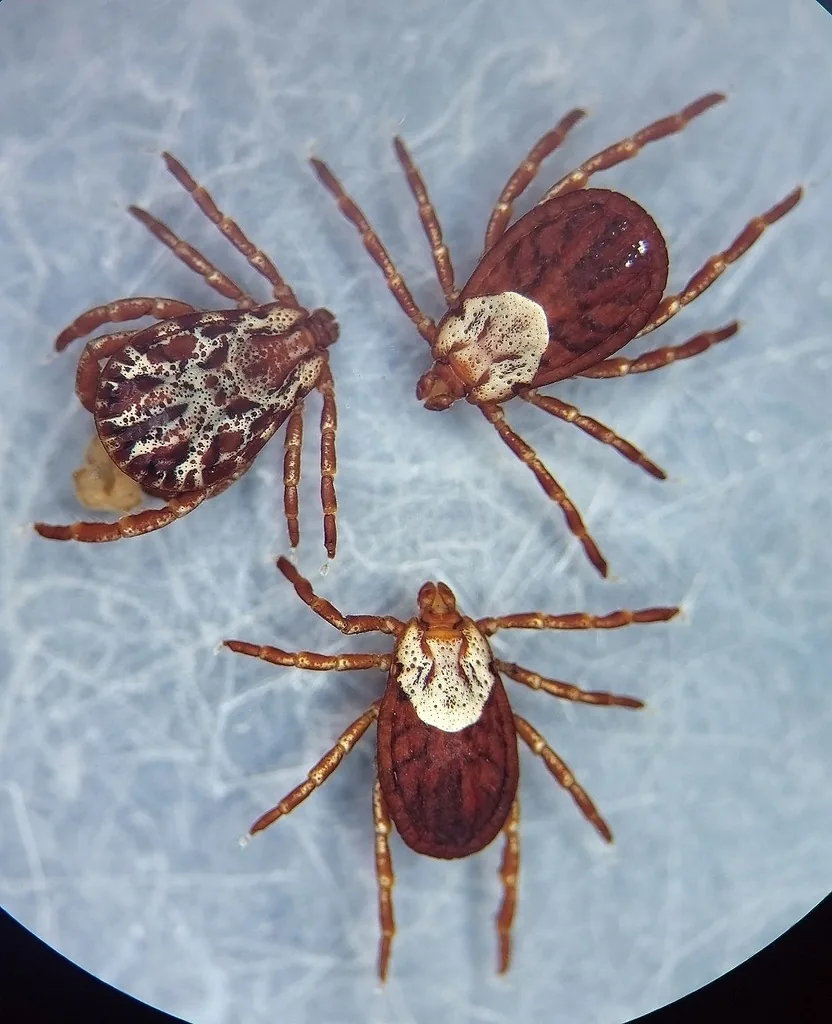
How to identify it
- It is a hard tick, with a hard plate behind the head and mouthparts that point forward and are visible from above.[1]
- The plate covers only the front part of the back on females but the entire back on males, so males and females look different.[4]
- It looks very similar to the American dog tick, so where the two overlap, location helps; the Rocky Mountain wood tick is the western one.[5][1]
- A fully fed female swells to the shape of a pea, gaining 100 to 120 times her unfed weight.[1][4]
Look-alikes
| Look-alike | How to tell them apart |
|---|---|
| American dog tick | Very similar in appearance; in Colorado and Montana the American dog tick is mostly found on the eastern plains, while the wood tick dominates in the mountains and foothills.[1][5] |
Where it lives
Rocky Mountain states and southwestern Canada at elevations of about 4,000 to 10,500 feet, especially in foothills, stream corridors, grassy meadows and sagebrush slopes.[2][4][5]
Biology and life cycle
It is a three-host tick: larvae and nymphs feed on small mammals such as rodents, and adults feed on larger animals like deer, livestock and people.[1]
Ticks wait on grasses, low plants and sagebrush and grab passing hosts; they can't jump or fly.[4][1]
In Utah, ticks are met most often from snowmelt through mid-July, and some become active again in fall.[4]
Development usually takes two to three years, and nymphs and adults can survive a year without feeding.[1]
It typically takes 12 to 24 hours to start feeding, which gives you time to find and remove it.[1]
Damage and signs
Health risk
The CDC lists Rocky Mountain spotted fever, Colorado tick fever and tularemia for this tick. Colorado tick fever causes fever, chills, headache, body aches and tiredness, and there is no vaccine or specific medicine for it.[2][3]
Control
Prevention
During tick season, avoid brushy field edges and grassy paths when you can, and walk in the center of trails.[1]
Wear light-colored long pants and long sleeves with socks pulled over pant legs, and use a repellent containing DEET, picaridin, IR3535 or oil of lemon eucalyptus.[1]
Permethrin can be applied to clothing, not skin, and can keep killing or repelling ticks through several washings.[1]
Do a thorough tick check right after leaving tick habitat or walking through brush and tall grass.[4][5]
Traps and physical control
Grasp the tick with fine-tipped tweezers close to the skin and pull slowly and steadily straight out, then disinfect the bite and wash your hands. Skip matches and petroleum jelly.[1][5]
Common questions
- Does the Rocky Mountain wood tick spread Lyme disease?
- No. It does not transmit Lyme disease, and no Lyme case has been traced to a tick bite in Colorado.[5][1][4]
- What should I do if I get sick after a tick bite?
- If you develop a rash or fever within several weeks of removing a tick, see a doctor and mention the bite, when it happened and where you picked up the tick.[1]
- When are wood ticks worst?
- Mostly in spring and early summer. They become dormant as late spring and summer heat sets in.[1][4]
Sources
- Colorado State University Extension, “Colorado Ticks and Tick-Borne Diseases.” extension.colostate.edu/resource/colorado-ticks-and-tick-borne-diseases/ (accessed 2026-10-06)
- Centers for Disease Control and Prevention, “Where Ticks Live.” www.cdc.gov/ticks/about/where-ticks-live.html (accessed 2026-10-06)
- Centers for Disease Control and Prevention, “About Colorado Tick Fever Virus (reviewed June 22, 2026).” www.cdc.gov/colorado-tick-fever/about/index.html (accessed 2026-10-06)
- Utah State University Extension and Utah Plant Pest Diagnostic Laboratory, “Ticks and Tickborne Diseases of Utah (ENT-189-17, December 2017).” epi.utah.gov/wp-content/uploads/Ticks-and-Tickborne-Diseases-of-Utah.pdf (accessed 2026-10-06)
- Montana State University Extension Urban IPM, “It's Tick Season.” urbanipm.montana.edu/entomology/resources/fact-sheets/its_tick_season.html (accessed 2026-10-06)
- iNaturalist, “Dermacentor andersoni taxon page (order and family).” www.inaturalist.org/taxa/297285 (accessed 2026-10-06)