How to identify it
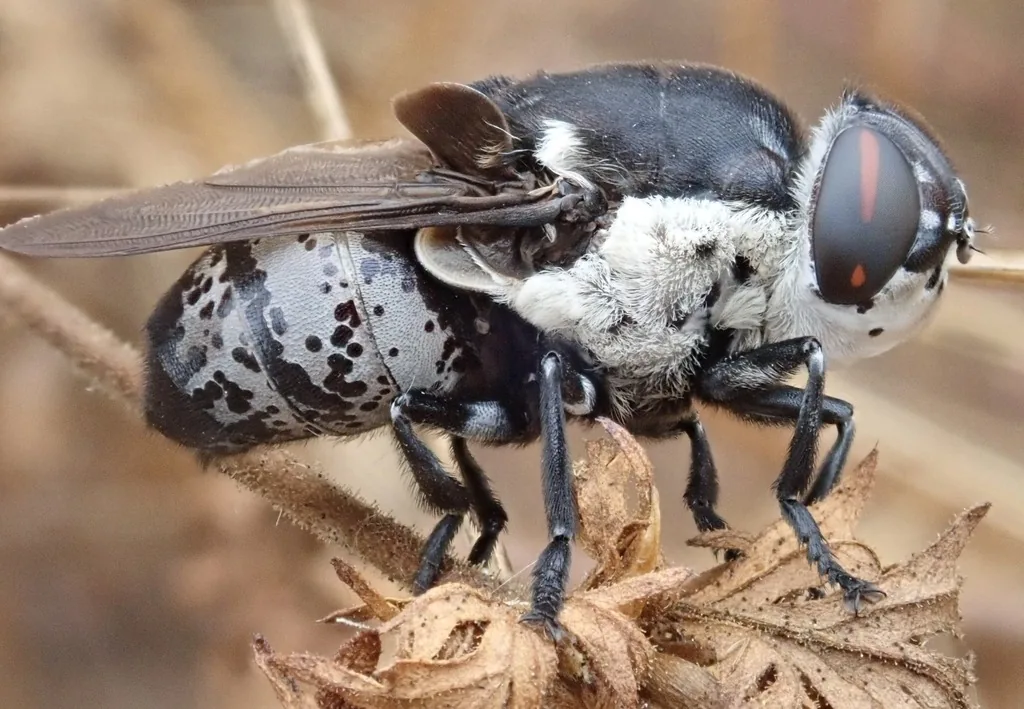
- Adult flies are large and bee-like, and they do not feed or bite.[3]
- A warble is a lump under the skin with a small breathing hole at the top; on a squirrel it looks like a hairless growth with a dark opening.[1][2]
- Grown larvae are dark brown, about 0.8 to 1.7 inches long and 0.3 to 0.4 inches wide.[1]
- In pets, look for a soft, well-defined swelling under the skin with a visible breathing pore.[3]
Look-alikes
| Look-alike | How to tell them apart |
|---|---|
| Squirrel fibromas (squirrel pox) | Fibroma growths look much like warbles but lack the large black opening in the center of each lump.[2] |
| Bumble bees | Adult Cuterebra flies look bee-like but cannot feed or bite, and you are far more likely to see the larval warble than the adult fly.[3][1] |
Where it lives
Several Cuterebra species occur throughout North America.[1]
Biology and life cycle
Females lay eggs where hosts will pass, such as at den or burrow entrances, along runways, or on nearby stones and plants.[1][3]
Body heat from a passing animal makes the eggs hatch, and the larvae enter through the mouth, nose, eyes or an open wound.[1][3]
Larvae settle under the skin and develop for several weeks, up to about seven, breathing through a hole in the skin.[2][3]
The full-grown larva leaves through the same hole, drops to the ground and pupates in the soil through winter before emerging as an adult fly.[2]
Warbles are noticed most often in late summer and early fall.[2][3]
Damage and signs
- Cuterebra mainly infest rodents and rabbits, but they have also been found in deer, foxes, mink, cattle, pigs, cats, dogs and people.[1]
- Warbles are rarely fatal to wild hosts, though heavy infestations or secondary infections can harm an animal, and large larvae can make small mammals walk awkwardly.[2][1]
- Bots and warbles do not appear to have a significant effect on wildlife populations in North America.[1]
Health risk
Cuterebra have no public health significance, and warbles in game meat don't spread disease to people; human cases are rare.[1][2]
Control
Prevention
Free-roaming outdoor pets are at higher risk than indoor pets, because they pick up eggs around rodent and rabbit burrows.[3]
Treating free-ranging wildlife is unnecessary and impractical; captive animals can be treated by removing the larvae and cleaning the wounds.[1]
When to call a professional
If a pet has a swelling with a breathing hole, take it to a veterinarian, who enlarges the pore and removes the larva in one piece, then flushes the wound.[3]
Do not squeeze the lump: rupturing the larva can cause a chronic foreign-body reaction.[3]
Warbles in pets
Dogs, cats and ferrets are abnormal hosts, and in them larvae sometimes wander to the head, nasal passages, throat, eyelids or brain.[3]
Wandering larvae in the brain can cause seizures, blindness or abnormal behavior, sometimes weeks or months after a bout of violent sneezing.[3]
Pets cannot catch warbles from other animals that have them.[2]
Warbles in game animals
Rabbits, squirrels and other game mammals with warbles are safe to eat if properly cooked; the warbles can be cut away with a knife.[1]
Common questions
- What is the lump with a hole in it on my squirrel or rabbit?
- It is likely a warble, a bot fly larva growing under the skin; the hole lets it breathe, and the skin heals after the larva leaves.[2][1]
- Should I pull a bot fly larva out of my pet myself?
- No. A veterinarian should remove it whole; squeezing can rupture the larva and cause a lasting reaction.[3]
- Can people get warbles?
- It is rare. Cuterebra larvae have been found in people, but they have no public health significance.[1][2]
Sources
- Pennsylvania Game Commission, “Bots and Warbles.” www.pa.gov/agencies/pgc/wildlife/wildlife-health/wildlife-diseases/bots-and-warbles (accessed 2026-10-06)
- North Carolina Wildlife Resources Commission, “Squirrel Diseases.” www.ncwildlife.gov/connect/have-wildlife-problem/common-wildlife-diseases/squirrel-diseases (accessed 2026-10-06)
- Merck Veterinary Manual, “Cuterebra Infestation in Small Animals (professional version, reviewed February 2025).” www.merckvetmanual.com/integumentary-system/cuterebra-infestation-in-dogs-and-cats/cuterebra-infestation-in-dogs-and-cats (accessed 2026-10-06). Written by Karen A. Moriello, DVM, DACVD, University of Wisconsin-Madison School of Veterinary Medicine; peer reviewed.
- iNaturalist, “Cuterebra taxon page (order and family).” www.inaturalist.org/taxa/154883 (accessed 2026-10-06)