❓ Common Questions About 🐀 Roof Rat — Attic & Wall Elimination Guide
How do I confirm I actually have this pest (not something similar)?
The most reliable confirmation is a physical specimen — capture one and compare to reference images on this page. For cryptic pests (bed bugs, termites), look for secondary signs: frass, shed skins, mud tubes, or bites with a specific pattern. When uncertain, a professional inspection is faster than months of misidentification.
Can I treat this myself or do I need a professional?
DIY is effective for small, accessible infestations caught early. Professionals are worth the cost when: the infestation is inside wall voids or structural elements, multiple rooms are affected, you have health-risk pests (hantavirus, venomous species), or DIY has already failed twice.
How long until the infestation is completely gone?
Expect 3–8 weeks for most infestations with proper treatment. Insects with dormant life stages (pupae, eggs) extend the timeline because those stages are impervious to most insecticides. Follow-up treatments at 2 and 4 weeks catch each new cohort as they emerge.
What's the most common mistake people make treating this pest?
Treating only the visible pest population while ignoring the harborage site, entry point, or breeding location. Killing adults provides temporary relief but the population rebuilds from hidden egg cases, pupae, or new arrivals through unaddressed entry points.
Exclusion is the only durable rodent control
Trapping reduces a rodent population temporarily; baiting reduces it more durably; exclusion prevents reinvasion. Without exclusion, every successful control program is on a countdown to reinvasion from the surrounding rodent reservoir. Effective exclusion addresses gaps mice (1/4 inch and larger) and rats (1/2 inch and larger) can squeeze through. Common entry points missed by quick inspections: gaps where utility lines penetrate exterior walls, behind dryer vent flaps, dryer vent screens with corrosion damage, garage door bottom seals (especially at corners), gaps under sill plates, weep holes in brick veneer, and gaps where roof returns meet walls. Steel wool packed into voids and sealed with caulk handles most gaps; hardware cloth (1/4 inch) over larger openings holds long-term. A thorough exclusion pass takes a weekend and provides multi-year benefits.
Why integrated pest management produces better outcomes
Integrated Pest Management (IPM) is the framework most pest management professionals follow and the framework the EPA recommends for residential and commercial settings. IPM is not anti-pesticide; it's a sequencing approach that uses cultural controls (sanitation, exclusion, moisture management) first, mechanical controls (traps, vacuuming, physical removal) second, biological controls (beneficial insects, microbial agents) where applicable, and chemical controls last and targeted. The benefit isn't ideological — it's empirical. IPM-treated sites have lower long-term pest pressure than chemical-only treated sites, because chemicals address the visible population without addressing why the population developed. Homeowners who adopt IPM principles see longer intervals between treatments, lower total pesticide use, and better outcomes during the times when chemicals are appropriate. The shift from 'spray when I see them' to 'fix the conditions, monitor, treat targeted' is the single highest-leverage change most DIY practitioners can make.
Rodent signs to look for during home inspection
Active rodent presence usually leaves signs that are easy to spot if you know where to look. Droppings — mouse droppings are rice-grain sized, dark and pointed; rat droppings are larger, capsule-shaped. Gnaw marks on edges of doors, window sills, plastic food containers, and wires (chewed insulation is a fire risk). Greasy rub marks along baseboards and floor-wall junctions where rodents repeatedly travel. Nests in attics, basements, garages, and inside seldom-used appliances and stored cardboard. Sound — scratching or scurrying in walls, ceilings, or attics, especially at dusk and dawn. Pet behavior — dogs and cats focused on a wall or appliance often detect rodents people miss. Once signs are confirmed, both treatment and exclusion work need to start, not just one or the other.
Outdoor rodent management around the structure
Reducing rodent pressure outside the structure reduces entry attempts and supports interior control. Specific changes: store firewood at least 20 feet from the structure and elevated off the ground, avoid heavy ground cover (English ivy, dense shrubs) against the foundation, store birdseed and pet food in metal containers (rodents chew through plastic), keep garbage in lidded containers and avoid leaving any out overnight uncontained, eliminate fruit drop from trees if possible, and seal openings into outbuildings, sheds, and garages. Bait stations along the foundation perimeter, at fence lines, and near outbuildings provide an interception layer for rodents traveling through the property. This perimeter approach reduces interior pressure significantly and is the standard for ongoing rodent management in higher-pressure rural and semi-rural settings.
How professional pest control programs differ from one-off treatments
A single treatment — DIY or professional — addresses what's visible today, but most pest pressure is cyclical. Professional pest control programs that work long-term are structured around inspection, monitoring, treatment, and follow-up as a recurring cycle rather than discrete events. The inspection phase identifies conducive conditions (moisture, harborage, food access, exclusion gaps) that one-time treatments don't address. The monitoring phase uses sticky traps, bait stations, or visual sweeps to catch population rebounds early, before they become visible infestations again. The treatment phase targets the specific life stages active during that visit — different than blanket spraying everything. The follow-up phase verifies treatment efficacy and adjusts. Homeowners can replicate this structure on a quarterly or seasonal schedule without buying expensive equipment, and the underlying logic — track, treat targeted, verify — produces consistently better results than reactive treatment after problems become obvious.
Roof rats vs. Norway rats: identification and treatment differences
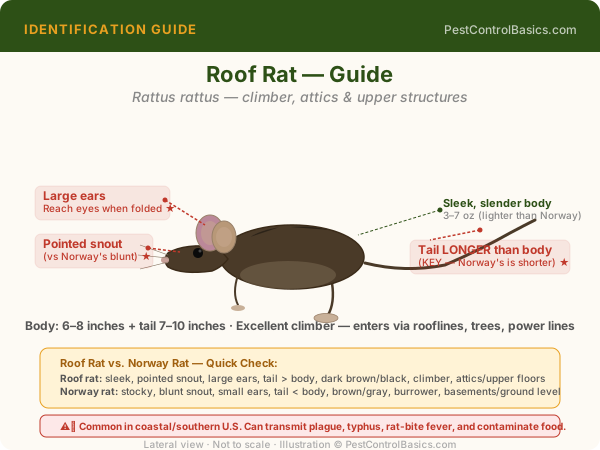
The two rat species common in U.S. residential settings — Norway rats and roof rats — present meaningful differences in behavior and treatment that affect control strategy. Norway rats are larger, more aggressive, ground- and burrow-dwelling, and prefer protein-rich diets; they're more common in the northeastern and midwestern U.S. and in urban environments. Roof rats (also called black rats or ship rats) are smaller, more cautious, climbing-oriented, and prefer fruits and vegetable matter; they're more common in the southeastern, southwestern, and west coast states and in residential areas with mature trees and vegetation. The behavioral differences drive trapping strategy: Norway rats are caught at ground level along walls and in basement-style locations with peanut butter or meat-based baits, while roof rats are trapped in attics, on rafters and ceiling joists, and along utility lines using fruit, nut butter, or seed-based baits. Misidentification leads to treatment failures because traps placed for ground-dwelling rats won't intercept arboreal roof rats, and vice versa. Identification typically requires seeing droppings (Norway rat droppings are blunt-ended and larger; roof rat droppings are tapered and smaller) or actually seeing animals.
How treatment thresholds change what 'success' should mean
Most homeowners frame pest control as elimination — zero individuals seen — but professional programs operate on threshold concepts that better match what's actually achievable and economically reasonable. A treatment threshold is the population level at which intervention is justified; below it, the cost and disruption of treatment outweigh the damage prevented. For aesthetic pests like the occasional ant or spider, the threshold is essentially zero only because tolerance is low, not because zero is biologically realistic. For pests with health implications (cockroaches, rodents) or property damage potential (termites, carpenter ants), thresholds are set well below visible damage to allow time for response. The implication for self-evaluation: a program that drops a cockroach population by 95% without reaching zero may be functioning correctly, and pushing for the last 5% may require disproportionate effort or treatment intensity that creates other problems. Reframing 'success' as durable reduction below threshold rather than absolute zero produces saner program design, more reasonable expectations of paid services, and less wasted DIY effort chasing the long tail of a population that's already controlled in any practical sense.
Rodent bait stations: when they're appropriate and when they aren't
Rodenticide bait stations have a specific role in rodent management but get misused frequently in residential settings. The appropriate use case is exterior, particularly for ongoing rat pressure from outdoor sources — well-secured tamper-resistant stations placed along the foundation perimeter at intervals of 25-50 feet, with regular monitoring of consumption. Interior bait station use is generally inadvisable: rodents that consume bait often die in walls or other inaccessible spots, producing odors that last weeks and attract secondary pests including flies and dermestid beetles. Non-target risk is the other major issue with interior use: pets, children, and protected wildlife can be exposed through the dying rodent or directly. For interior rodent control, trapping is almost always the better choice because dead rodents are removed promptly. Exterior baiting works well for properties with chronic outdoor pressure (commercial buildings, rural homes, properties adjacent to fields or wooded areas) but should always use tamper-resistant stations, not loose bait, to protect non-targets.
Food source elimination as the primary control lever
Rodent infestation is, more than anything else, a function of available food, and trying to control rodent populations without addressing food sources is consistently less effective than addressing food sources and then dealing with what remains. The food sources homeowners commonly miss include bird seed in feeders and on the ground beneath them, pet food left in bowls overnight, compost without rodent-proof containment, fruit that drops from trees, and stored grain or feed in garages and outbuildings. Indoor food sources include pantry foods in non-rodent-proof packaging, grease accumulated behind stoves, food debris in cabinets and on counters overnight, and trash that's not in a sealed container. The behavioral shift required for rodent control is more demanding than for most pest categories — it requires consistent practice rather than periodic action — but it's the only approach that addresses the root condition rather than just the symptom. A property with consistent food source management supports a much smaller rodent population, and the trapping and exclusion that handle the remainder become tractable rather than overwhelming.
When neighborhood-level coordination matters for treatment
Some pests are house-scale problems and some are neighborhood-scale problems, and treating a neighborhood-scale problem as if it were house-scale leads to a familiar frustration: treatment works, then activity returns within weeks because the source was never inside your property. German cockroach problems in multi-unit buildings are the canonical example — treating one unit while the rest of the building is untreated produces temporary relief at best. Rodent infestations frequently span multiple adjacent properties, especially row houses, condo complexes, and dense suburban developments with shared boundary fencing or shared utility easements. Mosquito problems are obviously neighborhood-scale because adult mosquitoes don't respect property lines. The practical implication is that for these pests, isolated treatment is not just incomplete but in some cases economically wasteful. Coordinating with neighbors, talking to HOA or property management about whole-building or whole-block treatment, and identifying the actual sources rather than the symptom locations is what produces durable results. This is uncomfortable work in some neighborhoods, but no amount of treatment intensity in a single unit substitutes for it.
Utility penetrations as the single most important exclusion target
Across residential rodent control, the single most consistent finding during exclusion work is that the gaps around utility penetrations — where pipes, conduits, cables, and vents enter the structure — are the primary entry routes that rodents are using. These gaps exist on essentially every residential structure, they're often hidden behind siding or in mechanical closets where homeowners don't routinely look, and the construction techniques used in original installation rarely include rodent-proof sealing. A new utility installation by a plumber, electrician, or HVAC technician almost always leaves a gap, because their work is focused on the utility function rather than on the building envelope. The implication for rodent exclusion is that any thorough inspection has to include a systematic check of every penetration, including the ones in basements, crawlspaces, attic plates, and inside cabinets where supply lines enter walls. Sealing these gaps with appropriate materials — copper mesh, steel wool, urethane foam over a metal substrate, or commercial rodent exclusion sealant — typically eliminates the majority of entry routes and produces dramatic improvements in long-term rodent activity.