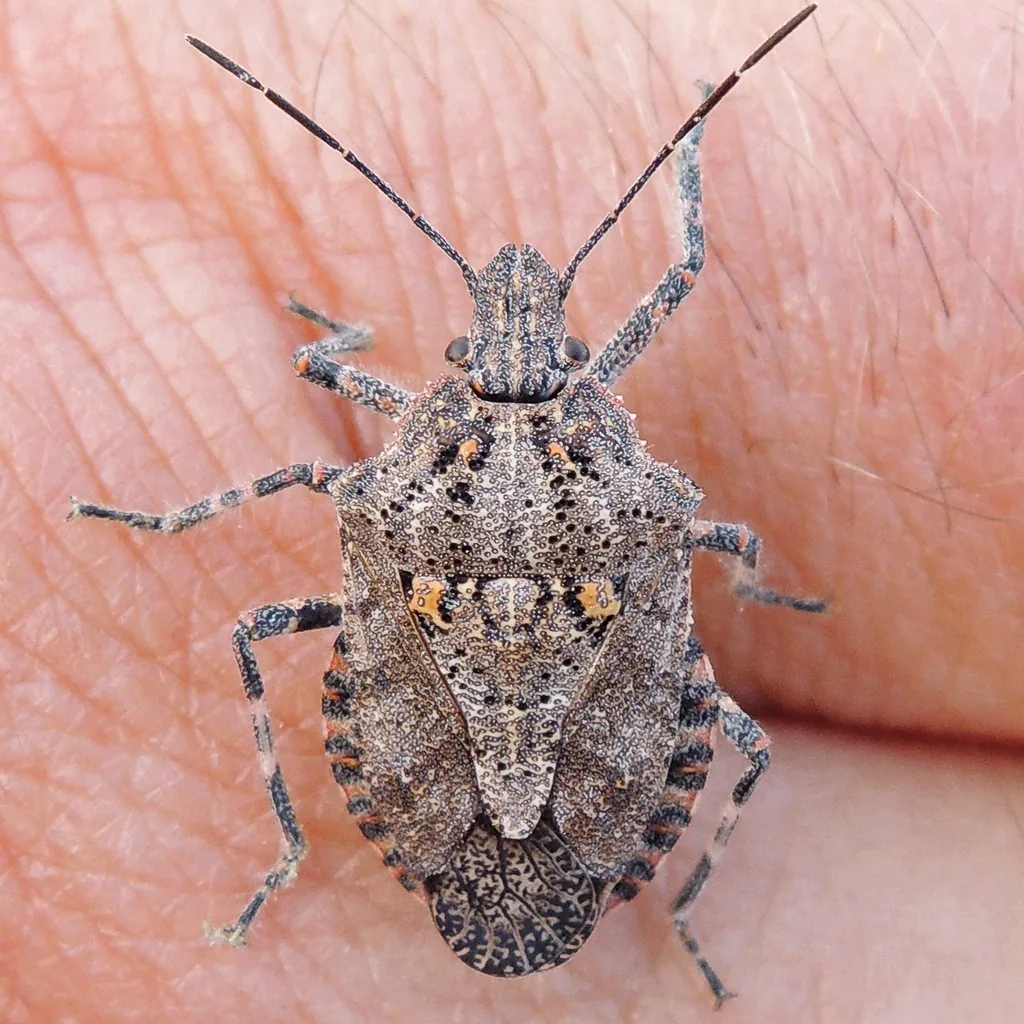
How to identify it
- Adults are broad, flattened, shield-shaped bugs about 7/16 inch to nearly 7/8 inch long.[1][2]
- They're mottled gray or brownish with black and white, which blends in with tree bark.[1][2]
- The front edge of the thorax, the shoulders, is rough or toothed, which gives the group its name.[1]
- Eggs are barrel shaped and pearly white, laid in clusters of about 10 to 20.[1][2]
Look-alikes
| Look-alike | How to tell them apart |
|---|---|
| Brown marmorated stink bug | Rough stink bugs have two white bands on each hind leg, unbanded antennae, a pointed face and toothed shoulders. The BMSB has one hind-leg band, banded antennae, a blunt face and smooth shoulders.[1] |
Where it lives
They're most common in trees and shrubs. California has at least six Brochymena species, and in Colorado Brochymena sulcata is found statewide.[1][2]
Biology and life cycle
Eggs hatch in about one to two weeks, and young nymphs stay together beside their empty egg shells at first.[1][2]
Adults live two to three months; where winters are cold they overwinter as adults under loose bark or in buildings.[1][2]
Colorado populations have one generation a year, with new adults appearing in August.[2]
Damage and signs
Health risk
Neither source mentions bites or other harm to people. They're mostly noticed when they wander indoors in fall or arrive on firewood.[2][1]
Control
Prevention
No treatment is needed outdoors; they cause no significant plant injury and eat some pest larvae.[2][1]
Keep them out
Expect a few indoors in fall, when they look for winter shelter, and check firewood before bringing it in.[2]
Biological control
Controlling ants and avoiding persistent, broad-spectrum sprays protects them along with other natural enemies.[1]
Common questions
- Is this a brown marmorated stink bug?
- Check the shoulders and antennae: toothed shoulders and unbanded antennae mean a rough stink bug.[1]
- Why is a rough stink bug in my house?
- Adults look for winter shelter in fall and sometimes come in on firewood.[2]
- Do rough stink bugs damage trees?
- They feed on tree leaves and seeds but aren't linked to significant injury.[2]
Sources
- University of California Statewide IPM Program, “Rough Stink Bugs (Natural Enemies Gallery).” ipm.ucanr.edu/natural-enemies/rough-stink-bugs/ (accessed 2026-10-06)
- Colorado State University Extension, “Colorado Insect of Interest: Rough Stink Bugs.” webdoc.agsci.colostate.edu/bspm/Hexapoda%20(Insects)/Rough%20Stink%20Bugs.pdf (accessed 2026-10-06)
- iNaturalist, “Brochymena taxon page (order and family).” www.inaturalist.org/taxa/127347 (accessed 2026-10-06)