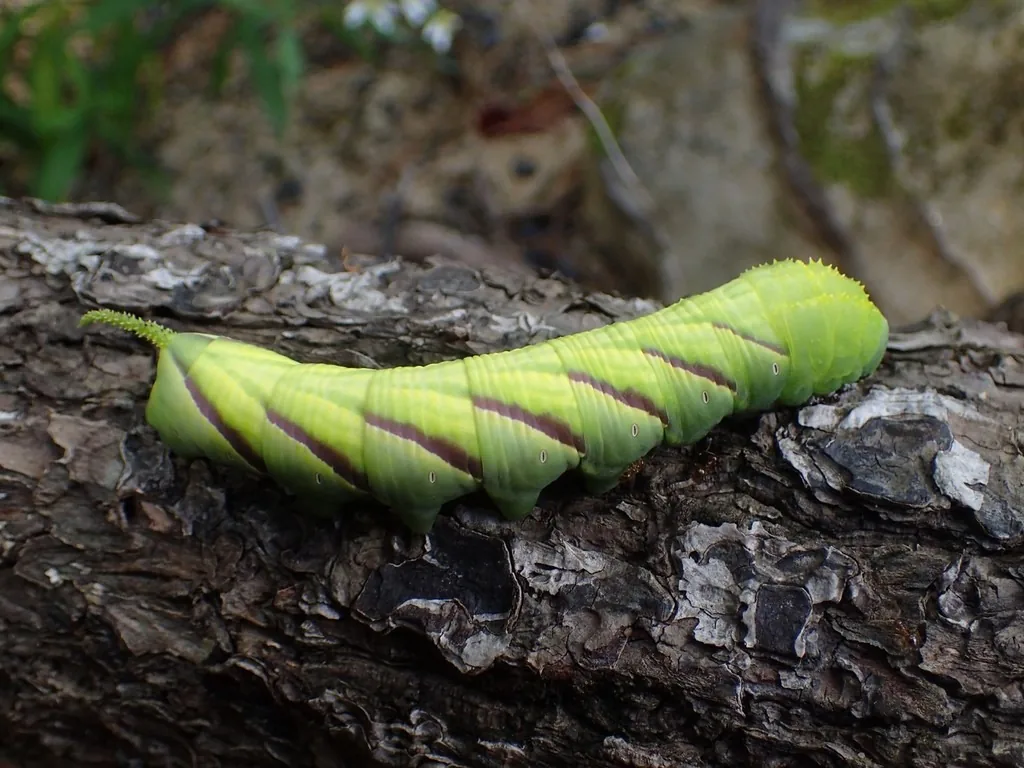
How to identify it
- Moths are large (3 1/2 to almost 6 inches across), heavy-bodied and mottled with black or dark brown and white, with three pairs of yellow spots on the abdomen usually hidden by the wings.[1][2]
- Caterpillars are bright green with yellow diagonal stripes bordered in dark green to purple-black, with a small horn at the rear.[2]
- The horn is rough with granules, which helps tell it from other hornworms with smooth horns.[2]
Look-alikes
| Look-alike | How to tell them apart |
|---|---|
| Tobacco and tomato hornworms | Same genus; rustic sphinx caterpillars closely resemble tobacco hornworms but have a granulated horn.[2][1] |
Where it lives
Native to the southeastern United States, it ranges from southern Florida to Virginia and west to Arizona and southern California, and south to Argentina; strays reach as far north as Maine.[2]
Biology and life cycle
Females lay one to five eggs at a time on leaf undersides, up to 2,000 in all, and caterpillars hatch about four days later.[1]
Moths fly at night and visit many night-blooming flowers, including petunias.[1][2]
Damage and signs
Health risk
Control
Traps and physical control
Hand-pick caterpillars when large numbers are eating a plant.[1]
Biological control
A tiny wasp, Cotesia congregata, develops inside the caterpillars and spins small white cocoons on them; other predators and parasites attack eggs, caterpillars and pupae.[1]
Pesticides
It is sporadic, so preventive sprays are unwise; any insecticide labeled for landscape use should work if needed.[1]
Common questions
- What is the big green hornworm on my beautyberry?
- Likely a rustic sphinx caterpillar.[1][2]
- How is it different from a tomato hornworm?
- Rustic sphinx caterpillars have a rough, granulated horn and feed mainly on ornamentals.[2][1]
- What are the white cocoons on the hornworm?
- Cocoons of a parasitic wasp, Cotesia congregata, which kills the caterpillar.[1]
Sources
- NC State Extension, “Rustic Sphinx.” content.ces.ncsu.edu/rustic-sphinx (accessed 2026-10-15)
- University of Florida IFAS Extension (Featured Creatures), “Rustic Sphinx, Manduca rustica (EENY-652).” ask.ifas.ufl.edu/publication/IN1134 (accessed 2026-10-15)
- iNaturalist, “Manduca rustica taxon page (order and family).” www.inaturalist.org/taxa/126568 (accessed 2026-10-06)