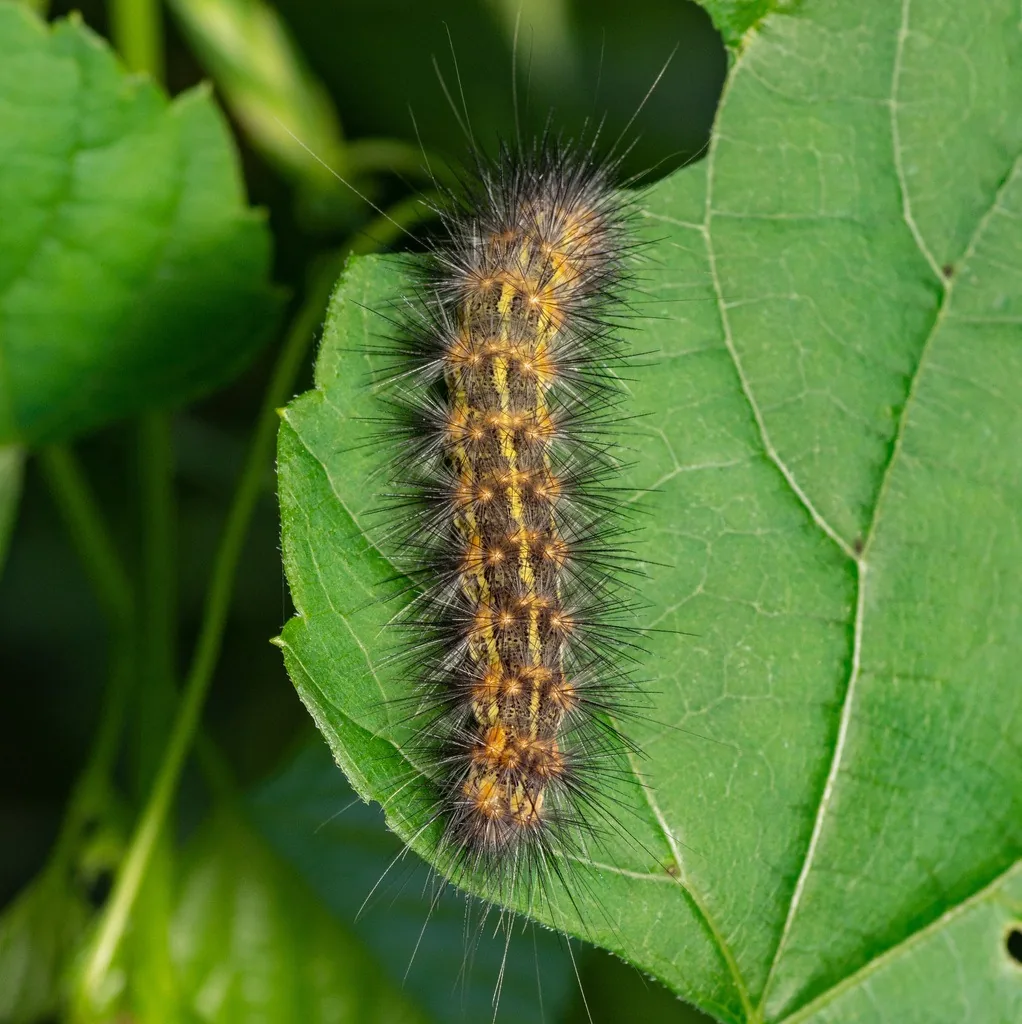
How to identify it
Where it lives
UC IPM calls it an uncommon pest of field and vegetable crops and grapes.[1]
Biology and life cycle
Mature larvae overwinter and become moths in early spring; females lay egg clusters of up to several hundred under leaves.[1]
Egg to adult takes four to six weeks, with three to four generations a year.[1]
The fall generation is the largest and does the most damage.[1]
Damage and signs
- Older larvae chew through leaves, leaving ragged foliage on beans, carrots, cole crops, grapes, lettuce and tomatoes.[1]
Health risk
It feeds on plants; UC IPM mentions no risk to people.[1]
Control
Biological control
Tachinid flies and an Ophion wasp parasitize it, often unnoticed.[1]
Pesticides
Only if intolerable, spray leaf undersides with Bt or spinosad; apply spinosad to blooming plants only in the evening.[1]
Common questions
Sources
- University of California Statewide IPM Program, “Saltmarsh Caterpillar (Pests in Gardens and Landscapes).” ipm.ucanr.edu/PMG/GARDEN/VEGES/PESTS/saltmarshcater.html (accessed 2026-10-06)
- iNaturalist, “Estigmene acrea taxon page (order and family).” www.inaturalist.org/taxa/121612 (accessed 2026-10-06)