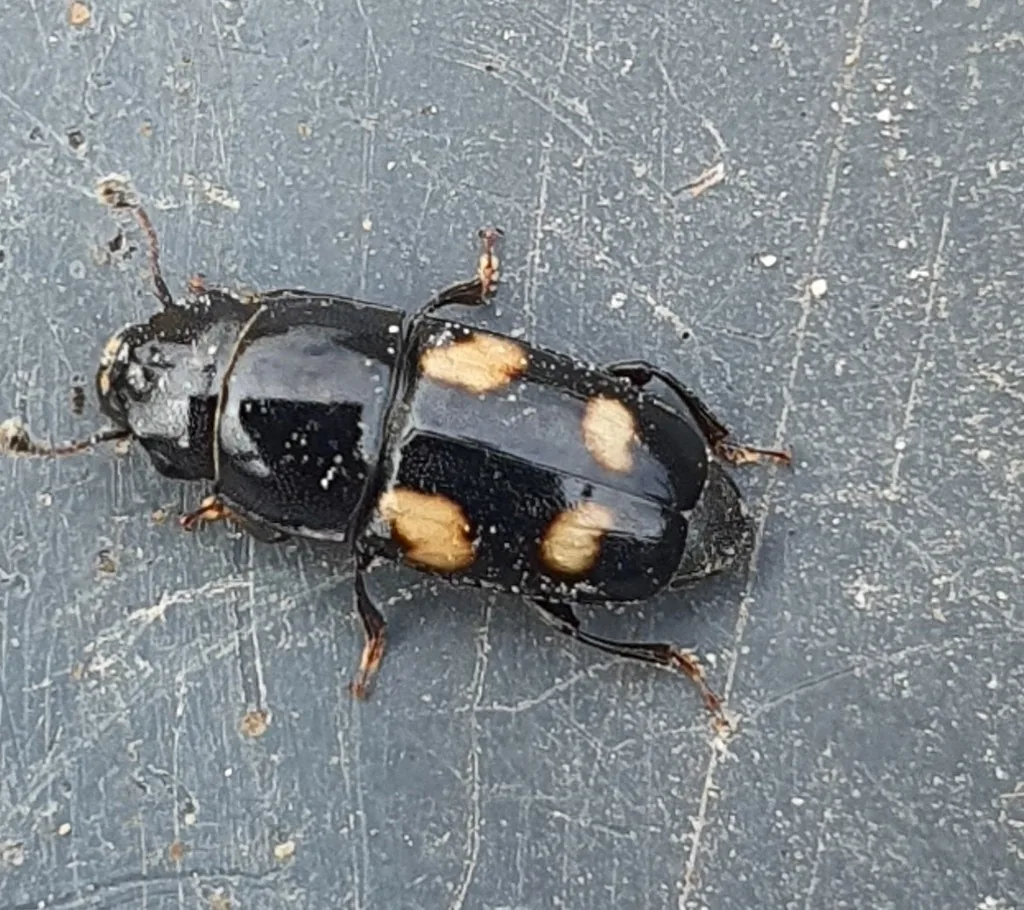
How to identify it
- The picnic beetle is about 1/4 inch long and shiny black, with four orange or yellowish spots on its wing covers.[1][2][3]
- Its wing covers are shorter than the abdomen, leaving the tip exposed.[3]
- All sap beetles have antennae ending in a knob-like club, a handy way to recognize the group.[1]
- Larvae are small, under 1/4 inch, white to cream-colored with a brown head, and are found in decaying produce.[1][3]
Look-alikes
Where it lives
The picnic beetle is one of the most common sap beetles in the Midwest; Minnesota lists it among its three most common species, and Iowa State calls it the best known of about 180 sap beetle species.[1][2]
Biology and life cycle
Adults spend the winter outside the garden and become active in April and May.[1][2]
They lay eggs near fermenting or decaying plant material, and later in the silks and kernels of damaged corn.[1][3]
Larvae feed for about three weeks, then pupate in the soil; development from egg to adult takes about 30 to 35 days.[1][3]
Minnesota reports one generation a year, while Illinois reports two or more.[1][3]
Numbers build through the summer, so they are most noticeable in late summer and fall.[2]
Damage and signs
- They mostly attack fruits and vegetables already damaged by other insects or disease, but they can also bore into sound produce, especially berries and sweet corn.[1][3]
- They hollow out deep cavities in strawberries, much like slug damage, and carry fungal spores that spread rot.[1]
- Corn earworm damage at an ear tip draws sap beetles, and their larvae then feed on the undamaged kernels.[1]
- At picnics they gather around garbage cans, food and drinks, especially beer, earning the nickname beer-bug.[2]
Health risk
Sap beetles are a nuisance around food and drinks and make produce unfit to eat; the extension sources describe no bite or disease risk to people.[2][3]
Control
Sanitation
Sanitation is the best control: pick produce as soon as it ripens and regularly remove damaged, diseased and overripe fruits and vegetables.[1][2][3]
Bury fallen apples, melons, tomatoes and other rotting produce deep in the soil or destroy it so beetles have nothing to feed or breed on.[1]
At a cookout, empty trash promptly and keep food and drinks covered.[2]
Traps and physical control
Traps baited with stale beer, molasses-water-yeast, vinegar or overripe fruit, set several feet outside the garden and emptied every few days, may reduce numbers, though Iowa State notes proof of effectiveness is lacking.[1][2]
Pesticides
Sprays are discouraged because they would go on ripe crops; for severe infestations Minnesota mentions carbaryl or bifenthrin, using a product labeled for the crop and its harvest waiting period.[1][2]
Common questions
- What are the black beetles with four orange spots in my sweet corn?
- They are likely picnic beetles, a common sap beetle. They are drawn to damaged or overripe ears and produce, and their larvae feed on the kernels.[1][2]
- Why do little black beetles keep landing in my drink outside?
- Picnic beetles are attracted to fermenting juices, so they gather around open drinks, especially beer, plus food and trash cans.[2]
- Will spraying stop sap beetles?
- Not well. New beetles keep flying in while ripe produce is present, so removing overripe and damaged fruit works better.[1][2]
Sources
- University of Minnesota Extension, “Sap Beetles (reviewed 2021).” extension.umn.edu/yard-and-garden-insects/sap-beetles (accessed 2026-10-06)
- Iowa State University Extension and Outreach, “Sap Beetles Love a Picnic (Yard and Garden, July 25, 2007).” yardandgarden.extension.iastate.edu/article/2007/7-25/SapBeetle.html (accessed 2026-10-06)
- University of Illinois Extension, “Picnic Beetle.” extension.illinois.edu/insects/picnic-beetle (accessed 2026-10-06)
- iNaturalist, “Glischrochilus quadrisignatus taxon page (order and family).” www.inaturalist.org/taxa/203328 (accessed 2026-10-06)