How to identify it
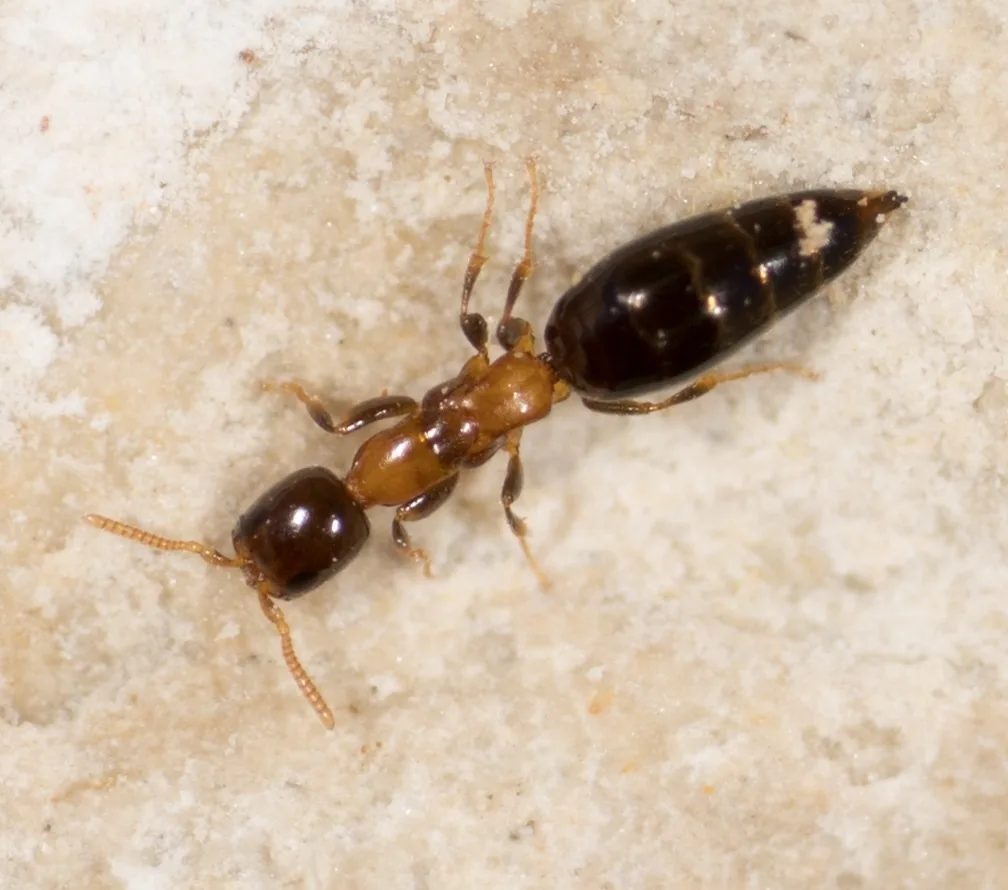
- They're 1.5 to 6 mm (0.05 to 0.25 inch) long, flattened and ant-like, with a large, boxy head and a long, tapered abdomen.[1]
- Most are wingless females, though both sexes can be winged or wingless.[1]
- S. carolinensis is light to dark reddish brown; S. macrogaster has cream patches on the thorax; S. ventura has a light red head and thorax and a dark brown abdomen.[1]
Where it lives
Three species occur in North America: S. carolinensis from Connecticut and Illinois to Georgia and Louisiana, S. macrogaster from Virginia to Texas and southward, and S. ventura in California.[1]
Biology and life cycle
They parasitize wood-boring beetle larvae, including longhorn beetles, metallic wood borers, death-watch beetles and bark beetles.[1]
Females cooperate to subdue large larvae and help raise each other's young, laying 5 to 120 eggs per host.[1]
Females can live up to seven months; an unmated female can raise sons, mate with them and then produce daughters.[1]
Damage and signs
Health risk
Females sting when picked up or trapped in clothing; a pinprick pain becomes a red, itchy welt that usually clears in 5 to 15 days, sometimes with mild fever or nausea.[1]
Control
Traps and physical control
Stings stop only when the infestation is found and removed; infested furniture or cabinetry can simply be taken out of the home.[1]
When to call a professional
When beetles and wasps are in rafters or framing, repeated insecticide treatments or fumigation by a licensed pest control operator may be needed.[1]
Common questions
Sources
- Penn State Extension, “Sclerodermus, a Small Wasp that Occasionally Infests Homes.” extension.psu.edu/sclerodermus-a-small-wasp-that-occasionally-infests-homes (accessed 2026-10-06)
- iNaturalist, “Sclerodermus taxon page (order and family).” www.inaturalist.org/taxa/212140 (accessed 2026-10-06)