How to identify it
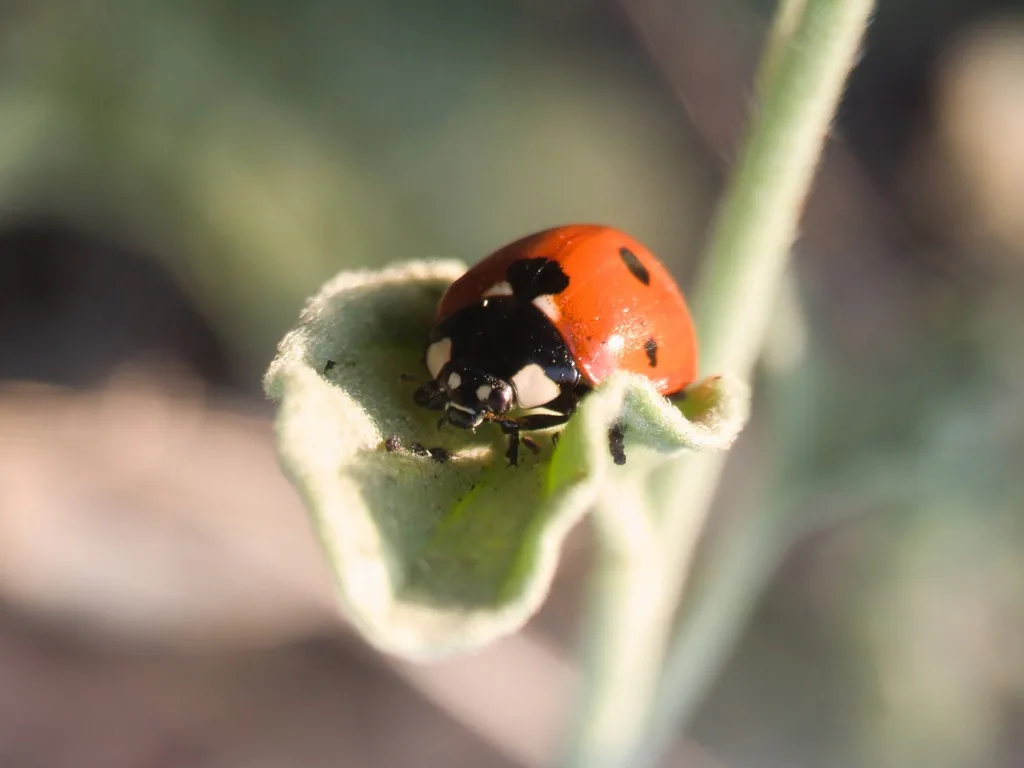
- Adults are large for a lady beetle, about 1/3 inch (7 to 8 mm) long, round and domed.[1][2]
- The orange or red wing covers carry seven black spots, usually in a 1-4-2 pattern.[1][2]
- The head and thorax are black, with a white blotch on each side.[1]
- Larvae look like tiny dark alligators with orange or yellowish spots; eggs are orange, spindle shaped and stand on end in clusters.[1]
Look-alikes
| Look-alike | How to tell them apart |
|---|---|
| Other spotted lady beetles | Many aphid-eating lady beetles are orange with black spots; the seven spots plus the pale blotches on head, thorax and front of the wing covers set this one apart.[1] |
Where it lives
After repeated releases it established in New Jersey in the early 1970s and has spread through many northeastern and north central states. In California it may be the most common Coccinella species.[2][1]
Biology and life cycle
A female lays about 200 to 300 eggs over a growing-season life of about two months.[1]
Egg to adult takes about six weeks in summer, with up to five generations a year.[1]
Egg laying stops as days shorten, and adults spend the winter in protected places.[1]
Adults fly well and move between plants all season wherever aphids build up.[1]
Damage and signs
Health risk
It's a predator of soft-bodied insects; neither UC IPM nor Cornell mentions any risk to people.[1][2]
Control
Prevention
Leave it alone. Its larvae are the alligator-like aphid eaters that gardeners sometimes mistake for pests.[1]
Biological control
Following IPM practices conserves it; overwintering adults tolerate some pesticides better than active larvae and adults do.[2]
It has been mass reared, but Cornell lists it as not commercially available.[2]
Common questions
- Is the sevenspotted lady beetle native?
- No. It came from Europe; repeated releases failed, but it established in New Jersey in the early 1970s and spread.[2]
- How many aphids does it handle?
- Young larvae pierce and suck prey, while older larvae and adults chew and eat whole insects, mostly aphids.[1]
- Can I buy them?
- Not at present, according to Cornell, even though the species has been mass reared.[2]
Sources
- University of California Statewide IPM Program, “Sevenspotted Lady Beetle (Natural Enemies Gallery).” ipm.ucanr.edu/natural-enemies/sevenspotted-lady-beetle/ (accessed 2026-10-06)
- Cornell University College of Agriculture and Life Sciences, “Biological Control: A Guide to Natural Enemies in North America: Coccinella septempunctata (Sevenspotted Lady Beetle).” biocontrol.entomology.cornell.edu/predators/Coccinella.php (accessed 2026-10-06)
- iNaturalist, “Coccinella septempunctata taxon page (order and family).” www.inaturalist.org/taxa/51702 (accessed 2026-10-06)