How to identify it
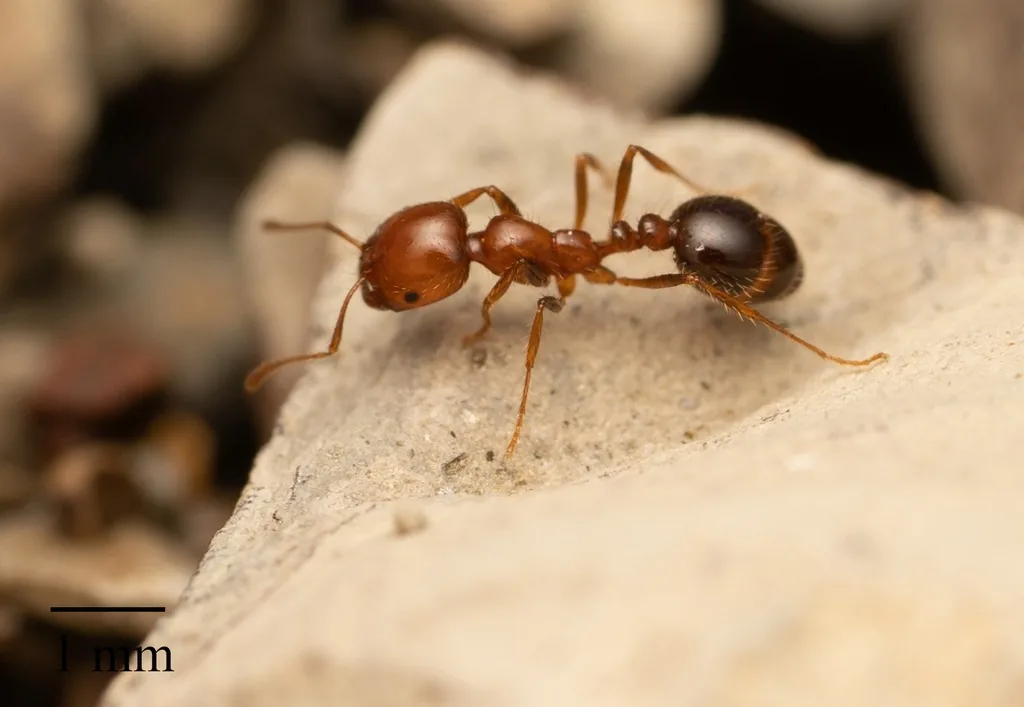
- Workers come in mixed sizes in the same colony, from about 1/8 inch to over 1/4 inch long.[1][2]
- The head and thorax are amber, the abdomen is black, and fine golden hairs cover the body.[2]
- Nests are low, fine-grained patches of loose soil with many openings, often near moisture, rather than tall dome-shaped mounds.[1][3]
- Under a microscope, the front edge of the head shows only two teeth, while the red imported fire ant has three.[3]
Look-alikes
| Look-alike | How to tell them apart |
|---|---|
| Red imported fire ant | About the same size and color, but it builds firm, dome-shaped mounds and is much more aggressive, quickly climbing onto anything that disturbs the nest.[3] |
| Thief ant | A close relative in the same genus, but tiny, about 1/32 inch, and yellow to light brown.[2] |
| California harvester ant | Workers are all one size, about 1/5 inch, and red, while southern fire ant workers vary in size.[3] |
Where it lives
A native species of the southern and southwestern United States; extension sources list it as native in Texas, common in Arizona, and native in California.[4][1][3]
Biology and life cycle
Colonies favor bare soil in full sun; bare or compacted turf, mowing too short and edging turf too low all create conditions where they thrive.[1]
Some nests are small mounds with flattened, irregular craters, and colonies also nest in wood or under rocks.[2][1]
They eat a wide range of foods, including insects, seeds, honeydew, sweets, grease and proteins; nut-filled candy bars are a favorite.[1][2]
Workers are most active in the morning and early evening.[1]
Damage and signs
Health risk
Workers bite to anchor themselves and then sting repeatedly, causing a burning pain. People vary widely in sensitivity, and hypersensitive people can develop anaphylaxis, which needs immediate emergency care.[1]
Control
Prevention
Don't stand on or disturb nests; wear protective shoes and clothing outdoors where fire ants are present, and teach children about the hazard.[1]
Keep the lawn healthy with proper mowing, watering, fertilizing and aeration, which can reduce fire ant colonies.[1]
Keep them out
Pest-proof the home so indoor spaces are harder for foraging ants to reach and less attractive to them.[1]
Sanitation
Don't leave pet food, soda cans, plates or food containers out overnight, and clean up spills before bedtime.[1]
Pesticides
Where control is needed in yards used by people and pets, use only EPA-registered baits or other products labeled for fire ants, following label directions exactly.[1]
Fire ants prefer baits made with oils; offering small amounts of different baits and watching which one they take helps you choose.[2]
If you are stung
Move at least 20 feet away, then brush the ants off quickly by hand or with a cloth, and check clothing for ants.[1]
Wash the skin gently with soap and water, disinfect with alcohol, and use a cool compress to ease swelling.[1]
Over-the-counter antihistamines can reduce itching and burning; follow the package directions.[1]
Dizziness, fainting, trouble breathing or swallowing, slurred speech, chest pain or major swelling are signs of a serious reaction; call 911.[1]
People who have had serious reactions to ant, bee or wasp stings should ask their doctor whether to carry an epinephrine auto-injector.[1]
Common questions
- Is the southern fire ant the same as the red imported fire ant?
- No. The southern fire ant is native, while the red imported fire ant is an invasive species that is much more aggressive and builds taller mounds.[3][1]
- Do southern fire ants build mounds?
- Usually not tall ones. Their nests tend to be low, irregular patches of loose, scattered soil with several hard-to-see entrances.[1][3]
- Why are fire ants in my kitchen?
- Southern fire ants forage indoors for sweets, grease and proteins, especially in warm months, so food left out overnight draws them in.[1]
Sources
- University of Arizona Cooperative Extension, “Beware of Fire Ant Stings, AZ1954 (October 2021).” extension.arizona.edu/sites/extension.arizona.edu/files/pubs/az1954-2021.pdf (accessed 2026-10-06)
- UC Statewide IPM Program (University of California Agriculture and Natural Resources), “Pest Notes: Ants.” ipm.ucanr.edu/home-and-landscape/ants/ (accessed 2026-10-06)
- University of California Statewide IPM Program, “Pest Notes: Red Imported Fire Ant, Publication 7487 (December 2013).” ipm.ucanr.edu/legacy_assets/PDF/PESTNOTES/pnredimportedfireant.pdf (accessed 2026-10-06)
- Texas A&M AgriLife Extension, Department of Entomology, “Fire Ant (Field Guide to Common Texas Insects).” texasinsects.tamu.edu/red-imported-fire-ant/ (accessed 2026-10-06)
- iNaturalist, “Solenopsis xyloni taxon page (order and family).” www.inaturalist.org/taxa/69547 (accessed 2026-10-06)