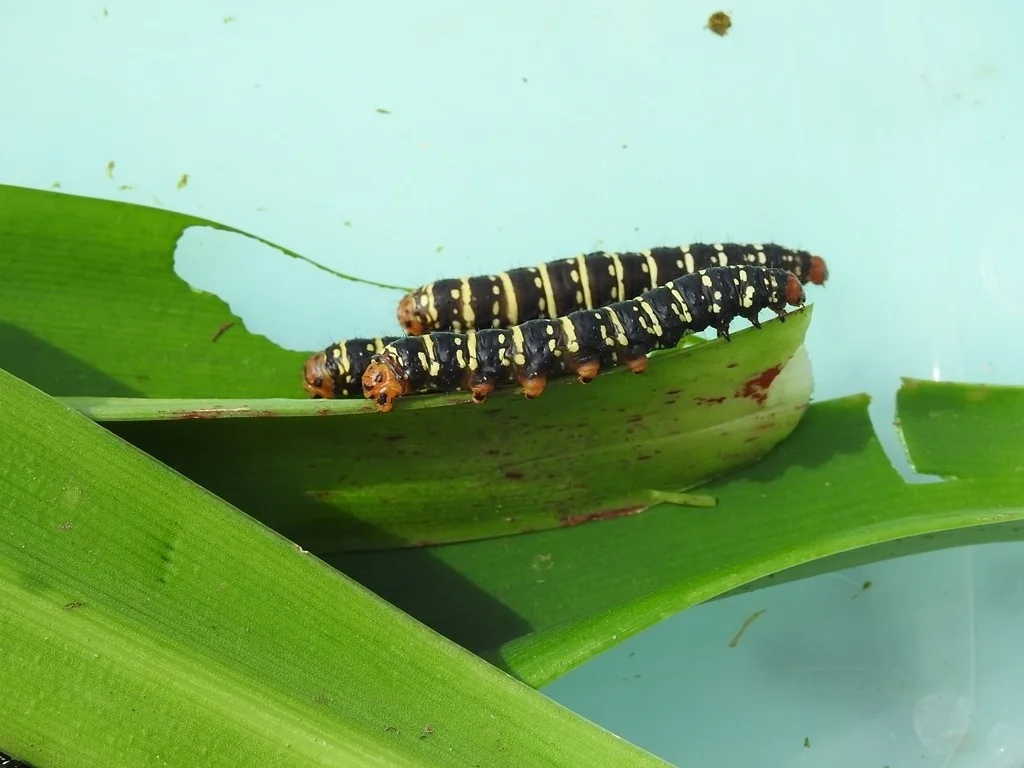
How to identify it
Where it lives
It ranges through the American tropics and, in North America, from the Carolinas to Texas, straying north along the Atlantic coast.[1]
Biology and life cycle
In Florida, moths are active from January to early June and September to December, with nearly continuous generations in the far south.[1]
Females lay clusters of several hundred eggs, usually under leaves, and larvae pupate in loose soil.[1]
Hosts include amaryllis, spider lily, clivia, crinum, narcissus, rain lily, iris and lily.[1]
Damage and signs
- Larvae chew in groups on leaves, bulbs and rhizomes.[1]
Health risk
It feeds on plants; UF/IFAS mentions no risk to people.[1]
Control
Prevention
Check leaves regularly for caterpillars, especially early in spring while plants are small; a blacklight can show when moths are flying.[1]
Biological control
A tachinid fly parasitoid attacks it.[1]
Pesticides
Bt (Bacillus thuringiensis) sprays control the caterpillars; other pesticides act faster.[1]
Common questions
Sources
- University of Florida IFAS Extension (Featured Creatures), “Spanish Moth or Convict Caterpillar, Xanthopastis timais (EENY-271).” edis.ifas.ufl.edu/publication/IN550 (accessed 2026-10-06)
- iNaturalist, “Xanthopastis timais taxon page (order and family).” www.inaturalist.org/taxa/1071140 (accessed 2026-10-06)