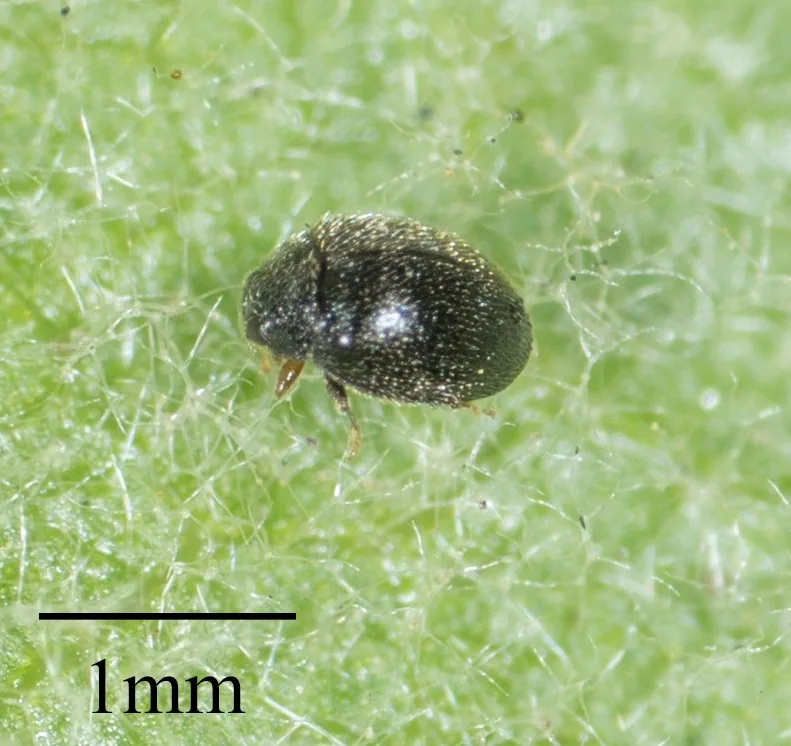
How to identify it
- Adults are black, oval and domed, about 1/16 inch (1.5 mm) long, and look grayish because of fine pale hairs.[1][2]
- Young larvae are dark gray with many tiny branched hairs, and they turn reddish from the edges inward as they mature.[1][2]
- Eggs are pale, oval and tiny, laid singly on their sides, mostly beside the main veins under leaves.[1][2]
- Newly emerged adults are reddish-orange for a few hours before turning black.[2]
Where it lives
At least seven Stethorus species live in the U.S. Stethorus punctum is native in the mid-Atlantic and Midwest; S. picipes is the species found in California.[1][2]
Biology and life cycle
Females lay about 100 to 200 eggs over a one- to two-month life, one to ten per leaf depending on mite numbers.[1][2]
In warm weather it goes from egg to adult in three to four weeks, and there are usually three overlapping generations.[1][2]
Adults overwinter in leaf litter and other sheltered spots around trees and fence rows.[2]
Damage and signs
Health risk
Its food is limited to spider mites and other plant-feeding mites; the sources describe no effect on people.[2]
Control
Biological control
Leave leaf litter under fruit trees undisturbed from November to late April, because overwintering adults shelter there.[2]
Some miticides and insect growth regulators, including abamectin and fenoxycarb, harmed it in studies.[2]
It isn't sold commercially, so conserving local beetles is the way to use it.[2]
Common questions
- What are the tiny black beetles in my mite-infested plants?
- Possibly spider mite destroyers. Adults fly well and gather where mites are thick, then lay eggs there.[1]
- Are the reddish hairy larvae a problem?
- No. Spider mite destroyer larvae turn reddish as they mature and feed on all stages of spider mites.[1][2]
- Can I buy spider mite destroyers?
- Cornell lists them as not commercially available.[2]
Sources
- University of California Statewide IPM Program, “Spider Mite Destroyer (Natural Enemies Gallery).” ipm.ucanr.edu/natural-enemies/spider-mite-destroyer/ (accessed 2026-10-06)
- Cornell University College of Agriculture and Life Sciences, “Biological Control: A Guide to Natural Enemies in North America: Stethorus punctum.” biocontrol.entomology.cornell.edu/predators/Stethorus.php (accessed 2026-10-06)
- iNaturalist, “Stethorus taxon page (order and family).” www.inaturalist.org/taxa/211369 (accessed 2026-10-06)