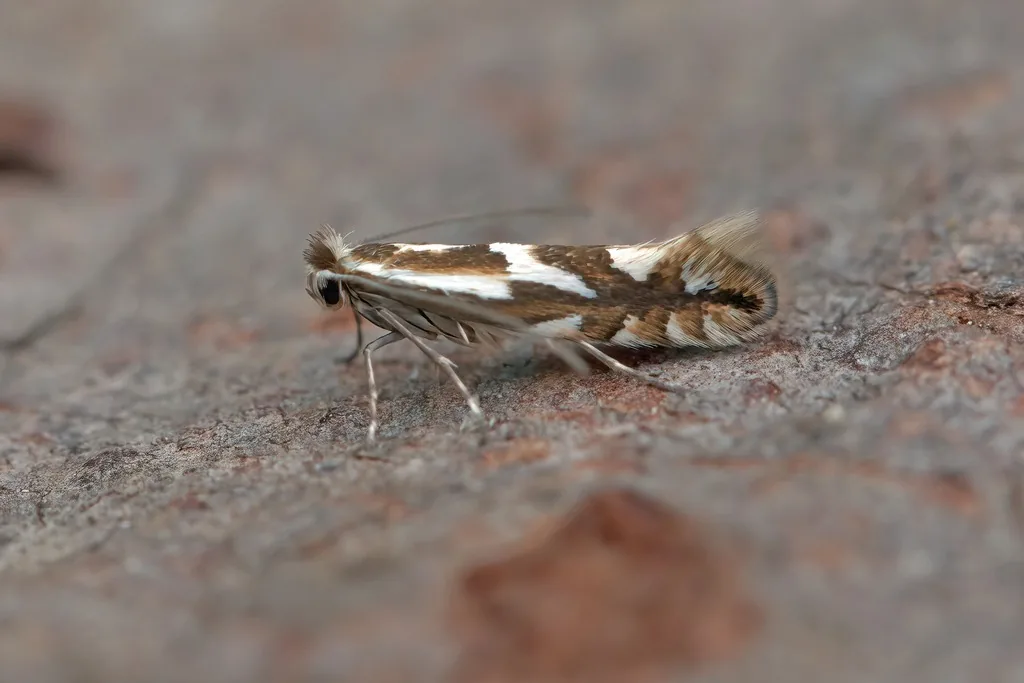
How to identify it
- Adults are tiny moths about 1/8 inch long with white wings marked by orange-gold patterns outlined in black.[1][2]
- Mines are oval, about 3/4 by 1/2 inch, at first visible only from below, later raised like a tent with small pale spots visible on the upper surface.[2][1]
- Larvae are yellow to pale green and never more than about 1/5 inch long.[1][2]
Where it lives
Native to Europe, it is now found throughout the eastern US and Canada; tentiform leafminers occur in virtually all North American apple-growing regions.[1][2]
Biology and life cycle
Pupae overwinter in fallen apple leaves, and adults emerge early in spring, around green tip through bloom.[1][2]
Females lay single eggs on leaf undersides; young sap-feeding larvae make a flat mine, and older tissue-feeding larvae hollow it into a blister.[1][2]
There are three generations a year in Wisconsin and usually three to four in North Carolina; moths fly mostly at dusk.[1][2]
Damage and signs
- It feeds only on leaves; a mature mine removes about 5 percent of a leaf's green tissue.[1]
- Heavy mining stresses the tree and can mean small, poorly colored fruit and early drop; Wisconsin puts the level that may affect the crop at about 5 accumulated mines per leaf on average.[2][1]
- In home trees, mines are commonly seen but rarely numerous enough to cause harm.[2]
Health risk
Control
Prevention
Before treating, open mines to check for live larvae, since mines stay visible after larvae have left or died.[1]
Sanitation
Pupae overwinter in fallen apple leaves.[1][2]
Biological control
Tiny parasitic wasps and predators keep it in check; without insecticides they can kill as many as 98 percent of larvae, and past outbreaks followed sprays that killed these natural enemies.[1][2]
Common questions
- What are the blister-like spots on my apple leaves?
- Likely spotted tentiform leafminer mines, which become tent-shaped and spotted.[1][2]
- Do I need to spray my home apple tree?
- Rarely; natural enemies usually keep it below damaging levels in home trees.[2]
- How many mines are too many?
- Wisconsin suggests about 5 accumulated mines per leaf on average may start to affect the crop.[2]
Sources
- NC State Extension, “Spotted Tentiform Leafminer.” content.ces.ncsu.edu/spotted-tentiform-leafminer (accessed 2026-10-15)
- University of Wisconsin-Madison Extension (Wisconsin Horticulture), “Spotted Tentiform Leafminer, Phyllonorycter blancardella.” hort.extension.wisc.edu/articles/spotted-tentiform-leafminer-phyllonorycter-blancardella/ (accessed 2026-10-15)
- iNaturalist, “Phyllonorycter blancardella taxon page (order and family).” www.inaturalist.org/taxa/1677214 (accessed 2026-10-06)