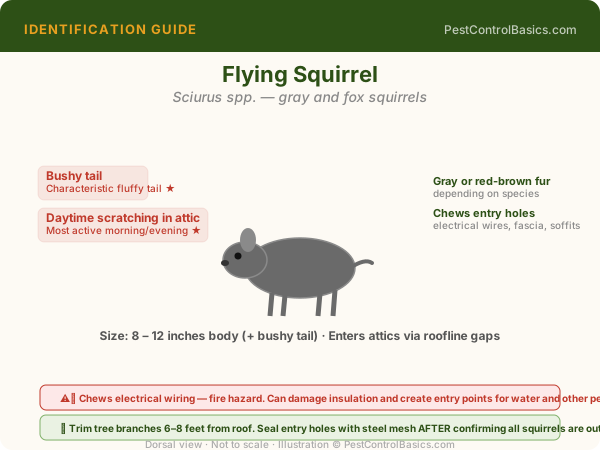
❓ Common Questions About 🐿️ Flying Squirrel
How do I confirm I actually have this pest (not something similar)?
The most reliable confirmation is a physical specimen — capture one and compare to reference images on this page. For cryptic pests (bed bugs, termites), look for secondary signs: frass, shed skins, mud tubes, or bites with a specific pattern. When uncertain, a professional inspection is faster than months of misidentification.
Can I treat this myself or do I need a professional?
DIY is effective for small, accessible infestations caught early. Professionals are worth the cost when: the infestation is inside wall voids or structural elements, multiple rooms are affected, you have health-risk pests (hantavirus, venomous species), or DIY has already failed twice.
How long until the infestation is completely gone?
Expect 3–8 weeks for most infestations with proper treatment. Insects with dormant life stages (pupae, eggs) extend the timeline because those stages are impervious to most insecticides. Follow-up treatments at 2 and 4 weeks catch each new cohort as they emerge.
What's the most common mistake people make treating this pest?
Treating only the visible pest population while ignoring the harborage site, entry point, or breeding location. Killing adults provides temporary relief but the population rebuilds from hidden egg cases, pupae, or new arrivals through unaddressed entry points.
Exclusion is the only durable rodent control
Trapping reduces a rodent population temporarily; baiting reduces it more durably; exclusion prevents reinvasion. Without exclusion, every successful control program is on a countdown to reinvasion from the surrounding rodent reservoir. Effective exclusion addresses gaps mice (1/4 inch and larger) and rats (1/2 inch and larger) can squeeze through. Common entry points missed by quick inspections: gaps where utility lines penetrate exterior walls, behind dryer vent flaps, dryer vent screens with corrosion damage, garage door bottom seals (especially at corners), gaps under sill plates, weep holes in brick veneer, and gaps where roof returns meet walls. Steel wool packed into voids and sealed with caulk handles most gaps; hardware cloth (1/4 inch) over larger openings holds long-term. A thorough exclusion pass takes a weekend and provides multi-year benefits.
Reading pesticide labels: what most homeowners miss
The pesticide label is the most important document in any pest control decision, and it's the document most people skim. Under FIFRA (the federal law that governs pesticide registration), the label is legally binding — using a product inconsistent with its label is a violation, regardless of intent. The label has several sections that homeowners should read fully before purchase, not after: the use sites (where it can legally be applied), the target pests (some products legal indoors are not for the specific pest), the mixing rate (overdosing wastes product without improving efficacy and increases drift risk; underdosing accelerates resistance), the PPE requirements (some require respirators, not just gloves), and the re-entry interval (how long until the treated area is safe for people and pets). The signal word — Caution, Warning, Danger — indicates acute toxicity but not chronic risk; that's elsewhere on the label. Reading labels well prevents nearly every common DIY misapplication.
Rodent signs to look for during home inspection
Active rodent presence usually leaves signs that are easy to spot if you know where to look. Droppings — mouse droppings are rice-grain sized, dark and pointed; rat droppings are larger, capsule-shaped. Gnaw marks on edges of doors, window sills, plastic food containers, and wires (chewed insulation is a fire risk). Greasy rub marks along baseboards and floor-wall junctions where rodents repeatedly travel. Nests in attics, basements, garages, and inside seldom-used appliances and stored cardboard. Sound — scratching or scurrying in walls, ceilings, or attics, especially at dusk and dawn. Pet behavior — dogs and cats focused on a wall or appliance often detect rodents people miss. Once signs are confirmed, both treatment and exclusion work need to start, not just one or the other.
Rodent-borne disease and sanitary handling
Rodents in the household are a health concern beyond property damage. Hantavirus is rare but serious and is transmitted via aerosolized contamination of dried droppings and urine — disturbing nests in enclosed spaces (cleaning out an attic, garage, or shed where rodents have been active) is the higher-risk activity. Leptospirosis, salmonellosis, and lymphocytic choriomeningitis are other potential rodent-borne diseases. CDC guidance on cleanup: ventilate the area before entering, wear gloves and an N95 mask, wet contaminated materials with disinfectant before disturbing (don't sweep dry — wetting prevents aerosolization), double-bag waste, and wash exposed clothing in hot water. After cleanup, sealing entry points prevents recurrence and the associated cleanup repeating.
Why integrated pest management produces better outcomes
Integrated Pest Management (IPM) is the framework most pest management professionals follow and the framework the EPA recommends for residential and commercial settings. IPM is not anti-pesticide; it's a sequencing approach that uses cultural controls (sanitation, exclusion, moisture management) first, mechanical controls (traps, vacuuming, physical removal) second, biological controls (beneficial insects, microbial agents) where applicable, and chemical controls last and targeted. The benefit isn't ideological — it's empirical. IPM-treated sites have lower long-term pest pressure than chemical-only treated sites, because chemicals address the visible population without addressing why the population developed. Homeowners who adopt IPM principles see longer intervals between treatments, lower total pesticide use, and better outcomes during the times when chemicals are appropriate. The shift from 'spray when I see them' to 'fix the conditions, monitor, treat targeted' is the single highest-leverage change most DIY practitioners can make.
Snap traps vs. glue boards vs. electronic traps: practical comparison
The three main consumer rodent traps each have practical use cases, and the choice depends more on the situation than on which is 'best.' Snap traps remain the most reliable for active mouse populations: cheap, effective, fast-killing, and easy to set in numbers. The key is using enough traps (six to twelve in a typical mouse infestation, not one or two) and placing them perpendicular to walls with the trigger toward the wall along observed runways. Glue boards have a specific niche — narrow corridors, behind appliances, voids — where snap traps don't fit, but they're inhumane (animals die slowly), they catch non-targets including snakes and small birds in some settings, and they aren't effective against rats, which generally pull free. Electronic traps (battery-powered devices that deliver a lethal shock) work well, are reusable, and present the kill conveniently, but the per-unit cost limits how many can be deployed. The practical recommendation: snap traps as the primary tool, glue boards for spots snap traps can't reach, electronic traps as a quality-of-life upgrade for ongoing monitoring rather than a primary tool.
Building a pest control file: documentation that compounds over years
Most homeowners treat pest issues episodically and lose information between events. Building a simple ongoing pest file — even a single document in a notes app or folder of photos — produces compounding benefits across years of property ownership. The contents that matter: date and location of every notable sighting, identification (with photos where possible), treatment applied and product names used, professional service records and warranty terms, structural sealing work performed and where, drainage and moisture correction work performed, and observations across seasons. Over two or three years, patterns emerge that aren't visible in single incidents: which months reliably bring ant activity, which exterior corner gets wasps every spring, which entry points keep failing, which products actually worked versus which were tried and abandoned. This file becomes useful at property sale (documenting professional treatment and remediation), at insurance claim time (documenting pre-existing conditions or treatment history), and at any future pest problem (where past records narrow the diagnostic space immediately). The effort to maintain is minimal — a few minutes per incident — and the cumulative information value substantial.
Rodent exclusion: the specific gaps that matter most
Rodent exclusion produces the longest-lasting rodent control because it addresses access rather than just existing population, and the specific gaps that matter follow a predictable pattern. Mice can squeeze through openings as small as a quarter-inch (a hole the diameter of a pencil); rats need about a half-inch (the diameter of a thumb). The high-yield inspection targets: garage door bottom seals (where most house mice originally enter), foundation cracks particularly where utilities penetrate (gas lines, water service, electrical service mast, AC line set penetrations), gaps where siding meets foundation, dryer vents and exhaust vents (where deteriorated flaps allow entry), gaps around exterior faucets and hose bibs, weep holes in brick construction (which should be screened against rodents while still venting), and gaps around eaves and roofline penetrations including roof vents and chimney flashings. Repair materials matter: copper mesh stuffed into openings then sealed with appropriate sealant works far better than steel wool (which degrades) or expanding foam alone (which rodents chew through). Hardware cloth (1/4-inch) is appropriate for larger openings and vent screens.
Utility penetrations as the single most important exclusion target
Across residential rodent control, the single most consistent finding during exclusion work is that the gaps around utility penetrations — where pipes, conduits, cables, and vents enter the structure — are the primary entry routes that rodents are using. These gaps exist on essentially every residential structure, they're often hidden behind siding or in mechanical closets where homeowners don't routinely look, and the construction techniques used in original installation rarely include rodent-proof sealing. A new utility installation by a plumber, electrician, or HVAC technician almost always leaves a gap, because their work is focused on the utility function rather than on the building envelope. The implication for rodent exclusion is that any thorough inspection has to include a systematic check of every penetration, including the ones in basements, crawlspaces, attic plates, and inside cabinets where supply lines enter walls. Sealing these gaps with appropriate materials — copper mesh, steel wool, urethane foam over a metal substrate, or commercial rodent exclusion sealant — typically eliminates the majority of entry routes and produces dramatic improvements in long-term rodent activity.
Annual pest control budgets: planning versus reactive spending
Most households treat pest control as an emergency expense rather than a line item, and the resulting spend is almost always higher than what a planned program would have cost. A property that allocates a modest annual budget toward inspections, preventive perimeter work, and one or two scheduled treatments at high-pressure times of year typically spends a fraction of what a comparable property spends on crisis response to a single major infestation. The math is straightforward: a moderate cockroach, rodent, or bed bug job typically costs more than a year of preventive service, and the labor and disruption costs to the household are not trivial either. Building a budget also forces the kind of structured thinking that catches problems early — when a homeowner has already decided to allocate funds, they're more willing to call for an inspection at the first ambiguous sign, rather than waiting until the situation is unambiguous and more expensive. The shift from reactive to planned spending is one of the highest-leverage changes a household can make in this category.
Food source elimination as the primary control lever
Rodent infestation is, more than anything else, a function of available food, and trying to control rodent populations without addressing food sources is consistently less effective than addressing food sources and then dealing with what remains. The food sources homeowners commonly miss include bird seed in feeders and on the ground beneath them, pet food left in bowls overnight, compost without rodent-proof containment, fruit that drops from trees, and stored grain or feed in garages and outbuildings. Indoor food sources include pantry foods in non-rodent-proof packaging, grease accumulated behind stoves, food debris in cabinets and on counters overnight, and trash that's not in a sealed container. The behavioral shift required for rodent control is more demanding than for most pest categories — it requires consistent practice rather than periodic action — but it's the only approach that addresses the root condition rather than just the symptom. A property with consistent food source management supports a much smaller rodent population, and the trapping and exclusion that handle the remainder become tractable rather than overwhelming.