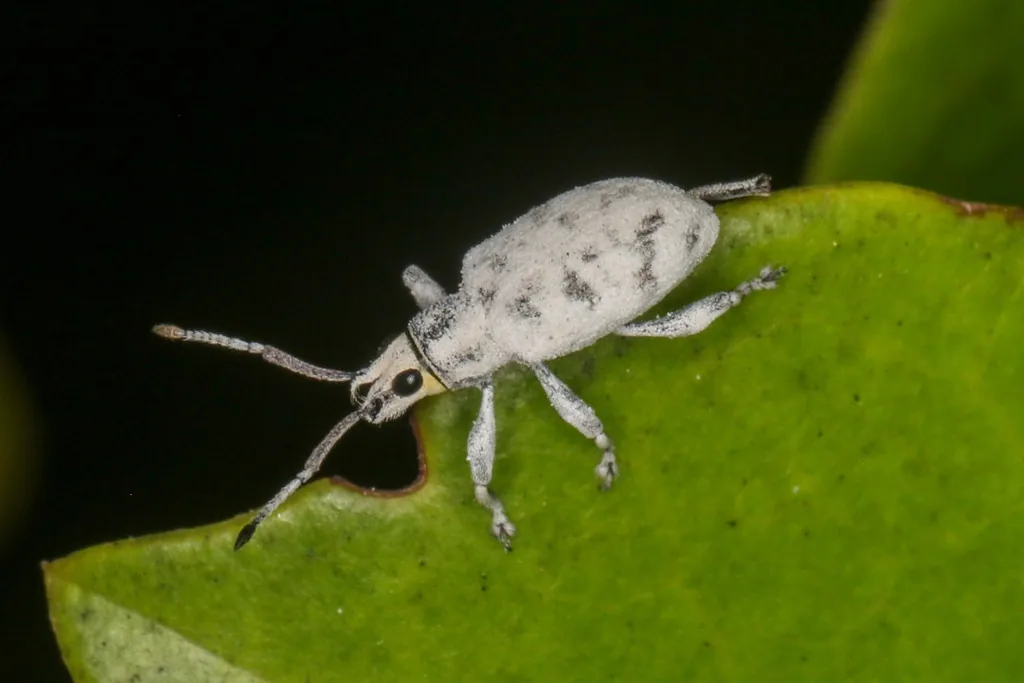
How to identify it
Look-alikes
| Look-alike | How to tell them apart |
|---|---|
| Little leaf notcher | Similar, but its legs lack teeth, its shoulders aren't angled and its wing covers are grayish to white.[1] |
Where it lives
First detected in Broward County in 2000, it has since been found in more than two dozen Florida counties.[1]
Biology and life cycle
Larvae, beige-white with a reddish-brown head, burrow into soil and feed on roots for one to two months.[1]
It has a host range of over 150 plants, including citrus, buttonwood, cocoplum, pygmy date palm, crepe myrtle and pepper.[1]
Damage and signs
- Adults chew inward from leaf edges, leaving notches, and prefer new growth; heavy feeding can stunt plants or kill seedlings.[1]
Health risk
It feeds on plants; UF/IFAS mentions no risk to people.[1]
Control
Traps and physical control
Shake branches over an open, upside-down umbrella and dump the weevils into soapy water.[1]
Pesticides
Pesticides give only limited control because adults fly, hide or drop and play dead; check with UF/IFAS Extension for current advice.[1]
Common questions
Sources
- University of Florida IFAS Extension (Featured Creatures), “Sri Lankan Weevil, Myllocerus undecimpustulatus undatus (EENY-579).” edis.ifas.ufl.edu/publication/IN1016 (accessed 2026-10-06)
- iNaturalist, “Myllocerus undecimpustulatus taxon page (order and family).” www.inaturalist.org/taxa/55183 (accessed 2026-10-06)