How to identify it
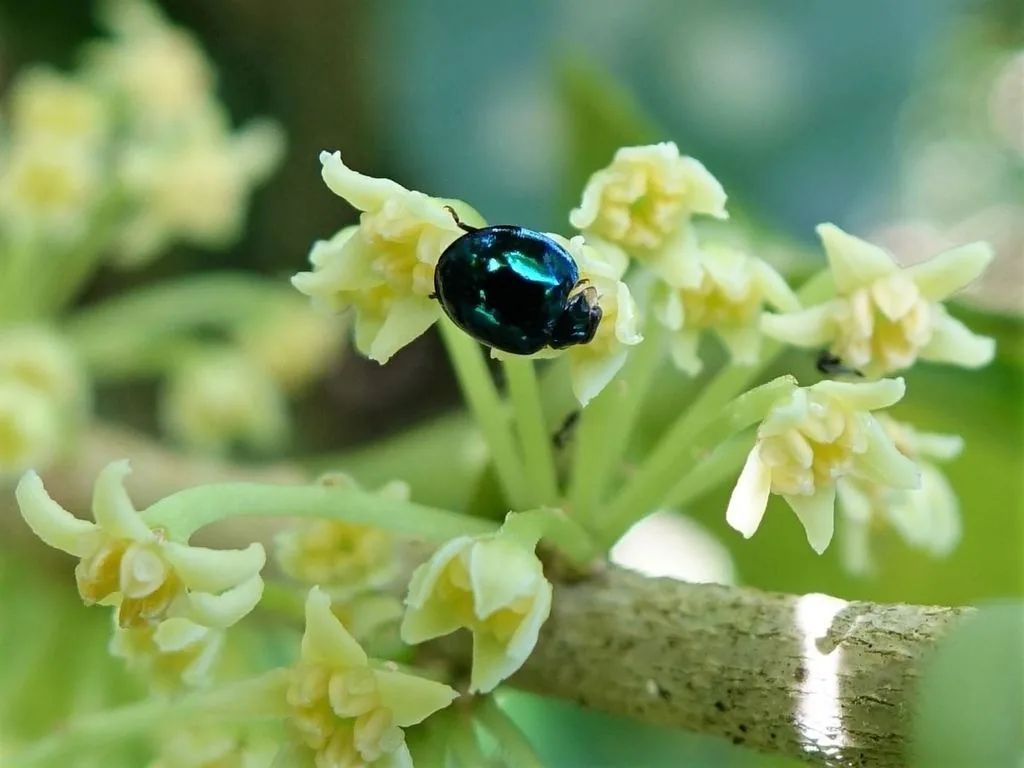
- Adults are metallic dark blue, green or purple, round and domed, about 1/8 to 1/6 inch long.[1]
- Females are uniformly dark; males have orange or yellow on the head and thorax edges.[1]
- The lower edges of the wing covers flare out into a ridge.[1]
- Larvae carry many short, branched spines and develop dark blotches as they grow.[1]
Look-alikes
| Look-alike | How to tell them apart |
|---|---|
| Exochomus metallicus | This dark metallic blue lady beetle is the same size but covered in fine short hairs; the steelblue lady beetle is smooth and hairless.[1] |
Where it lives
It occurs at least in coastal Central and Southern California, where it was introduced to protect citrus.[1]
Biology and life cycle
Females lay eggs near prey, mostly by scale insects, and larvae pupate in the open on plants.[1]
Egg to reproductive adult takes about five weeks in warm weather, with several generations a year.[1]
Adults often overwinter in groups in ground litter or dense lower foliage.[1]
Damage and signs
Health risk
UC IPM presents it only as a scale predator, with no mention of people.[1]
Control
Biological control
Help it by controlling ants, growing flowering plants and avoiding persistent broad-spectrum sprays.[1]
Common questions
Sources
- University of California Statewide IPM Program, “Steelblue Lady Beetle (Natural Enemies Gallery).” ipm.ucanr.edu/natural-enemies/steelblue-lady-beetle/ (accessed 2026-10-06)
- iNaturalist, “Halmus chalybeus taxon page (order and family).” www.inaturalist.org/taxa/244625 (accessed 2026-10-06)