Invasive from Asia Fall Home Invader Seal Before September

Stink
Bugs

Halyomorpha halys โ€” Brown Marmorated Stink Bug

They don't bite, sting, or cause structural damage. But they invade homes by the hundreds every fall, and squishing them releases a pungent odor that attracts more. The only real solution is exclusion โ€” seal every entry point before September.

OriginChina โ€” arrived in PA ~1996
Now In40+ states & spreading
Invasion SeasonLate September โ€“ November
Do They Bite?No โ€” completely harmless to humans
๐Ÿฆ
Quick Reference Card
Brown Marmorated Stink Bug
Size5/8 inch โ€” shield-shaped body
ColorMottled brown-gray, banded antennae
ShapeGeometric shield โ€” distinctive pentagonal
SmellCilantro / coriander โ€” when threatened
InvadesSeptemberโ€“November seeking warmth
Dangerous?No โ€” nuisance only
Squish?NEVER โ€” releases odor + attracts more
Best controlSeal before September โ€” vacuum indoors
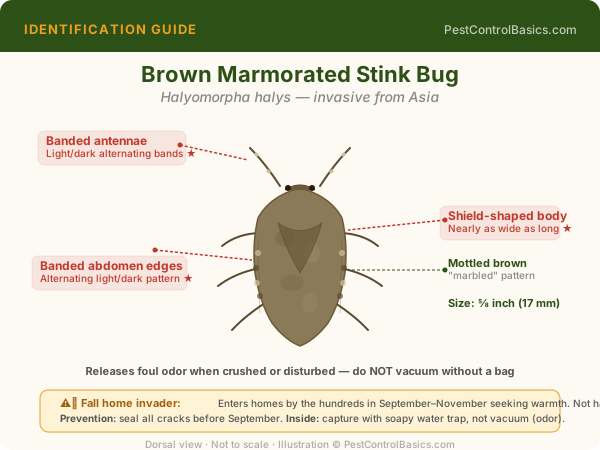
๐Ÿ“ FIELD GUIDE ILLUSTRATION
Brown marmorated stink bug (Halyomorpha halys) identification illustration with labeled anatomical features โ€” PestControlBasics.com

Original illustration by PestControlBasics.com. Use anatomical labels above to confirm your identification.

Origin & Invasion Biology

Why they show up every fall โ€” like clockwork

The Brown Marmorated Stink Bug arrived in Allentown, Pennsylvania from East Asia around 1996 โ€” likely in shipping containers. Without the parasitic wasps that control them in Asia, their population expanded explosively. They now occur in 40+ states and are established in most of the eastern U.S., with expanding populations in the Pacific Northwest and California.

What triggers the fall invasion is straightforward: dropping temperatures cause them to enter "diapause" โ€” a dormant overwintering state. They seek warm, protected spaces to wait out winter. Your home, particularly warm sunny sides and attic spaces, is ideal. They release aggregation pheromones that attract other stink bugs to the same overwintering sites โ€” which is why the same homes see repeated invasions year after year.

๐Ÿ›‘ Never Squish a Stink Bug Indoors

Squishing a stink bug releases two things: the pungent odor (which smells like coriander or cilantro) and aggregation pheromones that actively signal to other stink bugs that this is a good overwintering site. You will attract more. Use a jar, bag, or vacuum to capture and remove them without crushing. Flush down a toilet or release outside โ€” far from the structure.

๐Ÿ“… Stink Bug Annual Calendar โ€” When to Act
Jan
Dormant
Feb
Dormant
Mar
Emerge
Apr
Outdoors
May
Feeding
Jun
Breeding
Jul
Active
Aug
โš  SEAL NOW
Sep
๐Ÿ›‘ Invasion starts
Oct
๐Ÿ›‘ Peak invasion
Nov
โš  Tapering
Dec
Dormant
๐Ÿ“… The August Rule

All stink bug exclusion work must be completed by late August โ€” before the first cold nights trigger migration toward structures. By September, they are actively seeking entry. Sealing in October doesn't stop the invasion; it just traps some already inside. August is your window.

Exclusion โ€” The Only Real Solution

Seal every gap before September

Insecticides provide limited help against stink bugs โ€” they move quickly and contact time with treated surfaces is brief. Exclusion is the only effective strategy. Use this checklist every August.

โœ“ August Stink Bug Exclusion Checklist
Window and door weatherstripping
Replace any compressed, cracked, or missing weatherstripping. Even a 1/4 inch gap is sufficient for stink bug entry.
Door sweeps on all exterior doors
Include garage doors. Stink bugs enter under doors with daylight clearance. Install heavy-duty sweeps with brush seals.
Window screen integrity
Check every screen for holes and tears โ€” even small ones. Repair with screen patch kits or replace damaged screens before August.
Utility penetrations โ€” pipes, cables, AC lines
Seal gaps around all exterior pipe and cable penetrations with exterior caulk or foam. A common entry point that's easy to overlook.
Attic vents and crawlspace vents
Install fine mesh screens (1/16 inch) over attic and crawlspace vents. These are major entry points for attic overwintering.
Chimney with damper or cap
Open chimneys are highways for stink bugs and other overwintering insects. Install a chimney cap with mesh screening.
Perimeter caulking โ€” siding and trim
Walk the exterior and caulk any gap where siding meets trim, windows, or foundation. Use paintable exterior caulk.
Exterior light management
Stink bugs are attracted to light. Replace white exterior bulbs with yellow LED or sodium vapor โ€” significantly less attractive to insects.
Safe Indoor Removal

When they're already inside โ€” remove without releasing odor

The Vacuum Method โ€” Best Indoor Removal

Vacuum stink bugs up with a shop vac or regular vacuum. Important: empty the vacuum immediately into a sealed bag placed outside. Stink bugs in a vacuum bag will release odor into your home through the motor exhaust. A stocking over the vacuum nozzle can trap bugs before they reach the bag โ€” remove the stocking and seal it in a bag outdoors.

The Jar Method โ€” For Individual Bugs

Place a glass jar or zip-lock bag over the bug (don't touch it), slide a piece of paper underneath, and capture it. Seal and dispose outside. Drop into soapy water โ€” the detergent breaks surface tension and they drown quickly without releasing odor.

Soapy Water Trap

A shallow container of soapy water placed under a desk lamp (the only light source in a dark room) attracts stink bugs overnight. They fly toward the light, fall into the water, and drown. Effective for reducing indoor populations without contact or squishing.

๐Ÿ 
Perimeter Spray โ€” Outdoor Entry Point Treatment
Bifenthrin Perimeter Spray (Talstar, Bifen IT)
How it works: Applied to the exterior of the structure in August โ€” around windows, doors, eaves, and the foundation โ€” creates a contact-kill zone for stink bugs landing on the structure before entry. Provides 4โ€“6 weeks of residual. Must be applied before invasion begins. Re-apply in late September if activity continues. Combine with exclusion for maximum effectiveness โ€” spray alone without sealing gaps is insufficient.
โ˜…โ˜…โ˜…โ’ธโ’ธ
Supplemental
๐ŸŒฟ No Good Indoor Chemical Treatment Exists

There is no indoor pesticide treatment that effectively controls stink bugs already inside. Sprays kill individuals on contact but do not provide meaningful residual control for a species that's constantly re-entering. Indoor pesticide application for stink bugs is not recommended โ€” exclusion and manual removal are the only effective indoor strategies.

DG
Derek Giordano
Certified Pest Control Operator ยท Former Business Owner
Derek ran his own pest control company in Florida for several years, servicing thousands of regular customers. All content is based on hands-on field experience and current EPA & university extension guidelines.
🧪 Recommended Treatment Products
Bifenthrin Lambda-Cyhalothrin IPM Guide
Full product guides with mixing rates and safety info. → Browse All 130 Pesticide Guides

Related Resources

๐Ÿ“š Full Pest Library๐Ÿงช DIY vs. Pro Quiz๐Ÿ’ฐ Cost Guide๐ŸŒฟ IPM Guide๐Ÿ” Find a Pro
๐Ÿ”ฎ
Reviewed by Derek GiordanoContent on PestControlBasics.com is developed with input from certified pest management professionals and cross-referenced against EPA, CDC, and university extension guidance. Last reviewed: April 2026.
๐Ÿ“š Sources: EPA Termite Guide ยท NPMA Termite Info
Published: Jan 1, 2025 ยท Updated: Apr 7, 2026
๐Ÿ”— Deep-dive: Green Stink Bug vs Brown Marmorated
Side-by-side comparison of the two most common stink bugs โ€” visual ID and crop-damage differences.
๐Ÿ”— Deep-dive: Stink Bug Nymph Stages
Visual guide to the five nymphal instars โ€” recognizing immature stink bugs before they reach reproductive size.

Building a pest management calendar for residential properties

Most pest management problems become much easier to handle with a simple seasonal calendar mapping the high-leverage interventions to their optimal windows. A representative annual calendar for temperate-climate residential properties: February through March, conduct exterior exclusion audit and address gaps before spring pressure begins; March through April, schedule outdoor preventive treatment if appropriate (foundation perimeter, mosquito source reduction setup), inspect for early wasp nest construction; May through July, mosquito source reduction maintenance (weekly standing water check), tick prevention if regionally relevant; August through October, fall rodent exclusion check, schedule pest control inspection if on annual service, address overwintering pest entry points (occasional invaders); November through January, indoor monitoring (sticky traps for pantry pests and incidental species), assess prior year's pressure to plan next year's focus. A calendar entry per month, taking 15-30 minutes most months, produces dramatically better outcomes than reactive treatment after problems become visible.

Children, pets, and pesticide exposure: practical risk reduction

Pesticide safety guidance is often written for licensed applicators and translates awkwardly to households with children and pets. The practical residential framework: keep treated surfaces dry before re-entry (typically two to four hours for most water-based residuals, longer for solvent-based), keep pets away from treated zones until dry plus a buffer, store products in original containers in locked storage out of reach of children, never decant products into food or beverage containers (a documented cause of accidental poisonings), and rinse outdoor toys, dog beds, and similar items before re-introducing them to a treated yard area. The exposure routes that matter most are ingestion (children mouthing treated surfaces or contaminated items) and prolonged dermal contact (pets sleeping on freshly-treated carpet). Targeted application โ€” crack-and-crevice, bait stations, perimeter exterior โ€” produces far lower exposure than broadcast spraying, which is one of several reasons IPM-style targeted treatment has displaced broadcast approaches in residential settings.

Choosing a pest control company: questions worth asking

Pest control companies vary substantially in approach, training, and pricing, and the questions to ask before signing a contract often aren't the obvious ones. Worth asking: what's the technician's training and certification (state pest control certification is the floor; advanced training in IPM, structural inspection, or specific pest specialties is meaningful additional credentialing); what does the service include beyond visiting and spraying (inspection, monitoring, exclusion recommendations, follow-up scheduling); what guarantees apply if pests return between visits; what's the protocol for hard-to-resolve issues (some companies escalate to senior technicians or supervisors; others repeat the same approach); what active ingredients are used and whether the company will use specific products on request (homeowners with chemical sensitivities, pollinator gardens, or other concerns may want specific products); and what's the contract structure (per-visit, annual, multi-year). Worth less than expected: brand recognition and advertising spend (large national chains and small local operators both produce excellent and mediocre service); 'green' or 'organic' labels (which mean different things to different companies and often don't correspond to specific product or practice differences); price alone (typical pricing variance is modest, and the floor of cheap options often includes poor service).

Seasonal pest calendars: building one for your specific property

Generic seasonal pest calendars list typical activity windows by region, but every property has its own micro-calendar shaped by orientation, vegetation, drainage, neighbor properties, and structural features. After one or two years of observation, most homeowners can map their property's specific patterns: when wasps start scouting (typically early to mid spring as queens emerge), when ants first appear indoors (often after a specific rain pattern), when stored-product pests show up in pantries (often late spring through fall), when rodent activity increases (typically late fall as outdoor food declines and indoor warmth attracts them), when mosquito pressure peaks (varies enormously by local conditions), and when seasonal nuisances like cluster flies or boxelder bugs arrive (usually first hard cooling in fall). A personal calendar drives preventive timing โ€” exterior perimeter treatment shortly before ant pressure builds is dramatically more effective than treatment after they're inside, exclusion work for rodents in early fall beats trapping in late fall, and wasp prevention in early spring beats removal in summer. Two years of observation produces a calendar more useful than any published guide for the specific property.

The role of local cooperative extension in pest decisions

State cooperative extension services โ€” university-based educational and advisory programs in every state โ€” are dramatically underused resources for residential pest decisions. Most state extensions employ entomologists who answer homeowner questions free of charge through county offices, online query forms, or scheduled call hours. The information available is specific to the state's pest pressure, climate, and recommended practices, and is typically much more locally accurate than national resources. Extension publications cover identification, life cycle, treatment options, and specific product recommendations for state conditions; the publications are peer-reviewed by university scientists and updated periodically based on current research. For any pest situation where identification is uncertain or treatment options are unclear, a clear photograph submitted to the state extension produces an identification, a brief biological explanation, and one or more treatment options within typically a few days. The benefit beyond any single inquiry is building familiarity with the local resource โ€” extension contacts become a reference for future situations and produce better decisions than aggregated online advice.

Understanding pest forecast reports and what they signal

Pest forecast reports โ€” issued by some state agricultural agencies, cooperative extension services, and commercial pest control companies โ€” are an underutilized resource for homeowners who want to anticipate rather than react to seasonal pest activity. These reports typically combine historical pest data, current weather conditions, and growing degree day calculations to predict when specific pests will emerge or peak in specific regions. A tick forecast for an upcoming spring season, a mosquito pressure forecast after a wet winter, a termite swarm prediction for a specific week in the Southeast โ€” these aren't speculation but reasonably calibrated predictions based on biological timing. For homeowners, the value is in scheduling preventive treatment and personal protection to match the predicted high-pressure windows rather than reacting after problems have established. Subscribing to a regional pest newsletter from a cooperative extension service or state agriculture department is free or low cost and produces these forecasts during relevant seasons. The information is dramatically more actionable than generic pest control content because it's calibrated to your specific region and current conditions.

When neighborhood-level coordination matters for treatment

Some pests are house-scale problems and some are neighborhood-scale problems, and treating a neighborhood-scale problem as if it were house-scale leads to a familiar frustration: treatment works, then activity returns within weeks because the source was never inside your property. German cockroach problems in multi-unit buildings are the canonical example โ€” treating one unit while the rest of the building is untreated produces temporary relief at best. Rodent infestations frequently span multiple adjacent properties, especially row houses, condo complexes, and dense suburban developments with shared boundary fencing or shared utility easements. Mosquito problems are obviously neighborhood-scale because adult mosquitoes don't respect property lines. The practical implication is that for these pests, isolated treatment is not just incomplete but in some cases economically wasteful. Coordinating with neighbors, talking to HOA or property management about whole-building or whole-block treatment, and identifying the actual sources rather than the symptom locations is what produces durable results. This is uncomfortable work in some neighborhoods, but no amount of treatment intensity in a single unit substitutes for it.

Pest control and HOA dynamics: where they overlap

Homeowners' associations vary widely in how they engage with pest control, and the variations create practical issues that affect individual treatment decisions. Some HOAs maintain common-area pest treatment programs that handle perimeter spraying, mosquito treatment, or rodent monitoring on shared property; others leave all pest control to individual homeowners. Some have rules about treatment products or notification requirements; others don't. Some include treatment in the HOA fee structure; others bill separately. For homeowners in HOA communities dealing with persistent pest pressure, understanding what the HOA does and doesn't do is the first step in figuring out what additional individual action is needed. For HOAs without coordinated programs in areas with significant pressure, organizing a neighborhood-level treatment plan often produces dramatically better results than individual treatment efforts that don't coordinate timing or coverage. The conversations are sometimes politically awkward in HOA contexts, but the underlying problem โ€” that some pests are neighborhood-scale and unit-level treatment can't address them โ€” is structural rather than personal. Bringing the issue to an HOA meeting with concrete proposals tends to produce more constructive responses than complaint-style framing.

๐Ÿ—บ๏ธ US Distribution โ€” Stink Bugs

Common Occasional Not Present
States Present
32
Occasional
6
Primary Region
Eastern United States
๐Ÿ“Š Source: University extension services, USDA, CDC vector data, and published entomological surveys.