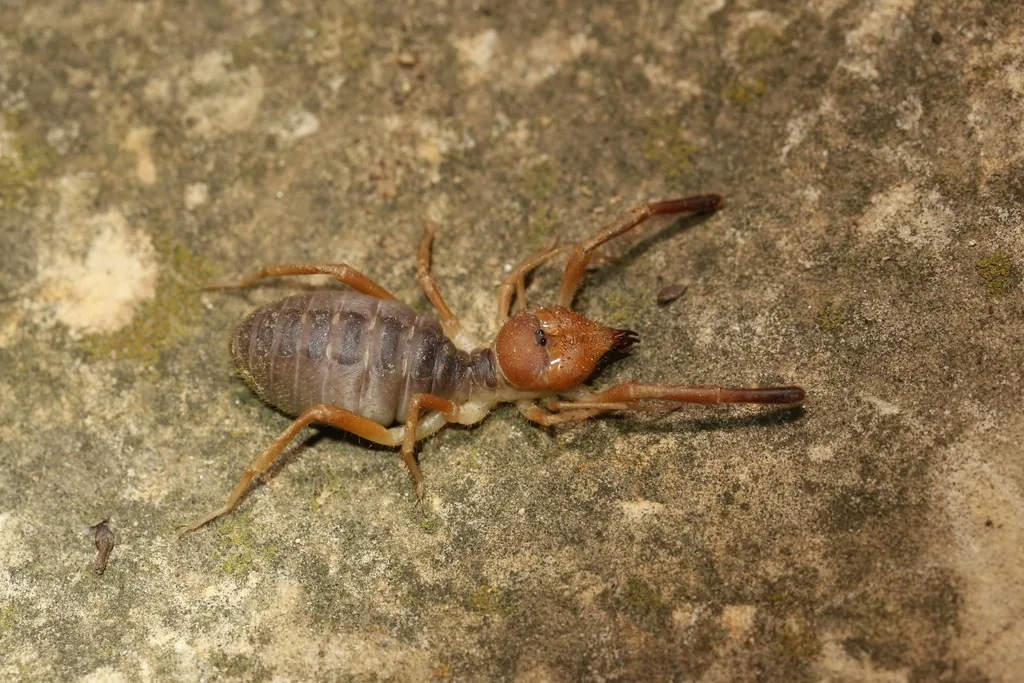
How to identify it
- The head end carries enormous jaws (chelicerae) that project forward and work up and down like pliers, giving the head a very distinctive shape.[2][1]
- Most are yellowish to light tan or brown, often with a darker abdomen; North American kinds range from about 3/8 inch to 2 inches long.[2][1]
- Besides eight legs, they have a pair of long, leg-like pedipalps held out in front; they run very fast carrying these raised above the body.[1][2]
- The body is often covered with short hairs and has two distinct parts: a front section with two eyes and the legs, and a 10-segmented abdomen.[1]
- Males usually have slimmer bodies and longer legs than females, which can make them look bigger.[2]
Look-alikes
Where it lives
More than 120 species have been described in North America, and the southwestern United States alone has over 50.[1]
Biology and life cycle
They hunt mainly at night, chasing down insects, spiders and other arthropods and sometimes even killing a scorpion or centipede.[1]
Sticky tips on the pedipalps catch and hold prey, which is then crushed in the jaws; they suck out body fluids and discard larger pieces.[1]
The windscorpion name comes from how fast they run.[1]
Some come to lights at night; a large Arizona species, Eremocosta striata, was collected at mercury vapor and ultraviolet lights.[3]
Damage and signs
- They cause no damage. Outdoors they are effective predators and are considered beneficial.[1]
Health risk
None are known to have venom. Despite their fierce look and speed, these insect hunters are considered beneficial rather than dangerous.[1]
Control
Prevention
They can ride in on firewood and other items stored outdoors or in sheds, so check those before bringing them in.[1]
Keep them out
Check caulking and weather stripping around windows and doors and seal where utility lines enter; this also blocks scorpions, centipedes, mice and kissing bugs.[1]
Sanitation
If they keep showing up inside, look for an indoor insect problem, such as crickets, that is feeding them.[1]
Traps and physical control
A sun spider indoors is usually hunting insects or trying to get back outside; cover it with a jar or glass, slide paper underneath, and release it outdoors.[1]
Pesticides
University of Arizona Extension does not recommend pesticides for managing solpugids, or for scorpions and centipedes.[1]
Common questions
- Are camel spiders venomous?
- No. Camel spider is another name for solpugids, and none are known to have venom.[1]
- Are sun spiders real spiders?
- No. They are arachnids in their own order, Solifugae, recognized by their huge forward-pointing jaws.[2][4]
- Why is there a sun spider in my house?
- It is either chasing insect prey such as crickets indoors or looking for a way back outside; some also come in with firewood.[1]
Sources
- University of Arizona Cooperative Extension, “Solpugids (Backyard Gardener, August 7, 2013, Jeff Schalau, Yavapai County).” extension.arizona.edu/sites/extension.arizona.edu/files/attachment/Solpugids_0.pdf (accessed 2026-10-06)
- Texas A&M AgriLife Extension, “Solifugae (Windscorpions) (Field Guide to Common Texas Insects).” texasinsects.tamu.edu/solifugae/ (accessed 2026-10-06)
- Texas A&M AgriLife Extension Service, “Order Solifugae (Windscorpions): Eremocosta striata, male (Extension Entomology image record, January 26, 2019).” elp.tamu.edu/ipm/bugs/windscorpions/05-class-arachnida-solifugae-eremobatidae-eremocosta-striata-windscorpions-male-tarsus-of-fourth-pair-of-legs/ (accessed 2026-10-06)
- iNaturalist, “Eremobates taxon page (order and family).” www.inaturalist.org/taxa/82055 (accessed 2026-10-06)