How to identify it
- Most sweat bees are small, about 0.1 to 0.4 inch long, and slender.[2][1]
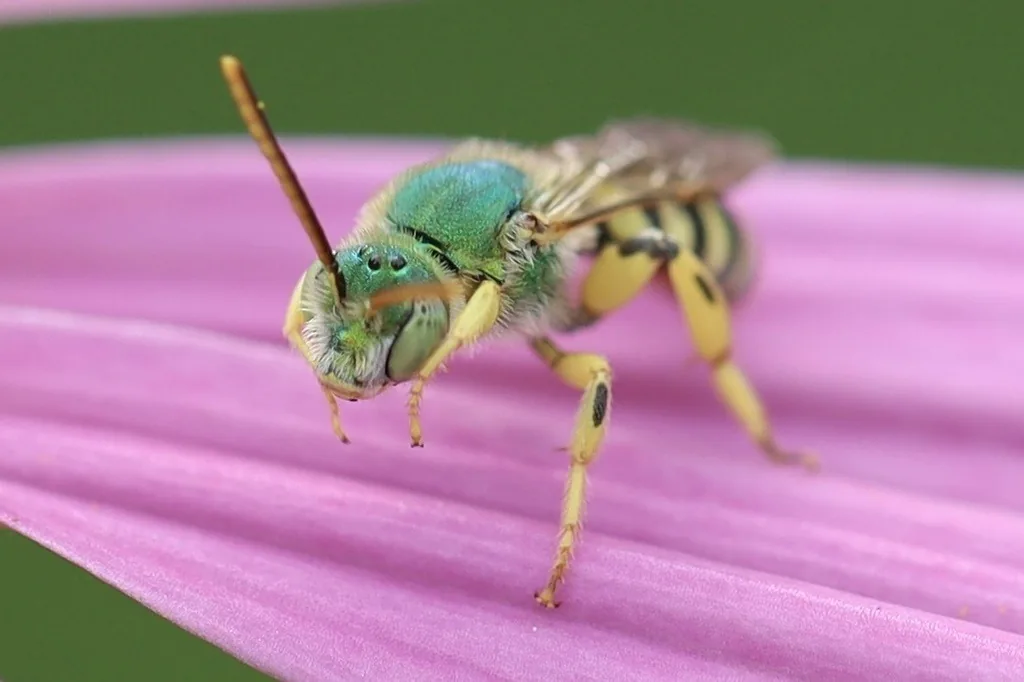
- Many are dull to metallic black, while others are bright metallic green, blue or purple; some have bands like a honey bee.[1][3]
- Agapostemon species usually have a bright metallic green head and thorax with a black-and-yellow striped abdomen.[2]
- Females carry pollen on the hairs of their hind legs; males are often slimmer and may have yellow markings on the face, abdomen or legs.[1][2]
- Up close, a strongly curved vein near the base of the wing separates sweat bees from other bee families.[1]
Look-alikes
| Look-alike | How to tell them apart |
|---|---|
| Cuckoo wasps | Also small and metallic blue or green, but their bodies are covered with tiny pits that give a pebbly look, and they can roll into a ball for defense.[3] |
Where it lives
Found worldwide and especially common in temperate regions. About 500 species live in North America, and many are common throughout the eastern U.S.[1][2][3]
Biology and life cycle
Most sweat bees nest in the ground, often in bare, loose or sandy soil in sunny spots; a few nest in rotting wood.[1][2][3]
Halictus and Lasioglossum species are attracted to human sweat, which they drink for its salt.[2][3]
Behavior ranges from solitary to social; social colonies usually last one year and start with a single queen in spring.[1][3]
Females stock each underground cell with a ball of pollen and nectar and lay one egg on it.[1][2]
Some sweat bees can buzz-pollinate, vibrating flowers to shake loose pollen, something honey bees can't do.[3]
Damage and signs
Health risk
Sweat bees are not aggressive. A bee drinking your sweat usually leaves after a gentle brush, but pressing on a female may cause a mild sting.[3]
Control
Prevention
No chemical control is recommended for these beneficial bees; avoid regular use of broad-spectrum insecticides so native pollinators can thrive.[2][1][3]
Traps and physical control
Gently brush or scrape a sweat bee off your skin instead of swatting or pressing it, which is what triggers a sting.[3]
Common questions
- Why do sweat bees land on me?
- They are after the moisture and salt in your perspiration, much like deer at a salt lick.[3][2]
- Do sweat bees sting?
- Females can, but they are not aggressive and usually sting only when pressed against the skin. Their sting is mild.[3]
- Should I get rid of sweat bees in my yard?
- Usually not. They pollinate wildflowers, fruits, alfalfa and sunflowers, and leaving some bare, sunny soil and using fewer insecticides helps them.[1][3][2]
Sources
- University of Florida IFAS Extension, Featured Creatures, “Sweat Bees, Halictid Bees, Halictidae (IN897).” edis.ifas.ufl.edu/publication/IN897 (accessed 2026-10-06)
- Washington State University Extension, “Halictidae: Alkali Bees, Sweat Bees and Cuckoo Bees (HortSense, reviewed May 15, 2026).” hortsense.cahnrs.wsu.edu/fact-sheet/halictidae-alkali-bees-sweat-bees-and-cuckoo-bees/ (accessed 2026-10-06)
- Missouri Department of Conservation, “Halictid Bees (Sweat Bees), Field Guide.” mdc.mo.gov/discover-nature/field-guide/halictid-bees-sweat-bees (accessed 2026-10-06)
- iNaturalist, “Halictidae taxon page (order and family).” www.inaturalist.org/taxa/49707 (accessed 2026-10-06)