How to identify it
- Most adults are 1/8 to 1/2 inch long; many are blackish to gray, and some mimic bees or wasps.[1]
- Abundant bristles cover the head and body, and many species look somewhat like house flies.[1][2]
- Eggs are oval and white; on some hosts you can see them glued to the head or back.[1][2]
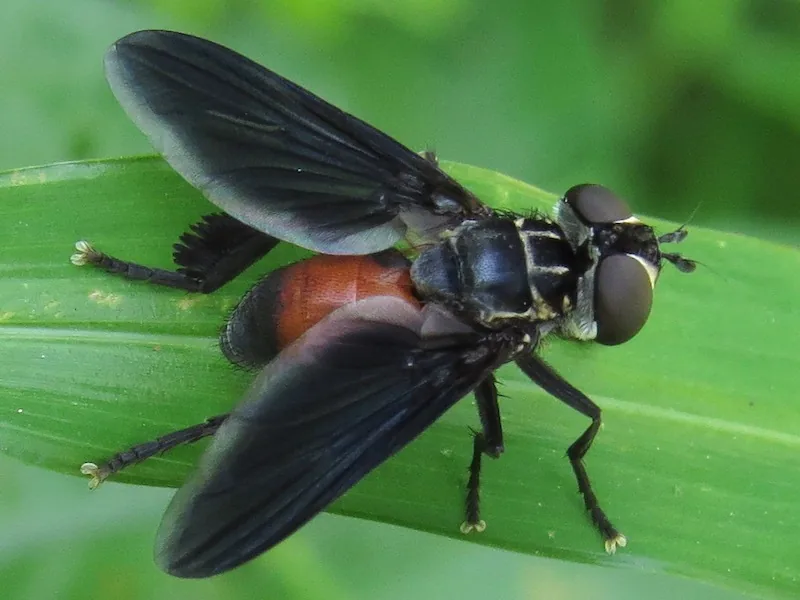
- Trichopoda pennipes, a parasite of squash bugs and stink bugs, is house-fly sized with an orange abdomen, velvety black head and thorax, and a fringe of hairs on the hind legs.[3]
- Mature larvae often leave the host and form an oblong, dark reddish to blackish pupal case nearby.[1]
Look-alikes
Where it lives
More than 1,300 species live in North America, and adults turn up in almost every habitat, resting on foliage, visiting flowers or searching for hosts.[2]
Biology and life cycle
Depending on species, females glue eggs onto a host, insert them into it, or lay them on leaves the host later eats.[1][2]
Larvae feed first on nonessential tissue, so the host lives normally for a while before it dies.[2]
Most tachinids overwinter as mature larvae inside a host, and many have several generations a year.[1]
Adults feed on nectar and on honeydew from aphids and scale insects.[2]
Trichopoda can parasitize up to 80% of squash bugs, though parasitized bugs keep feeding and laying eggs for a time.[3]
Damage and signs
Health risk
Tachinid flies do not harm people or plants.[4]
Control
Prevention
No control is needed; tachinids are important natural enemies of many major pests.[2][1]
Biological control
Many tachinid species have been introduced into North America to suppress pests that arrived from elsewhere.[2]
Common questions
- What are the small white dots on this caterpillar or squash bug?
- They may be tachinid eggs; several species glue conspicuous white eggs to the head or body of their host.[2][1]
- Why don't butterfly gardeners like them?
- Because tachinids parasitize caterpillars, people raising butterflies may not appreciate them.[2]
Sources
- University of California Statewide IPM Program, “Tachinid Flies (Natural Enemies Gallery).” ipm.ucanr.edu/natural-enemies/tachinid-flies/ (accessed 2026-10-06)
- University of Wisconsin-Madison Extension, “Tachinid Flies.” hort.extension.wisc.edu/articles/tachinid-flies/ (accessed 2026-10-06)
- Cornell University College of Agriculture and Life Sciences, “Biological Control: A Guide to Natural Enemies in North America: Trichopoda pennipes (Feather-legged Fly).” biocontrol.entomology.cornell.edu/parasitoids/trichopoda.php (accessed 2026-10-06)
- University of Florida/IFAS Entomology and Nematology Department, “Mole cricket glossary: Tachinid flies.” entnemdept.ufl.edu/molecrickets/mcri002e.htm (accessed 2026-10-06)
- iNaturalist, “Trichopoda pennipes taxon page (order and family).” www.inaturalist.org/taxa/133764 (accessed 2026-10-06)