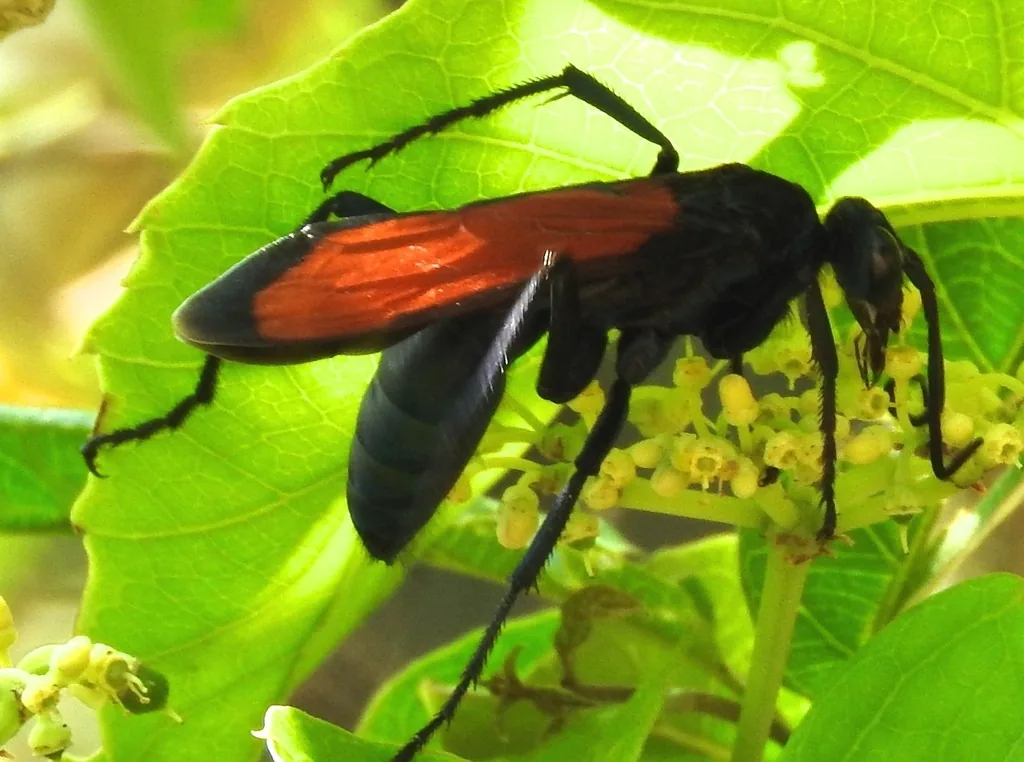
How to identify it
- These are big wasps, about 1/2 inch to 2 inches long; Pepsis thisbe, a common western species, reaches about 2 inches.[1][2]
- The body is metallic blue or black with an iridescent sheen, and the wings are bright orange to yellow, making them hard to miss.[1][2]
- They have long legs; males have straight antennae, while females' antennae are curled.[2][1]
Look-alikes
| Look-alike | How to tell them apart |
|---|---|
| Hemipepsis tarantula hawks | Hemipepsis ustulata is also called a tarantula hawk and has a black body and orange-brown wings with black tips; colors vary, so separating species takes a technical key.[1] |
Where it lives
Pepsis tarantula hawks occur throughout North and South America; in the United States they're mainly found in southwestern deserts and scrublands, such as southern Colorado and the Grand Canyon.[1][2]
Biology and life cycle
A female stings a tarantula, or sometimes another large spider such as a trapdoor or wolf spider, to paralyze it, then drags it to a burrow and lays a single egg on it.[1][2]
The larva feeds on the still-living spider for weeks, avoiding vital organs until late, then spins a cocoon and becomes an adult in two to three weeks.[1][2]
Adults drink nectar from flowers such as milkweed, mesquite and soapberry, and they are among the main pollinators of milkweed.[1][3]
Their venom, strong odor and hard body leave them with few predators; roadrunners are one of the few animals that eat them.[1][2][3]
Adult females live about 40 to 50 days.[1]
Damage and signs
- They generally don't harm homes or crops, though they have been seen feeding on grapes in California.[1]
Health risk
Only females can sting, using a stinger about 1/4 inch long. The sting is extremely painful, but the wasps are docile and sting only when strongly provoked.[2][1][3]
Control
Prevention
Colorado State recommends no control measures, and intervention usually isn't needed; leave them alone and don't handle them.[1][2]
Common questions
- Are tarantula hawks dangerous to people?
- Their sting is one of the most painful of any insect, but they are docile toward people and require extreme provocation before stinging.[1]
- Can a male tarantula hawk sting?
- No. Males have no stinger; only females sting, and they use it mainly to paralyze tarantulas.[2][3]
- Why are tarantula hawks all over my milkweed?
- Adults feed on flower nectar and pollen, and milkweed is a favorite; they are important milkweed pollinators.[1][3]
Sources
- Colorado State University Extension, “Tarantula Hawks of Colorado.” extension.colostate.edu/resource/tarantula-hawks-of-colorado/ (accessed 2026-10-06)
- U.S. National Park Service, “Tarantula Hawk (Grand Canyon National Park, last updated September 22, 2020).” home.nps.gov/grca/learn/nature/tarantula-hawk.htm (accessed 2026-10-06)
- University of California Cooperative Extension, Central Sierra, “What Is That Huge Thing on the Milkweed? (aka Tarantula Hawk Wasp), by Master Gardener Rebecca Miller-Cripps.” www.ccfruitandnuts.ucanr.edu/sites/default/files/2024-09/402196.pdf (accessed 2026-10-06)
- iNaturalist, “Pepsis thisbe taxon page (order and family).” www.inaturalist.org/taxa/53995 (accessed 2026-10-06)