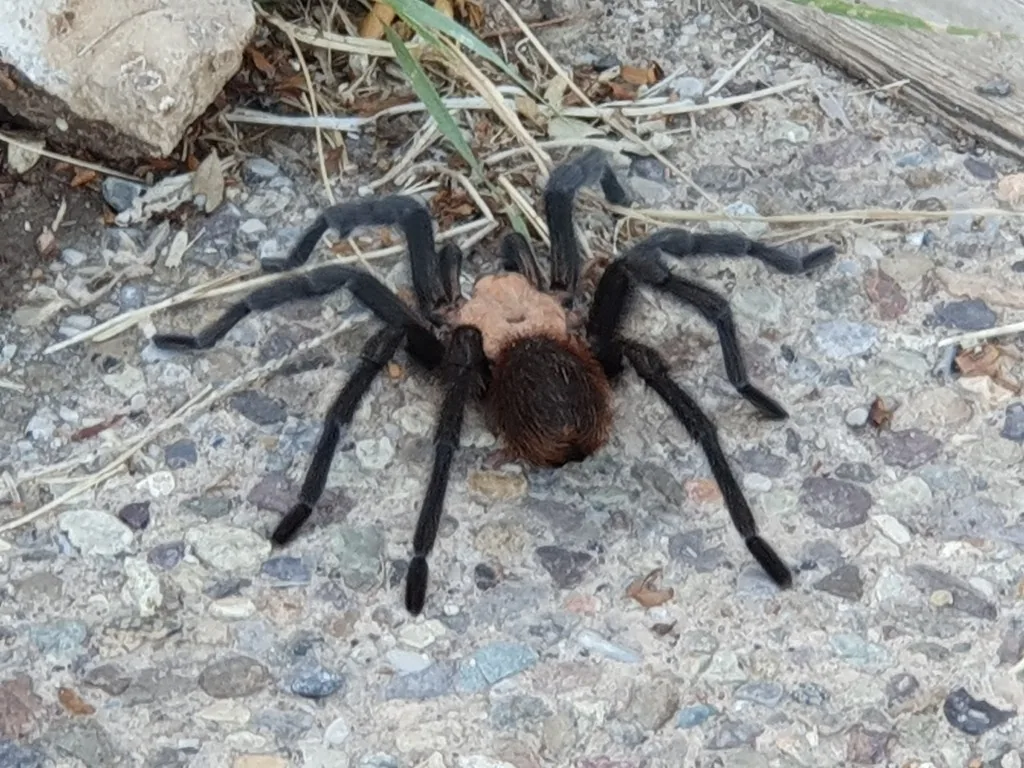
How to identify it
- Native tarantulas have a body about 1 1/2 inches long in Texas, and California species range from 1 to 2 inches.[1][3]
- The head region and legs are typically dark brown and the abdomen brownish black, though color varies and changes after a molt.[1]
- The whole body and legs are densely hairy.[2][3]
- Telling species apart is hard and requires mature males, a microscope and expert literature.[1]
Look-alikes
| Look-alike | How to tell them apart |
|---|---|
| Wolf spiders | Wolf spiders are hunting spiders with a distinctive eye pattern: four small eyes in a straight row in front, a larger middle pair, and a widely spaced rear pair; their eyes shine green in a flashlight beam.[3] |
Where it lives
Tarantulas live on every continent except Antarctica; in the U.S. they are common throughout Texas in grasslands and semi-open areas, and California has its own native species.[2][1][3]
Biology and life cycle
They live in burrows, often in well-drained soil, or use cavities under logs and stones, loose bark and old rodent burrows, lining shelters with silk.[1][2]
Tarantulas usually wait at the burrow entrance at night for passing prey such as crickets, beetles, grasshoppers, cicadas and caterpillars.[1][3][2]
Females lay 100 to 1,000 eggs in a hammock-like silk sac that they guard in the burrow; eggs hatch in 45 to 60 days.[1]
Females have lived over 25 years in captivity, but Texas males rarely live more than two or three months after maturing.[1]
For a few weeks each summer, mature males wander widely, apparently searching for females, which is when most people see them.[1][2][3]
Each tarantula lives alone, one to a burrow.[2]
Damage and signs
Health risk
Bites of native species are usually no worse than a bee sting. When threatened, tarantulas flick hairs off the abdomen that cause itching and rash on skin and irritation of the eyes and mucous membranes.[3][2][1][4]
Control
Prevention
Texas A&M AgriLife advises that tarantulas are not pests and don't warrant control, so leave outdoor tarantulas alone.[2]
Keep them out
Keep tarantulas outdoors by sealing the home; caulk foundation cracks, close gaps around doors and windows, and keep screens in good repair.[2][3]
Traps and physical control
A wanderer indoors can be caught under a jar, with a sheet of paper slid underneath, and released outside.[3]
If you are bitten or touched by the hairs
Clean a bite with soap and water and watch for infection, and make sure your tetanus vaccination is up to date.[4]
Remove irritating hairs from the skin with tape.[4]
For advice, call Poison Help at 1-800-222-1222, and see a doctor for any unusual or severe reaction.[4][3]
Common questions
- Are tarantulas dangerous?
- Native tarantulas can bite if provoked, but their venom doesn't affect people the way widow or recluse venom does; a bite is comparable to a bee sting.[2][3][4]
- Why are tarantulas crossing the road in summer?
- These are mostly mature males out searching for females, not a true migration.[2][1]
- Should I kill a tarantula in my yard?
- No need. They prey on insects and Texas A&M AgriLife says they don't warrant control; just keep them out of the house.[2][1]
Sources
- Texas A&M AgriLife Extension, “Tarantula, Aphonopelma sp. (Field Guide to Common Texas Insects).” texasinsects.tamu.edu/tarantula/ (accessed 2026-10-06)
- Texas A&M AgriLife Extension, Travis County, “Texas Tarantulas Use Hair As Defense (Wizzie Brown, October 25, 2023).” travis-tx.tamu.edu/2023/10/25/texas-tarantulas-by-wizzie-brown/ (accessed 2026-10-06)
- University of California Statewide IPM Program, “Spiders (Pest Notes, Home and Landscape).” ipm.ucanr.edu/home-and-landscape/spiders/ (accessed 2026-10-06)
- Arizona Poison and Drug Information Center (University of Arizona), “Bees, Spiders & Other Bugs.” azpoison.com/venom/bees-spiders-other-bugs (accessed 2026-10-06)
- iNaturalist, “Aphonopelma hentzi taxon page (order and family).” www.inaturalist.org/taxa/120596 (accessed 2026-10-06)