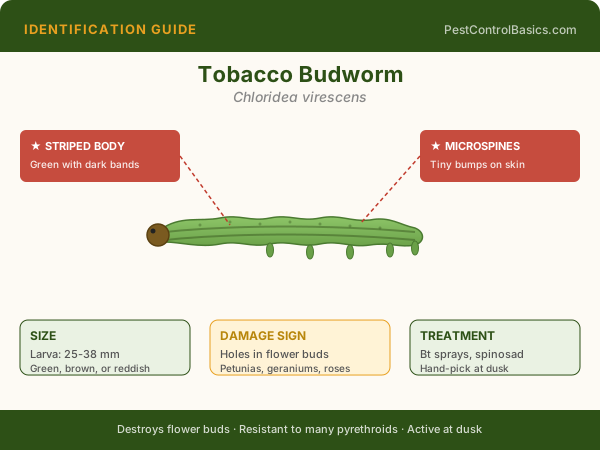
❓ Common Questions About 🐛 Corn Earworm / Tobacco Budworm
How do I confirm I actually have this pest (not something similar)?
The most reliable confirmation is a physical specimen — capture one and compare to reference images on this page. For cryptic pests (bed bugs, termites), look for secondary signs: frass, shed skins, mud tubes, or bites with a specific pattern. When uncertain, a professional inspection is faster than months of misidentification.
Can I treat this myself or do I need a professional?
DIY is effective for small, accessible infestations caught early. Professionals are worth the cost when: the infestation is inside wall voids or structural elements, multiple rooms are affected, you have health-risk pests (hantavirus, venomous species), or DIY has already failed twice.
How long until the infestation is completely gone?
Expect 3–8 weeks for most infestations with proper treatment. Insects with dormant life stages (pupae, eggs) extend the timeline because those stages are impervious to most insecticides. Follow-up treatments at 2 and 4 weeks catch each new cohort as they emerge.
What's the most common mistake people make treating this pest?
Treating only the visible pest population while ignoring the harborage site, entry point, or breeding location. Killing adults provides temporary relief but the population rebuilds from hidden egg cases, pupae, or new arrivals through unaddressed entry points.
How content is reviewed and updated
Content on this site is reviewed by Derek Giordano, a former pest control company owner and previously licensed Pest Control Operator in Florida with several years of field experience servicing thousands of regular customers. Reviews check treatment recommendations against current EPA-registered products and label use directions, cross-reference major treatment claims against university extension publications and CDC public health guidance, and verify that any product mentions reflect current registration status and reasonable consumer availability. Pages get updated as treatment recommendations evolve — pesticide products are deregistered, resistance patterns shift, regional pest distributions change. The 'Updated' date at the bottom of each page reflects the most recent review pass on that specific page; the site-wide approach to E-E-A-T (experience, expertise, authoritativeness, trustworthiness) follows Google's published guidance on health and safety topics.
How professional pest control programs differ from one-off treatments
A single treatment — DIY or professional — addresses what's visible today, but most pest pressure is cyclical. Professional pest control programs that work long-term are structured around inspection, monitoring, treatment, and follow-up as a recurring cycle rather than discrete events. The inspection phase identifies conducive conditions (moisture, harborage, food access, exclusion gaps) that one-time treatments don't address. The monitoring phase uses sticky traps, bait stations, or visual sweeps to catch population rebounds early, before they become visible infestations again. The treatment phase targets the specific life stages active during that visit — different than blanket spraying everything. The follow-up phase verifies treatment efficacy and adjusts. Homeowners can replicate this structure on a quarterly or seasonal schedule without buying expensive equipment, and the underlying logic — track, treat targeted, verify — produces consistently better results than reactive treatment after problems become obvious.
Sources used across this site
Editorial sources used consistently across this site: the EPA pesticide registration database for current product use directions and active ingredient information; CDC for public health context on pest-borne disease; the National Pesticide Information Center (NPIC) for homeowner pesticide questions; university Cooperative Extension publications (UC IPM, NC State Extension, Penn State Extension, University of Florida IFAS, and others) for region-specific identification and treatment guidance; the National Pest Management Association (NPMA) for industry context; and peer-reviewed entomological literature for biology, resistance management, and emerging issues. Product reviews reflect editorial testing and aggregated user-reported outcomes rather than manufacturer-supplied claims. Where regional information matters, we link to state and local extension publications rather than generalizing across regions.
How to use this guide effectively
This guide is one entry point in a connected library. Each pest profile, treatment guide, and tool on this site links to related references that go deeper than any single page can. Working through a pest problem effectively usually means starting with identification (so you know what you're treating), reading the species-specific treatment guide, checking the product or tool references for specific selection guidance, and confirming approach with the FAQ and troubleshooting sections. Bookmarking a few core references — the species profile, the relevant treatment guide, and one tool that supports the decision-making (product selector, cost estimator, treatment schedule) — gives you a workflow you can return to as the situation evolves. The structure is intentional: surface-level summary first, then increasing depth, with the deepest detail in the dedicated tool and reference pages.
Working with extension services and public resources
Every state has a Cooperative Extension Service — a university-affiliated public outreach program — and most homeowners don't know it exists. Extension publishes pest fact sheets specific to local conditions, offers free pest identification (often by photo submission), and runs Master Gardener volunteer programs that handle public inquiries. State departments of agriculture license and regulate pest control operators; their websites verify licenses and accept complaints. State and local health departments track vector-borne diseases and publish risk data that's more current than national averages. The EPA's pesticide product database lets you look up registered uses for any product before buying. The National Pesticide Information Center (1-800-858-7378) answers homeowner pesticide questions free of charge. These resources are paid for by taxes already; underusing them in favor of paid services is leaving money on the table.
Integrated pest management for households: the practical hierarchy
Integrated pest management (IPM) is a structured approach to pest control developed for agricultural and commercial settings that translates well to residential use. The hierarchy: prevention first (sanitation, exclusion, habitat modification to make conditions unfavorable for pests), monitoring second (sticky monitors, visual inspection, identifying pests at low population before infestation establishes), targeted intervention third (using the least disruptive effective method against an identified pest in an identified location), and broad chemical treatment last (when targeted approaches have failed or aren't feasible). The hierarchy matters because higher-level interventions are durable and address root causes, while lower-level chemical interventions address symptoms and require repeat application. Most residential pest control reverses this hierarchy — chemical treatment first, sometimes prevention later — and produces the predictable consequence of recurring problems. Households that adopt the IPM hierarchy (often without using the term) generally describe spending less time and money on pest issues over years even though specific incidents might take more thought to address than spray-and-forget approaches.
Why most pest 'sightings' aren't what people think they are
Species misidentification is the single most common reason that DIY pest treatment fails or that homeowners describe products as not working. The patterns are consistent: bed bug bites are routinely attributed to mosquitoes, fleas, or unknown causes; carpet beetle larvae are mistaken for bed bug nymphs; small black ants are called 'sugar ants' regardless of actual species; carpenter ants and termites are confused despite very different treatments; bat bugs are treated as bed bugs (the treatment may work, but the actual problem is overhead). Even when identification is correct at the family level, species within a family often require different approaches — German vs. American cockroaches, subterranean vs. drywood termites, or pavement vs. carpenter ants are practical examples. The first hour of any pest problem should go to identification, not treatment: photograph specimens with a coin for scale, send images to a local cooperative extension office (most respond within a day or two), or post to one of the moderated identification forums where entomologists answer. Correct identification narrows treatment options to those that actually work and discards the larger pile that don't.
The role of local cooperative extension in pest decisions
State cooperative extension services — university-based educational and advisory programs in every state — are dramatically underused resources for residential pest decisions. Most state extensions employ entomologists who answer homeowner questions free of charge through county offices, online query forms, or scheduled call hours. The information available is specific to the state's pest pressure, climate, and recommended practices, and is typically much more locally accurate than national resources. Extension publications cover identification, life cycle, treatment options, and specific product recommendations for state conditions; the publications are peer-reviewed by university scientists and updated periodically based on current research. For any pest situation where identification is uncertain or treatment options are unclear, a clear photograph submitted to the state extension produces an identification, a brief biological explanation, and one or more treatment options within typically a few days. The benefit beyond any single inquiry is building familiarity with the local resource — extension contacts become a reference for future situations and produce better decisions than aggregated online advice.
Understanding pest forecast reports and what they signal
Pest forecast reports — issued by some state agricultural agencies, cooperative extension services, and commercial pest control companies — are an underutilized resource for homeowners who want to anticipate rather than react to seasonal pest activity. These reports typically combine historical pest data, current weather conditions, and growing degree day calculations to predict when specific pests will emerge or peak in specific regions. A tick forecast for an upcoming spring season, a mosquito pressure forecast after a wet winter, a termite swarm prediction for a specific week in the Southeast — these aren't speculation but reasonably calibrated predictions based on biological timing. For homeowners, the value is in scheduling preventive treatment and personal protection to match the predicted high-pressure windows rather than reacting after problems have established. Subscribing to a regional pest newsletter from a cooperative extension service or state agriculture department is free or low cost and produces these forecasts during relevant seasons. The information is dramatically more actionable than generic pest control content because it's calibrated to your specific region and current conditions.
The economics of preventive versus reactive treatment
Preventive treatment costs money in a year when nothing is happening, which is precisely why most households avoid it. The decision to spend on prevention requires a willingness to compare what you actually spend against a counterfactual you never directly observe — the infestations you would have had without it. This is a hard mental move, and it's why preventive pest control consistently underconsumed relative to its economic value. The way to think about it more clearly is to compute the expected annual cost of treatment for a property like yours given local pest pressure, then compare that against the cost of a preventive program. In most regions and for most property types, a preventive program comes in lower in expected value, sometimes substantially. The variance is also lower: instead of a year with zero pest spending followed by a year with a large unexpected expense, you have a small consistent line item that smooths out the cash flow. For households where unexpected expenses are particularly painful, that variance reduction is itself worth something even before counting the expected-value benefit.
Pest control and HOA dynamics: where they overlap
Homeowners' associations vary widely in how they engage with pest control, and the variations create practical issues that affect individual treatment decisions. Some HOAs maintain common-area pest treatment programs that handle perimeter spraying, mosquito treatment, or rodent monitoring on shared property; others leave all pest control to individual homeowners. Some have rules about treatment products or notification requirements; others don't. Some include treatment in the HOA fee structure; others bill separately. For homeowners in HOA communities dealing with persistent pest pressure, understanding what the HOA does and doesn't do is the first step in figuring out what additional individual action is needed. For HOAs without coordinated programs in areas with significant pressure, organizing a neighborhood-level treatment plan often produces dramatically better results than individual treatment efforts that don't coordinate timing or coverage. The conversations are sometimes politically awkward in HOA contexts, but the underlying problem — that some pests are neighborhood-scale and unit-level treatment can't address them — is structural rather than personal. Bringing the issue to an HOA meeting with concrete proposals tends to produce more constructive responses than complaint-style framing.