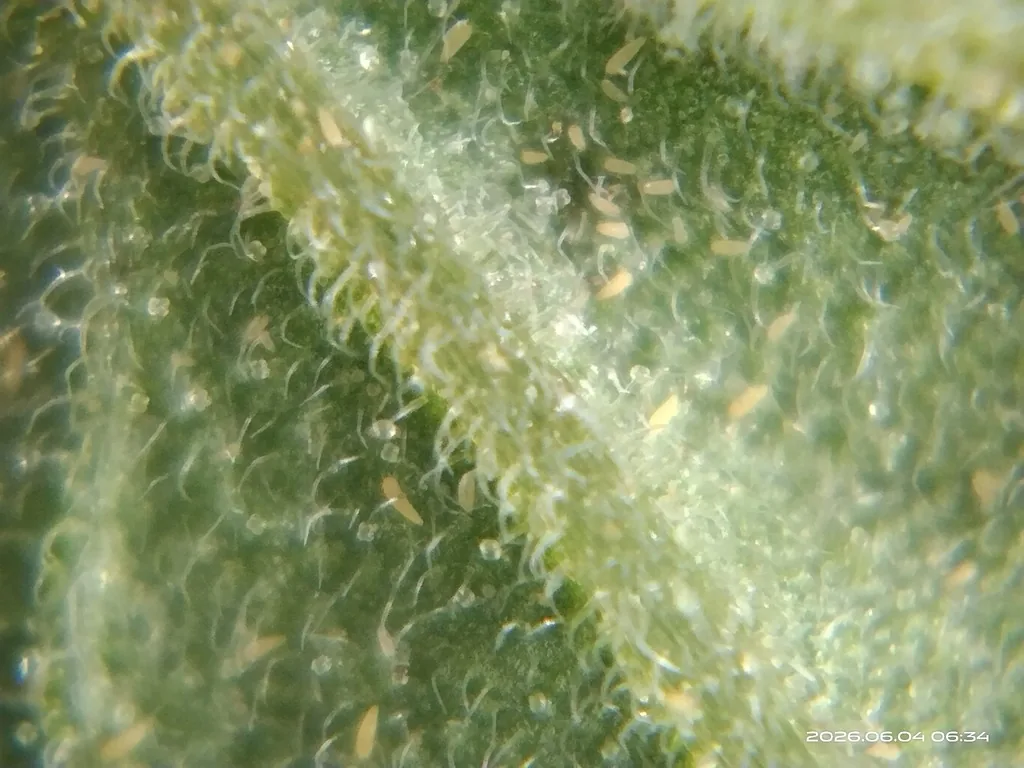
How to identify it
- The mites are cigar- or cone-shaped and yellowish tan to pink, and need a 14x hand lens or microscope to see.[1][2]
- The first sign is bronzing on lower leaves and stems; the mites are found on the damaged leaves and the green leaves just above them.[1][2]
- Damaged leaves may yellow, curl, wither and drop, and fruit can show long cracks and bronzing.[1]
Where it lives
Utah State and UC IPM both cover it on tomatoes; Utah State notes it is mainly a concern in hot, dry conditions.[1][2]
Biology and life cycle
It has multiple overlapping generations a year and overwinters as adults in crop debris.[1]
Infestations usually start near the ground and progress up the plant.[2]
Damage and signs
Health risk
Control
Sanitation
Remove or destroy infested plant debris promptly, clean tools after working on infested plants, and avoid planting during hot, dry periods.[1]
Where it recurs, remove alternate hosts such as nightshades and morning glory.[2]
Pesticides
Once mites are present, sulfur or abamectin is the main option; sulfur should not be applied above 90°F or near an oil application.[1][2]
Common questions
- Why are my tomato stems turning bronze from the bottom up?
- Tomato russet mites cause greasy bronze stems and lower leaves that progress up the plant.[1][2]
- Can I see tomato russet mites?
- Not with the naked eye; you need a 14x hand lens or a microscope.[2][1]
- How do I control tomato russet mite?
- Sulfur or abamectin once mites are present, plus prompt cleanup of infested plants.[1][2]
Sources
- Utah State University Extension, “Tomato Russet Mite.” extension.usu.edu/planthealth/ipm/notes_ag/veg-tomato-russet-mite.php (accessed 2026-10-15)
- University of California Statewide IPM Program, “Tomato Russet Mite (Pest Management Guidelines: Tomato).” ipm.ucanr.edu/agriculture/tomato/tomato-russet-mite/ (accessed 2026-10-15)
- iNaturalist, “Aculops lycopersici taxon page (order and family).” www.inaturalist.org/taxa/262808 (accessed 2026-10-06)