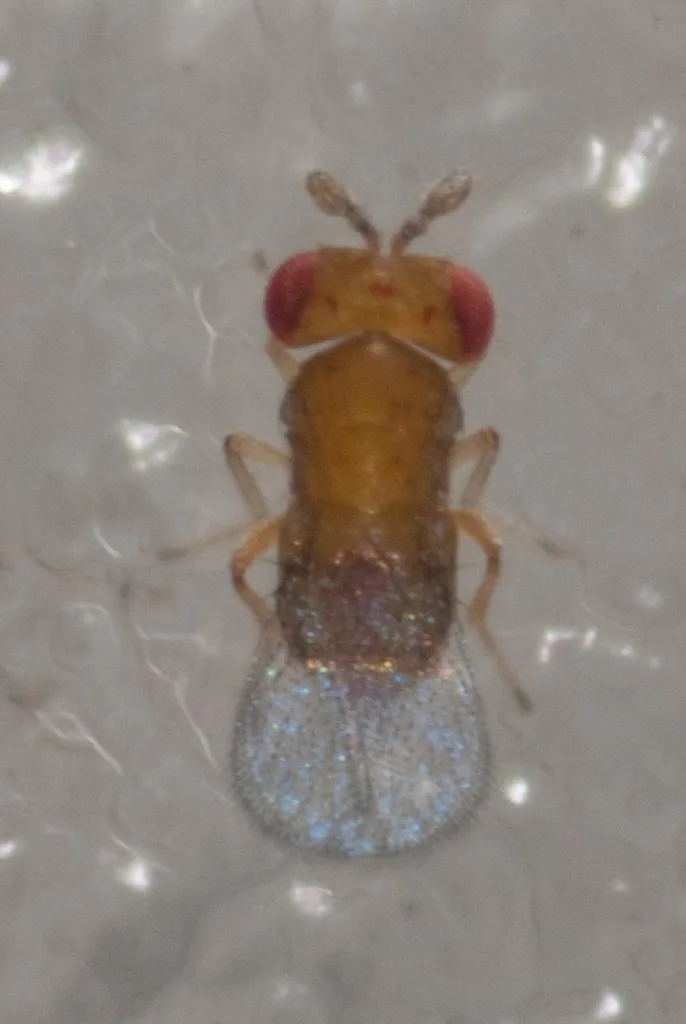
How to identify it
- Adults are orange to yellowish brown and only 1/100 to 1/25 inch (0.25 to 1 mm) long, with red eyes and clear, hair-fringed wings.[1][2]
- Parasitized host eggs darken; eggs attacked by Trichogramma turn solid black after about four days.[1][2]
- An emerging wasp leaves a round hole and dark specks inside the shell, while a hatched caterpillar leaves a ragged hole in an empty, pale shell.[1]
- Species are hard to tell apart because they are so small and similar.[1]
Where it lives
They occur naturally in field and tree crops, gardens, landscapes and wildlands wherever their host eggs are found.[1]
Biology and life cycle
A female lays one or more eggs inside a freshly laid host egg, and the wasp larvae eat the developing embryo.[1][2]
Each female can parasitize about 100 host eggs and kills more by puncturing and feeding on them.[1]
Egg to adult takes about 7 to 14 days in the growing season, so they often have more generations than their hosts.[1]
They overwinter as mature larvae inside host eggs and stay active all year in mild climates when hosts are present.[1]
In one study, T. ostriniae females given honey lived about 14 days and produced 86 offspring, against 2.7 days and 22 offspring without food.[2]
Damage and signs
- They don't feed on plants; their hosts are the eggs of various insects, especially moths.[1]
Health risk
Parasitoid wasps, including tiny egg parasites like Trichogramma, do not sting people.[3][1]
Control
Prevention
Parasitoid wasps are very sensitive to insecticides, so avoid or limit chemical sprays where they're working.[3]
Biological control
Trichogramma are sold as immatures inside moth eggs glued to small cards that you hang on infested plants.[1]
Successful mass releases include T. platneri against codling moth in walnuts, tomato fruitworm in tomatoes and amorbia in avocado.[1]
Nectar-bearing flowers may improve releases, because fed females live longer and produce more offspring.[2]
Common questions
- Why are some moth eggs on my plants turning black?
- They've probably been parasitized. Eggs attacked by Trichogramma darken and turn solid black after about four days.[1][2]
- How are Trichogramma released?
- They're shipped as immature wasps inside moth eggs glued to cards, which are hung by hand on infested plants.[1]
- Do they sting?
- No. Parasitoid wasps aren't interested in people and do not sting them.[3]
Sources
- University of California Statewide IPM Program, “Trichogramma Parasitoids (Natural Enemies Gallery).” ipm.ucanr.edu/natural-enemies/trichogramma-parasitoids/ (accessed 2026-10-06)
- Cornell University College of Agriculture and Life Sciences, “Biological Control: A Guide to Natural Enemies in North America: Trichogramma ostriniae.” biocontrol.entomology.cornell.edu/parasitoids/trichogramma.php (accessed 2026-10-06)
- University of Maryland Extension, “Parasitoid wasps.” extension.umd.edu/resource/parasitoid-wasps (accessed 2026-10-06)
- iNaturalist, “Trichogramma taxon page (order and family).” www.inaturalist.org/taxa/250417 (accessed 2026-10-06)