How to identify it
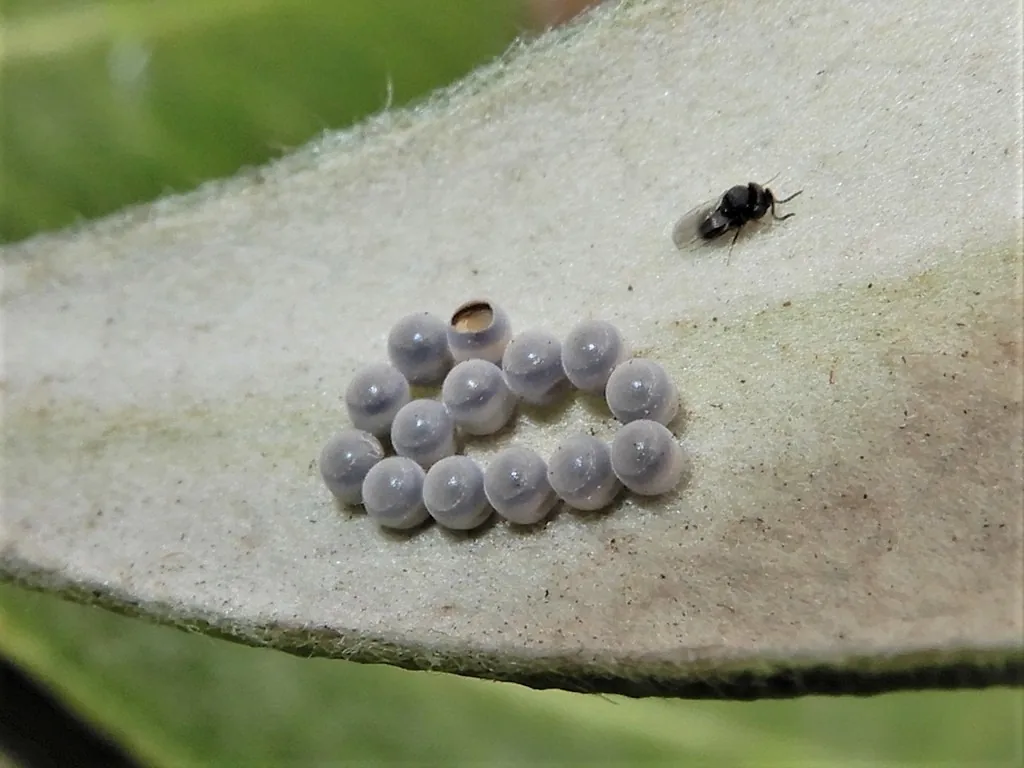
- Adults are mostly black, stout wasps about 1/16 inch (1.5 mm) long, with clear wings, elbowed antennae and a flat-topped abdomen.[1][3]
- Parasitized stink bug eggs darken, and the emerging wasp chews a rough-edged hole.[1][3]
- Hatched stink bug eggs stay pale, with a smooth round opening and the cap often still hinged on.[1]
Look-alikes
| Look-alike | How to tell them apart |
|---|---|
| Hatched stink bug eggs | A stink bug nymph leaves a pale shell with a clean round opening; a wasp leaves a darkened shell with a ragged hole.[1] |
| Anastatus wasps | Another wasp that parasitizes brown marmorated stink bug eggs; the samurai wasp is smaller and wider.[3] |
Where it lives
T. basalis has lived in the southern U.S. for decades, and six Trissolcus species occur in California. The samurai wasp, native to China, Japan and Korea, was first recorded in the western U.S. in Vancouver, Washington, in 2015.[2][1][3]
Biology and life cycle
Adults mate as soon as they emerge, and the female puts one egg in each stink bug egg.[1][2]
A female lays about 200 eggs in a life of about a month, then marks parasitized eggs so others skip them.[1]
Females and males guard parasitized egg masses; adults overwinter in ground litter.[1]
Egg to adult takes two to three weeks in warm weather, with several generations a year.[1]
Damage and signs
Health risk
These are stink bug egg parasites, and parasitoid wasps do not sting people.[4]
Control
Biological control
In California trials, T. basalis parasitized 80 percent of southern green stink bug egg masses examined.[2]
Plant nectar sources such as alyssum, in bloom by early April when the adults become active.[1]
Avoid broad-spectrum, persistent insecticides; T. basalis is not sold commercially in North America.[1][2]
Common questions
- What does the samurai wasp do?
- It lays eggs inside brown marmorated stink bug eggs, and wasps rather than stink bugs emerge.[3]
- How can I tell a parasitized stink bug egg mass?
- Parasitized eggs darken and show rough exit holes; hatched eggs are pale with smooth round openings.[1][3]
- Do these wasps sting?
- No. Parasitoid wasps do not sting people.[4]
Sources
- University of California Statewide IPM Program, “Stink Bug Trissolcus Parasitoids (Natural Enemies Gallery).” ipm.ucanr.edu/natural-enemies/stink-bug-trissolcus-parasitoids/ (accessed 2026-10-06)
- Cornell University College of Agriculture and Life Sciences, “Biological Control: A Guide to Natural Enemies in North America: Trissolcus basalis.” biocontrol.entomology.cornell.edu/parasitoids/trissolcus.php (accessed 2026-10-06)
- Oregon State University Extension Service, “Samurai Wasp: Promising egg parasitoid for management of Brown Marmorated Stink Bug (EM 9164).” extension.oregonstate.edu/sites/default/files/documents/em9164.pdf (accessed 2026-10-06)
- University of Maryland Extension, “Parasitoid wasps.” extension.umd.edu/resource/parasitoid-wasps (accessed 2026-10-06)
- iNaturalist, “Trissolcus taxon page (order and family).” www.inaturalist.org/taxa/250421 (accessed 2026-10-06)