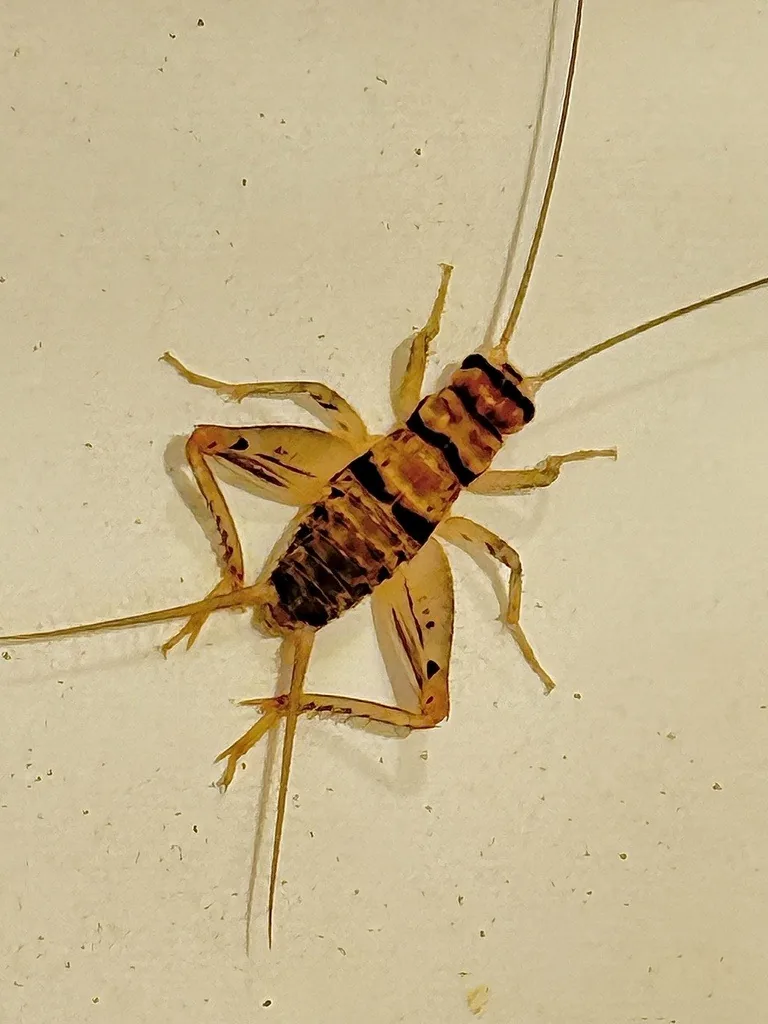
How to identify it
Look-alikes
| Look-alike | How to tell them apart |
|---|---|
| House cricket | Rare long-winged tropical house crickets look like house crickets but have a narrow space between the antennae.[1] |
Where it lives
Probably native to southwestern Asia, it has spread by commerce through the tropics and is common in urban areas.[1]
Biology and life cycle
There's no overwintering stage; generations are continuous, taking two to three months from egg to adult.[1]
Damage and signs
- It comes out at night from cracks between pavement blocks to forage and sing.[1]
Health risk
UF/IFAS says tropical house crickets generally do no harm.[1]
Control
Pesticides
If they're a problem indoors, baits sold for cockroach or earwig control can eliminate them.[1]
Common questions
Sources
- University of Florida IFAS Extension (Featured Creatures), “Tropical House Cricket, Gryllodes sigillatus (EENY-064).” edis.ifas.ufl.edu/publication/IN221 (accessed 2026-10-06)
- iNaturalist, “Gryllodes sigillatus taxon page (order and family).” www.inaturalist.org/taxa/154340 (accessed 2026-10-06)