How to identify it
- Full-grown caterpillars are about 1 1/2 inches long, smooth and hairless, and range from greenish or brownish to nearly black.[1][2]
- Light stripes run the length of the body: three along the back and a pale orange, white-edged stripe on each side.[2][1]
- The head is brown with a dark, honeycomb-like net pattern rather than the pale upside-down Y of the fall armyworm.[2][4]
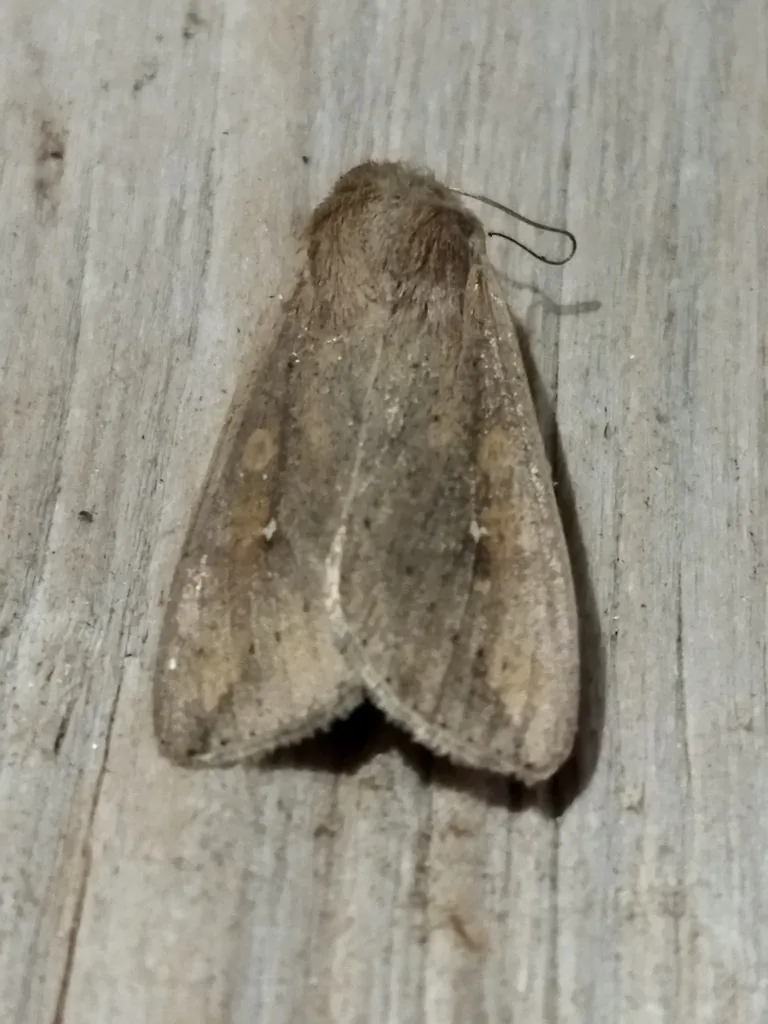
- The moth is tan to light brown, with a wingspan of about 1 1/2 inches and a tiny white dot in the center of each forewing.[1][2]
Look-alikes
| Look-alike | How to tell them apart |
|---|---|
| Fall armyworm | Fall armyworm larvae have a pale inverted Y on a dark head and four dark spots in a square near the rear; the true armyworm head shows a honeycomb pattern instead.[4] |
| Corn earworm | Corn earworm larvae have a plain orange-brown head, while the true armyworm's brown head carries dark honeycomb markings.[4] |
Where it lives
Found across much of North America from southern Canada southward and widespread east of the Rocky Mountains; in colder areas such as Colorado, moths fly in from the south each year to restart populations.[2]
Biology and life cycle
Females lay light green eggs at night on the undersides of grass blades, in rows or clusters, and one female can lay several hundred eggs.[1][2]
In Maine, eggs hatch in about 10 days, larvae feed for three to four weeks, then pupate in the soil and emerge as moths two to three weeks later.[1]
Maine sees up to three generations a year, and the first one, feeding in June, is usually the most destructive.[1]
Larvae feed at night and on cloudy days and hide under debris in bright sun, so infestations can go unnoticed until damage is heavy.[2][1]
Outbreaks are sporadic and hard to predict, and in most years natural enemies keep numbers low.[2][3]
Damage and signs
- Caterpillars chew grass blades; once a patch is eaten down they move together to new grass, and they will feed on other plants when grass runs out.[1][3]
- Small larvae scrape the green surface off leaves, leaving windowpane strips, while the last two larval stages eat about 85 percent of all the foliage consumed.[3]
- Damaged lawn areas look off-color, then turn brown as whole leaves are eaten.[3]
- The same caterpillars strip corn, small grains and hayfields, and young corn plants can be completely defoliated.[2][1]
Health risk
The true armyworm is a plant pest: the moths feed on nectar and the caterpillars eat grasses and other plants, so the concern is damage to lawns and crops.[1][3]
Control
Prevention
Look for caterpillars at the base of grass and in debris when you see ragged or browning patches; they are easiest to find in the evening or on cloudy days.[2][1]
Traps and physical control
Mowing an infested lawn short kills many caterpillars and removes their food; short grass is also less attractive to them.[1]
Biological control
Parasitic wasps and flies, ground beetles, birds, viruses and fungi often keep armyworms in check, so treat only when caterpillars are numerous or damage is spreading.[3][2]
Skip spraying when many caterpillars carry small white tachinid fly eggs behind the head, a sign that parasites are already at work.[2]
Bt (Bacillus thuringiensis kurstaki) products control small armyworms without harming beneficial insects, but residues last only a day or two on turf.[3][1]
Pesticides
Texas A&M lists spinosad as a low-impact choice and bifenthrin, carbaryl and permethrin among conventional lawn options; Maine notes pyrethrins give no residual control.[3][1]
Spray late in the day, since the caterpillars feed at night, and treat while they are small; large larvae on the move are harder to kill and will soon stop feeding.[1][2]
Common questions
- Why did my lawn turn brown almost overnight in early summer?
- Armyworms may be the cause. Their caterpillars feed at night, hide by day, and can eat a patch down before anyone notices them.[1][2]
- Is the true armyworm the same as the fall armyworm?
- No. They are different moths; the fall armyworm has a pale inverted Y on its head, while the true armyworm's head has a honeycomb pattern.[4][3]
- Will Bt kill armyworms?
- Yes, on small larvae. Bt works on young armyworms without harming beneficial insects, but it breaks down on turf within a day or two.[3][1]
Sources
- University of Maine Cooperative Extension, “Armyworms, Mythimna unipuncta (Pest Management Fact Sheet #5040, revised 2025).” extension.umaine.edu/ipm/ipddl/publications/5040e/ (accessed 2026-10-06)
- Colorado State University, Department of Agricultural Biology, “Armyworm, Mythimna unipuncta.” agsci.colostate.edu/agbio/ipm-pests/true-armyworm/ (accessed 2026-10-06)
- Texas A&M AgriLife Extension, Insects in the City, “Armyworms in Turfgrass (ENT-1007).” citybugs.tamu.edu/factsheets/landscape/lawns/ent-1007/ (accessed 2026-10-06)
- University of Kentucky Entomology, “ENTFACT-110: Fall Armyworm in Corn.” entomology.ca.uky.edu/ef110 (accessed 2026-10-06)
- iNaturalist, “Pseudaletia unipuncta taxon page (order and family).” www.inaturalist.org/taxa/1671287 (accessed 2026-10-06)