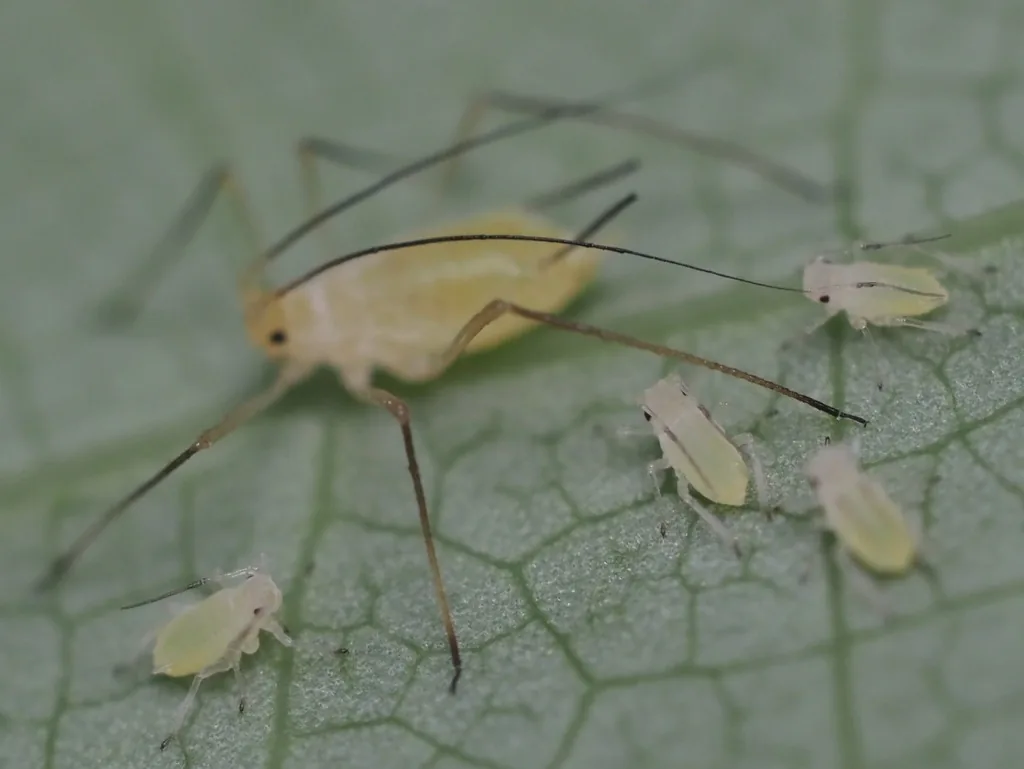
How to identify it
Where it lives
The PNW Insect Management Handbook covers it on tulip trees in Pacific Northwest landscapes.[1]
Biology and life cycle
Adults lay eggs in fall in crevices between buds and branches, where the eggs spend the winter.[1]
Eggs hatch at budbreak, and unmated females give birth to live young; winged adults that can move to new hosts develop in fall.[1]
Damage and signs
Health risk
It feeds on plants; the PNW Insect Management Handbook mentions no risk to people.[1]
Control
Prevention
Start checking for aphids and their natural enemies at budbreak in spring.[1]
Avoid heavy nitrogen fertilizer and heavy watering, which produce the succulent growth aphids favor.[2]
Traps and physical control
Wash aphids off with a strong stream of water where you can reach them.[2]
Biological control
Lady beetles, syrphid fly larvae, green lacewings and parasitoid wasps attack aphids; avoid broad-spectrum sprays that kill them.[2]
Common questions
Sources
- Pacific Northwest Pest Management Handbooks (OSU, WSU, University of Idaho), “Tuliptree (Liriodendron): Tuliptree aphid (Insect Management Handbook).” pnwhandbooks.org/insect/hort/landscape/hosts-pests-landscape-plants/tuliptree-liriodendron-tuliptree-aphid (accessed 2026-10-06)
- Pacific Northwest Pest Management Handbooks (OSU, WSU, University of Idaho), “Landscape pests: Aphid (Insect Management Handbook).” pnwhandbooks.org/insect/hort/landscape/common/landscape-aphid (accessed 2026-10-06)
- iNaturalist, “Illinoia liriodendri taxon page (order and family).” www.inaturalist.org/taxa/244604 (accessed 2026-10-06)