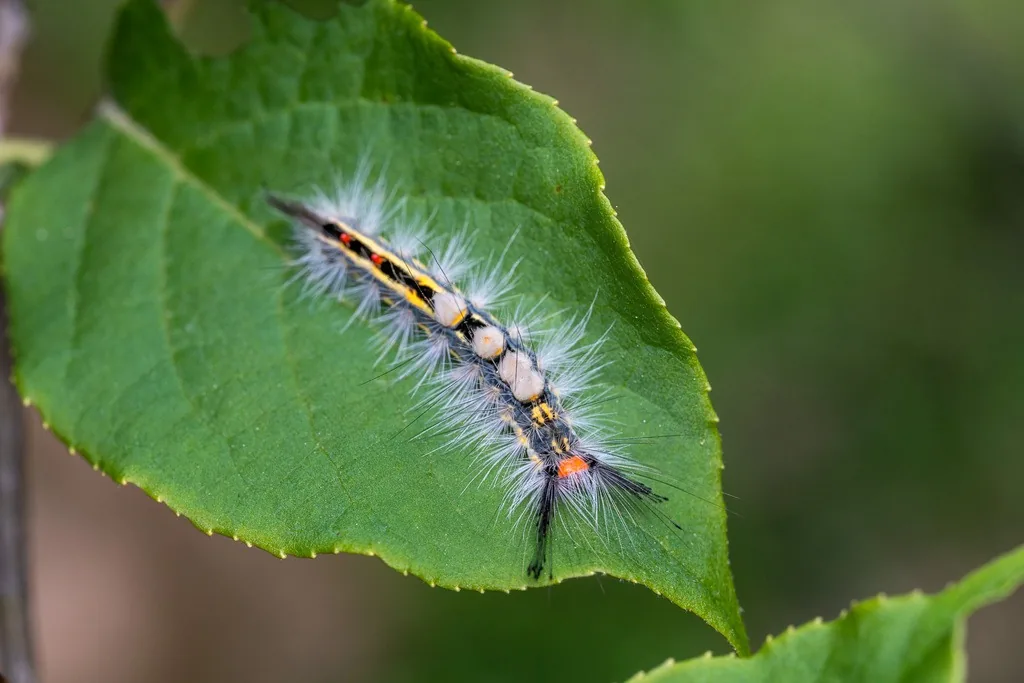
How to identify it
- Grown caterpillars are about 1 1/4 inches long, with four dense, brush-like tufts of white to light tan hairs on the top of the front of the abdomen.[2][1]
- Two long pencils of black hairs reach forward past the head, and a single pencil sticks out from the rear end.[1][2]
- The head is red-orange, a black stripe runs down the back with yellow stripes beside it, and two bright red bumps sit near the rear.[2][3][1]
- Males are gray-brown moths with a wingspan of about 1 to 1 1/4 inches; females have tiny, useless wings and look like plump gray or whitish insects.[1][2][3]
- Eggs are laid in a mass on the female's old cocoon and covered with a white, frothy coating that hardens.[1][3]
Look-alikes
| Look-alike | How to tell them apart |
|---|---|
| Hickory tussock moth caterpillar | Covered in white and black hairs with black tufts along the back, without the red head and the four pale tufts of the whitemarked tussock moth; it is mostly seen in fall.[4][2] |
| Pale tussock moth caterpillar | Lacks the upright tufts of short, light hairs on the front of the abdomen and is covered in whitish hairs, with long hair pencils at both ends.[2] |
| Sycamore tussock moth caterpillar | Has white body hair with hair pencils at both ends and feeds on American sycamore and London plane trees.[2] |
Where it lives
Native to eastern North America and parts of Canada, west into Texas; a southern subspecies favors live oak, redbud, pyracantha and mimosa.[3][2]
Biology and life cycle
Winter is spent in the egg stage, and caterpillars hatch in spring, roughly April through June, as host leaves are coming out.[2][3][1]
Some young caterpillars drop on silk threads and are carried by wind, which lets them spread to new landscapes.[1][3]
After about 30 to 40 days of feeding, caterpillars spin grayish cocoons made of silk and their own hairs on bark, branches and nearby objects.[2][3]
Adults emerge about two weeks later and mate; there are one to three generations a year depending on location, with two in North Carolina and three in Texas.[1][2][3]
Damage and signs
- Young caterpillars skeletonize leaves, while older ones eat everything but the larger veins.[2][3]
- They have been recorded on plants in 116 genera, with oak, cherry, hackberry, willow, maple, apple and sycamore among the common hosts.[1][3][2]
- Outbreaks can last several years and then nearly vanish; large trees usually tolerate the feeding, while smaller ornamental trees and shrubs suffer more.[3]
- Mature caterpillars can be a nuisance when they crawl around looking for places to spin cocoons.[1]
Health risk
Some of the hairs are urticating and can cause an itchy rash on sensitive skin; cases have been reported from schools and day-care centers, and old cocoons can still cause it a year later.[1][3]
Control
Prevention
Teach children to recognize these caterpillars and cocoons and not to handle them.[3]
Traps and physical control
Remove and destroy overwintering egg masses on old cocoons while wearing gloves, and wash any clothing that touches cocoons separately.[3]
Biological control
Diseases, parasites and predators such as birds, ground beetles and paper wasps usually keep populations at manageable levels.[1][3]
Bacillus thuringiensis can give adequate control when sprayed while caterpillars are young and actively feeding.[1]
Pesticides
Young caterpillars are also susceptible to pyrethroids, but spraying mature, wandering caterpillars is a waste of time because they tolerate insecticides well.[1]
When to call a professional
Getting a spray into the canopy of tall trees safely is hard; consider a professional arborist or landscaper for large trees.[1]
Hickory tussock moth: the fall caterpillar people find on sidewalks
The hickory tussock moth (Lophocampa caryae) is a fuzzy white and black caterpillar that grows to about 1.7 inches and is most noticeable from July through September.[4]
It feeds mainly on hickory, walnut, pecan and American hornbeam, and has one generation a year; mature caterpillars wander in search of protected places to spin cocoons.[4]
Its barbed hairs break off easily and usually cause a local rash and itching; Penn State notes no known systemic allergic reactions to this species.[4]
If hairs embed in skin, lift them with tape; seek medical care right away if hairs get in the eyes or are swallowed.[4]
Because most feeding happens a few weeks before leaves drop, it rarely harms the long-term health of trees, so control is rarely warranted.[4]
Common questions
- Can I pick up a tussock moth caterpillar?
- It's best not to. Their hairs can cause welts and itching that may last several days, so teach children to leave the caterpillars and cocoons alone.[3][1]
- Should I spray the caterpillars crawling on my house?
- No. By the time they are wandering, they have usually finished feeding and are looking for a place to spin a cocoon, and mature caterpillars tolerate insecticides well.[1]
- Will tussock moth caterpillars kill my tree?
- Large trees usually tolerate the feeding; smaller ornamental trees and shrubs are more likely to be hurt during an outbreak.[3]
Sources
- NC State Extension, “Whitemarked Tussock Moth (PDIC Factsheet, reviewed October 2019).” content.ces.ncsu.edu/whitemarked-tussock-moth (accessed 2026-10-06)
- Texas A&M AgriLife Extension, “Whitemarked Tussock Moth (Field Guide to Common Texas Insects).” texasinsects.tamu.edu/whitemarked-tussock-moth/ (accessed 2026-10-06)
- UMass Extension Landscape, Nursery and Urban Forestry Program, “Orgyia leucostigma, White-Marked Tussock Moth (Landscape Insect and Mite Guide).” www.umass.edu/agriculture-food-environment/landscape/publications-resources/insect-mite-guide/orgyia-leucostigma (accessed 2026-10-06)
- Penn State Extension, “Hickory Tussock Moth Caterpillar (updated September 8, 2025).” extension.psu.edu/hickory-tussock-moth-caterpillar (accessed 2026-10-06)
- iNaturalist, “Orgyia leucostigma taxon page (order and family).” www.inaturalist.org/taxa/81665 (accessed 2026-10-06)