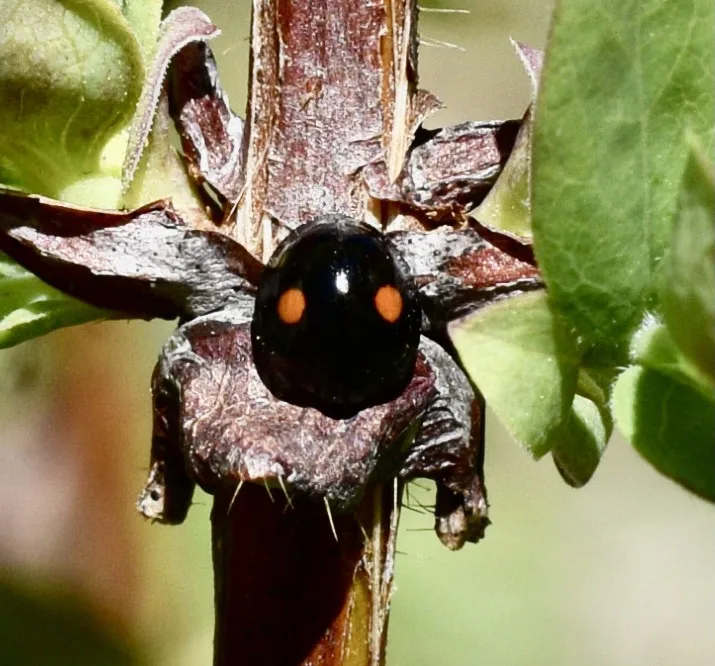
How to identify it
- Adults are shiny black, about 3.75 to 5 mm long, with a large red spot in the middle of each wing cover.[2]
- The underside of the abdomen is yellow or red; the rest of the body is black.[2]
- Larvae are black or gray and covered in fleshy spines.[2][1]
- Eggs are about 1 mm long, laid singly or in small groups near prey.[2][1]
Look-alikes
Where it lives
Chilocorus stigma is the native species found in most of the United States but not west of the Sierra Nevada. In California, the very similar C. orbus is a common scale feeder on trees and shrubs.[2][1]
Biology and life cycle
Two generations a year are typical in the northern U.S.; Florida populations can have several.[2]
Overwintered adults become active in April or May, mate for about three weeks and then lay eggs.[2]
Larvae pass through four stages before pupating, and the new adults overwinter in ground litter.[2]
Damage and signs
Health risk
Cornell and UC IPM describe only its role as a scale predator; neither mentions any concern for people.[2][1]
Control
Biological control
Broad-spectrum insecticides kill it. Dormant or horticultural oils may be less harmful to the beetles when scale needs treatment.[2]
Windbreaks and wooded edges give it refuges from which to recolonize scale-infested plantings.[2]
It isn't sold commercially in the United States.[2]
Common questions
- Is a black ladybug with two red spots a pest?
- Usually not. The twicestabbed lady beetle and its look-alikes are predators, mostly of scale insects.[1][2]
- Does it eat aphids?
- Sometimes. Scales are its main food, but it also eats aphids and mealybugs.[2]
- How effective is it on scale?
- Reports vary. Some researchers found it greatly reduced pine needle scale; others question its impact without other predators.[2]
Sources
- University of California Statewide IPM Program, “Twicestabbed Lady Beetle (Natural Enemies Gallery).” ipm.ucanr.edu/natural-enemies/twicestabbed-lady-beetle/ (accessed 2026-10-06)
- Cornell University College of Agriculture and Life Sciences, “Biological Control: A Guide to Natural Enemies in North America: Chilocorus stigma (Twice-stabbed Lady Beetle).” biocontrol.entomology.cornell.edu/predators/Chilocoruss.php (accessed 2026-10-06)
- iNaturalist, “Chilocorus stigma taxon page (order and family).” www.inaturalist.org/taxa/120282 (accessed 2026-10-06)