How to identify it
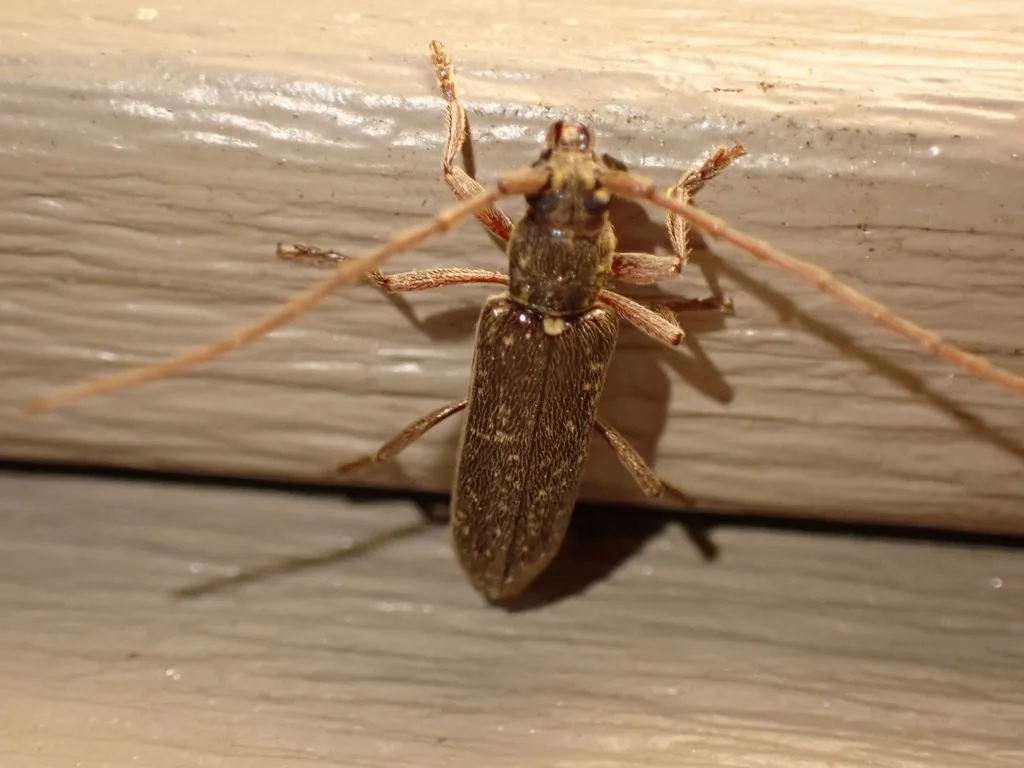
- Adults are slender, grayish-yellow to brown longhorned beetles about 1/2 to 3/4 inch long, with antennae longer than the body.[1][2]
- Fallen branches have a smooth, concave cut end, often with a small oval hole packed with frass where the larva sits.[1][2]
- Larvae are slender, legless roundheaded borers, white with a dark head, about 1 inch long when mature.[1][2]
Look-alikes
| Look-alike | How to tell them apart |
|---|---|
| Twig girdler | Twig girdlers chew a groove around the outside of a twig, so the cut end looks gnawed, as if by a beaver.[2] |
Where it lives
NC State and Maryland Extension report it on shade and ornamental trees in their states.[1][2]
Biology and life cycle
Females lay eggs in twigs; larvae bore toward the trunk and chew concentric cuts through the wood but not the bark, until the branch breaks and falls.[1][2]
The larva finishes developing, pupates and overwinters inside the fallen twig.[1][2]
Damage and signs
Health risk
Control
Prevention
Look under trees in August and September for twigs with concave cut ends, and split them lengthwise to find larvae.[2]
Sanitation
Rake up and destroy fallen twigs in fall or winter, before adults emerge in spring.[1][2]
Pesticides
Where twig pruners have been active, NC State says a pyrethroid spray the following spring could be considered.[1]
Common questions
- Why are small branches with clean cut ends falling from my oak?
- A twig pruner larva inside likely cut the branch from within.[1][2]
- How do I control twig pruners?
- Rake up and destroy fallen twigs before spring, since the larvae overwinter inside them.[1][2]
- Will twig pruners kill my tree?
- The damage is to twigs and small branches; stressed trees are more attractive to the beetles.[1]
Sources
- NC State Extension, “Twig Pruner (PDIC Factsheet).” content.ces.ncsu.edu/twig-pruner (accessed 2026-10-15)
- University of Maryland Extension, “Twig Girdlers and Twig Pruners on Trees.” extension.umd.edu/resource/twig-girdlers-and-twig-pruners-trees (accessed 2026-10-15)
- iNaturalist, “Anelaphus villosus taxon page (order and family).” www.inaturalist.org/taxa/213608 (accessed 2026-10-06)