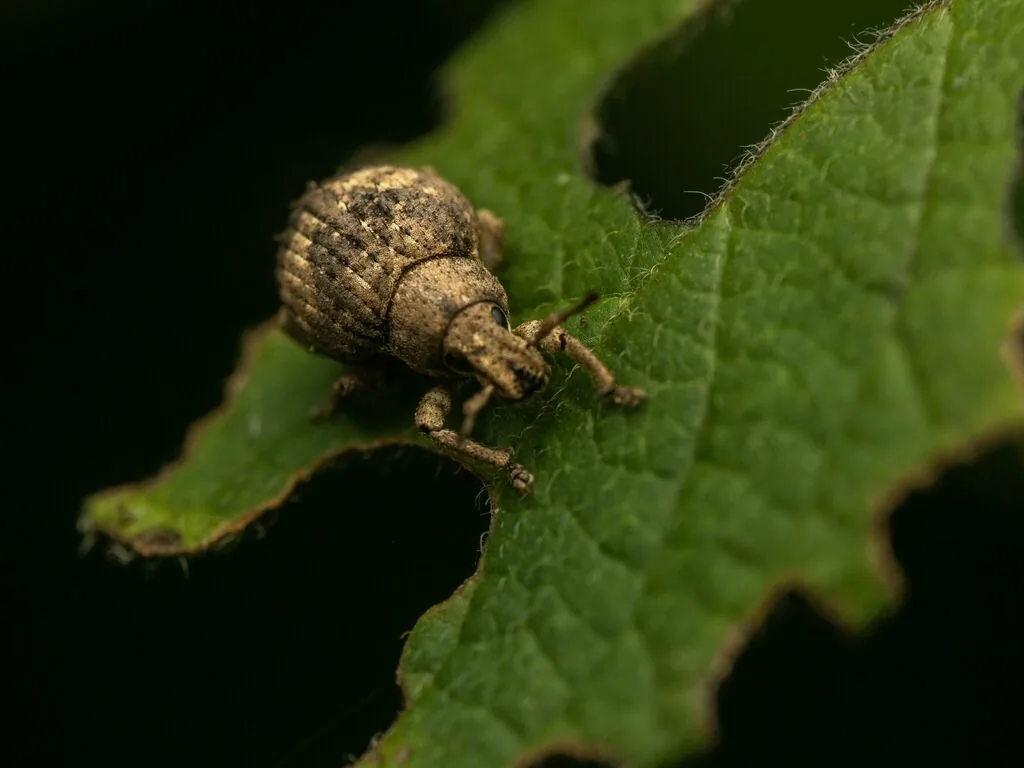
How to identify it
Where it lives
Native to East Asia, it's established in New England, the mid-Atlantic, Indiana, Illinois and the Southeast, and was confirmed in Florida in 2005.[1]
Biology and life cycle
Females reproduce without mating, and males generally aren't found in the U.S.[1]
Adults feed by day; larvae live in soil and eat roots.[1]
Damage and signs
- Adults chew notches in leaf margins, and new adults can cause severe defoliation.[1]
Health risk
It feeds on plants; UF/IFAS mentions no risk to people.[1]
Control
Traps and physical control
Shake or tap plants over a white sheet; the weevils drop and play dead, so they're easy to collect and destroy.[1]
Pesticides
If spraying, the best timing is in spring when overwintered adults start feeding.[1]
Common questions
Sources
- University of Florida IFAS Extension (Featured Creatures), “Twobanded Japanese Weevil, Pseudocneorhinus bifasciatus (EENY-361).” edis.ifas.ufl.edu/publication/IN646 (accessed 2026-10-06)
- iNaturalist, “Pseudocneorhinus bifasciatus taxon page (order and family).” www.inaturalist.org/taxa/474853 (accessed 2026-10-06)