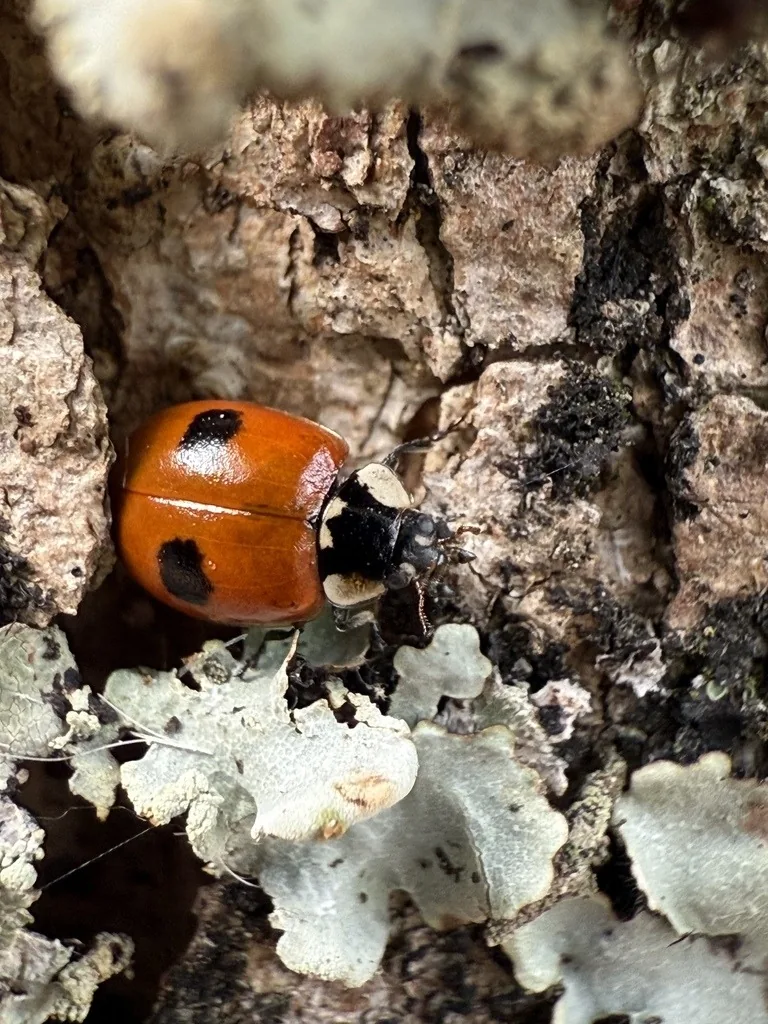
How to identify it
- Adults are 1/6 to 1/5 inch long and oblong from above.[1]
- The most common form has orange or red wing covers with two black spots and a black-and-white thorax.[1]
- Other forms are mostly black with four or six orange to red spots.[1]
- Eggs are orange to pale yellow and stand on end in groups; older larvae are black, gray and whitish with orange or yellow marks.[1]
Where it lives
It may be native to North America and turns up on almost any aphid-infested plant, from crops to gardens and wildlands.[1]
Biology and life cycle
Females lay egg groups mostly under aphid-infested leaves, and larvae pass through four stages.[1]
Egg to reproductive adult takes about three weeks in warm weather, with at least three generations a year.[1]
With blossoms and prey available, adults live about two months.[1]
Damage and signs
- It eats aphids mostly, plus adelgids, psyllids and other plant-sucking insects.[1]
Health risk
UC IPM describes it only as an aphid predator, with no mention of any concern for people.[1]
Control
Prevention
Persistent, broad-spectrum insecticides kill lady beetles, so choose targeted controls.[1]
Biological control
Flowers with nectar and pollen help adults live longer and lay more eggs.[1]
Keep ants under control, since they attack lady beetles.[1]
Common questions
Sources
- University of California Statewide IPM Program, “Twospotted Lady Beetle (Natural Enemies Gallery).” ipm.ucanr.edu/natural-enemies/twospotted-lady-beetle/ (accessed 2026-10-06)
- iNaturalist, “Adalia bipunctata taxon page (order and family).” www.inaturalist.org/taxa/52506 (accessed 2026-10-06)