How to identify it
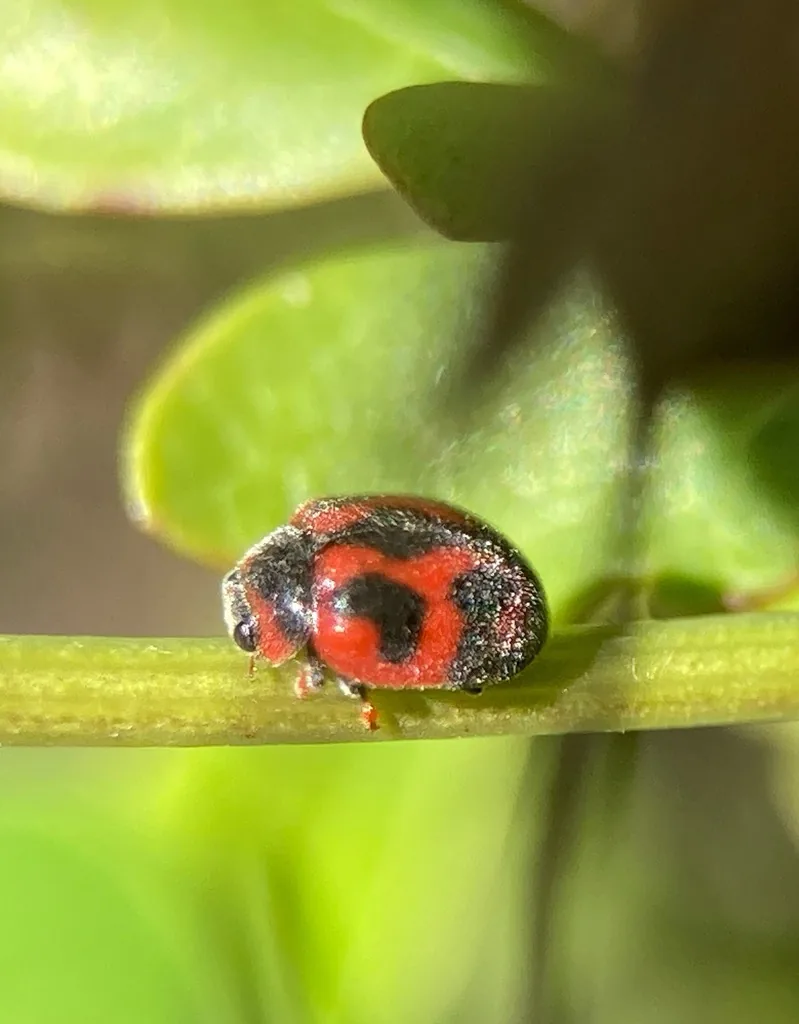
- Adults are about 1/8 inch long, oval and covered with fine hairs, irregularly marked in red and black.[1][2]
- Some individuals are mostly black and others mostly red, and the hairs can make them look grayish.[1]
- Eggs are red and oblong, easiest to see on the white egg sacs of cottony cushion scale.[1]
- Older larvae are dark pink to bluish gray with black bumps and grow to about 1/4 inch.[1]
Look-alikes
| Look-alike | How to tell them apart |
|---|---|
| Cottony cushion scale crawlers | Both are small, red and oblong, but scale crawlers have black legs and forward-pointing black antennae; young vedalia larvae have red legs and no obvious antennae.[1] |
Where it lives
Vedalia is established in California and Florida and turns up in scattered places in the southern U.S.[2]
Biology and life cycle
Females lay from about 150 to several hundred eggs over a life of one to three months.[1][2]
Egg to adult takes four to six weeks in warm weather, and coastal California sees about eight generations a year.[1][2]
Egg laying stops and larvae develop slowly when days top 90 degrees F.[1]
Damage and signs
Health risk
UC IPM and Cornell describe it only as a scale predator, with no mention of any risk to people.[1][2]
Control
Biological control
Arriving in Central Valley citrus in March or April, adults can clear a serious infestation in four to six weeks if not disrupted.[1]
Pesticide sprays and hot weather are what disrupt it, so avoid broad sprays where cottony cushion scale is under its control.[1]
Along the coast, a tiny parasitic fly, Cryptochaetum iceryae, does much of the work instead, and the two share middle areas.[1]
Common questions
- Why is the vedalia beetle famous?
- Its 1888-89 release saved California's citrus industry and is considered the start of classical biological control.[2]
- What does it eat besides cottony cushion scale?
- Almost nothing. Cornell calls it specific to cottony cushion scale.[2]
- Why did my vedalia beetles disappear in summer?
- Heat slows them: egg laying stops and larvae develop slowly once temperatures pass 90 degrees F.[1]
Sources
- University of California Statewide IPM Program, “Vedalia (Natural Enemies Gallery).” ipm.ucanr.edu/natural-enemies/vedalia/ (accessed 2026-10-06)
- Cornell University College of Agriculture and Life Sciences, “Biological Control: A Guide to Natural Enemies in North America: Rodolia cardinalis (Vedalia Beetle).” biocontrol.entomology.cornell.edu/predators/Rodolia.php (accessed 2026-10-06)
- iNaturalist, “Novius cardinalis taxon page (order and family).” www.inaturalist.org/taxa/1065202 (accessed 2026-10-06)