How to identify it
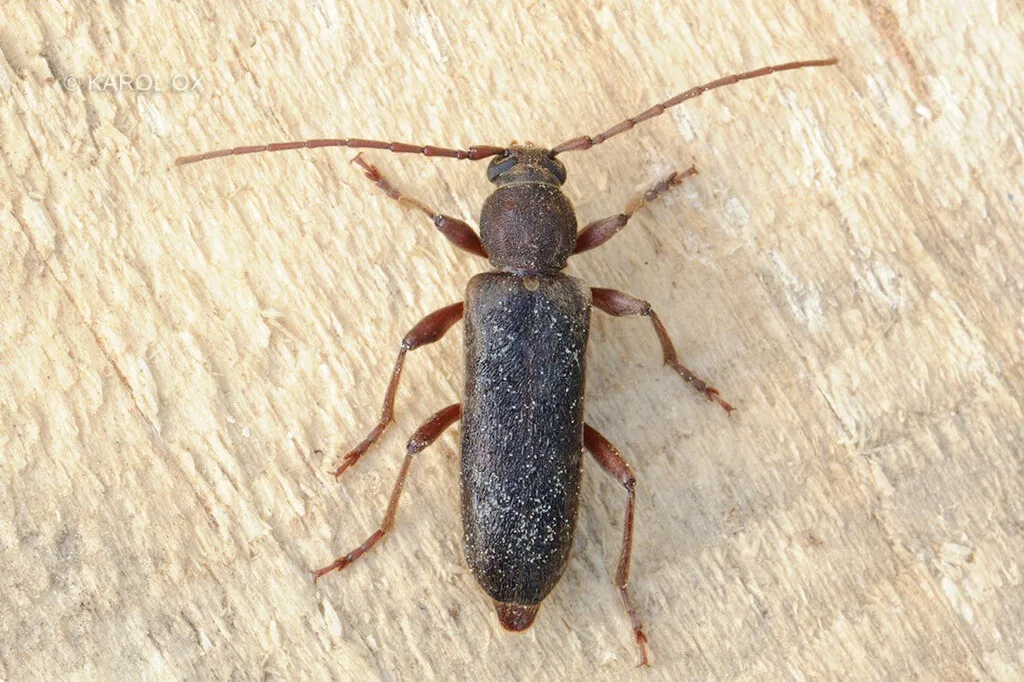
- Adults are 1/2 to 3/4 inch long and dark brown to brownish orange, with legs and antennae lighter than the body.[1][2]
- Fine hairs scattered over the body and wing covers form light patches, the source of the name velvet.[1][2]
- Adults leave round exit holes about 3/8 inch across in trunks and branches.[2]
Look-alikes
Where it lives
First found in North America in Quebec in 2002 and in the U.S. in Rhode Island in 2006, it has been detected in a few other states, including Utah since 2010; Minnesota's Department of Agriculture monitors for it.[1][2]
Biology and life cycle
Adults emerge from June to August (May to August in Utah) and fly at night.[1][2]
Females lay eggs on trunks and branches of healthy, stressed or dying trees and on cut timber; larvae tunnel under the bark and into the wood.[2]
Larvae can take two or more years to develop and pupate in late winter to spring.[1][2]
Damage and signs
Health risk
Control
Prevention
Don't move firewood; it and wood packing material are how the beetle spreads to new areas.[2]
When to call a professional
Report suspects to your state department of agriculture or extension diagnostic lab, as Minnesota and Utah ask.[1][2]
Common questions
- How do I identify a velvet longhorned beetle?
- Look for a 1/2- to 3/4-inch brownish beetle with lighter legs and antennae and patches of fine hair; many look-alikes exist, so have it confirmed.[1][2]
- What trees does it attack?
- Apple, cherry, mulberry, peach, maple and many other hardwoods and conifers, plus cut and dried wood.[1][2]
- What should I do if I find one?
- Report it to your state department of agriculture or extension diagnostic lab.[1][2]
Sources
- University of Minnesota Extension, “Velvet longhorned beetle.” extension.umn.edu/natural-resources/forestry-and-wildlife/invasive-species/velvet-longhorned-beetle (accessed 2026-10-15)
- Utah State University Extension, “Velvet Longhorned Beetle, Trichoferus campestris (Rodman et al., July 2020).” extension.usu.edu/planthealth/research/velvet-longhorned-beetle.php (accessed 2026-10-15)
- iNaturalist, “Trichoferus campestris taxon page (order and family).” www.inaturalist.org/taxa/447062 (accessed 2026-10-06)