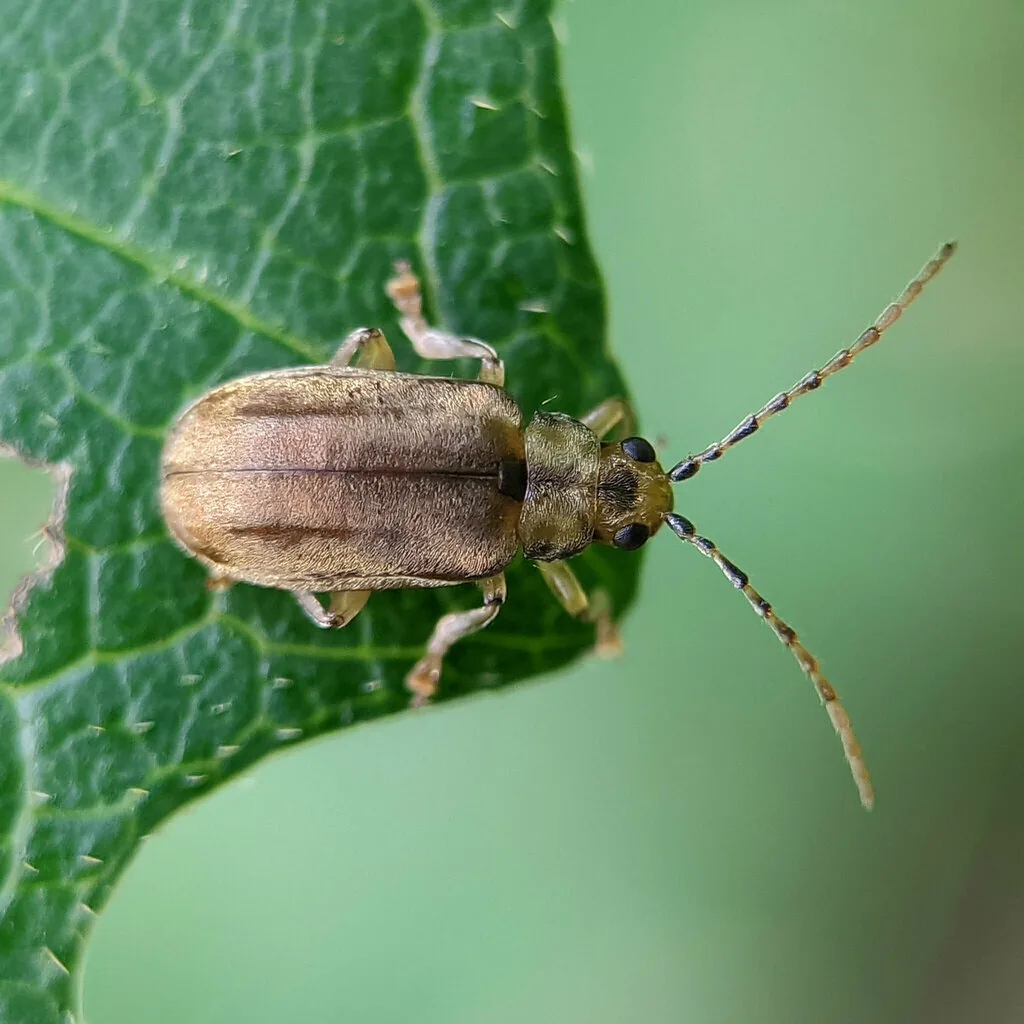
How to identify it
- Adults are golden brown and only 4.5 to 6.5 mm long, smaller than mature larvae; short golden-gray hairs can give them a metallic sheen in sunlight.[1]
- Larvae start out tiny and dark or greenish-yellow, then become greenish-yellow to yellowish-brown with black spots, reaching about 1/3 to 1/2 inch.[1][2]
- Egg sites are small pits chewed in neat rows near twig tips, each capped with chewed bark and excrement, giving the twig a rough look.[1][2]
- Larvae skeletonize leaves between the veins, while adults chew elongated oval holes that may cross leaf veins.[1][3]
Look-alikes
| Look-alike | How to tell them apart |
|---|---|
| Japanese beetle | Japanese beetle adults may also skeletonize viburnum, so check for viburnum leaf beetle larvae on the leaves or egg pits on new twigs; if either is present, it's likely viburnum leaf beetle.[3] |
Where it lives
First found in North America in Ontario in 1947 and in the U.S. in Maine in 1994. It now ranges from New England and New York west through Ohio, Wisconsin and Illinois to Minnesota (2019), and also occurs in British Columbia and Washington.[1][3]
Biology and life cycle
It overwinters as eggs inside twig pits; females lay about 8 eggs per pit and up to 500 eggs each.[1][2]
Eggs hatch in late April or early May, and larvae feed in groups, starting on the undersides of lower leaves.[1][2]
After 8 to 10 weeks, larvae crawl down the stem to pupate in moist soil; adults emerge in mid-July.[1][2]
Adults feed, mate and lay eggs from July until the first killing frost; there is one generation a year.[1][3]
Overwintering eggs need a long chilling period, which may limit its spread into warmer southern areas.[1]
Damage and signs
- Heavy infestations can skeletonize every leaf, leaving only the midribs and major veins, and completely defoliate the shrub.[1][2]
- Two to three years of complete defoliation can weaken a viburnum enough to kill it.[1]
- Egg pits also weaken young stems, and twigs with many pits may not survive the next winter.[1]
Health risk
It feeds only on viburnum plants and is a landscape pest, not a threat to people or pets.[1]
Control
Prevention
Plant resistant viburnums, such as doublefile, Koreanspice, Judd, tea and dawn viburnum, and consider replacing susceptible shrubs that are infested year after year.[1][2][3]
Traps and physical control
Prune out and destroy twigs with egg caps between October and mid-April, before eggs hatch; late winter is easiest and least likely to miss late-laid eggs.[1][2]
Biological control
Lady beetles, lacewing larvae and spined soldier bugs feed on it, and lab tests found insect-killing nematodes killed most pupae in the soil.[2]
Pesticides
Treat young larvae in late April to early May; insecticidal soap and spinosad work on larvae, but sprays must contact them directly.[2][1]
A dormant horticultural oil spray before leaves open reduced egg hatch by 75 to 80 percent in research trials; apply any insecticide after bloom to protect pollinators.[2]
Common questions
- Why are my viburnum leaves turning to lace?
- Lacy, skeletonized viburnum leaves in late spring are a strong sign of viburnum leaf beetle larvae; check leaf undersides for groups of spotted larvae.[3][1]
- When should I look for viburnum leaf beetle eggs?
- Look for rows of capped egg pits on twig tips, mainly on current-season growth, from July through the following spring.[2][1]
Sources
- UMass Extension Landscape, Nursery and Urban Forestry Program, “Viburnum Leaf Beetle (fact sheet).” www.umass.edu/agriculture-food-environment/landscape/fact-sheets/viburnum-leaf-beetle (accessed 2026-10-06)
- UMass Extension Landscape, Nursery and Urban Forestry Program, “Pyrrhalta viburni (Landscape Insect and Mite Guide).” www.umass.edu/agriculture-food-environment/landscape/publications-resources/insect-mite-guide/pyrrhalta-viburni (accessed 2026-10-06)
- Minnesota Department of Agriculture, “Viburnum Leaf Beetle fact sheet (08/2025).” www.mda.state.mn.us/sites/default/files/docs/2025-08/Viburnum_Leaf_Beetle_Factsheet_WEB.pdf (accessed 2026-10-06)
- iNaturalist, “Pyrrhalta viburni taxon page (order and family).” www.inaturalist.org/taxa/121329 (accessed 2026-10-06)