How to identify it
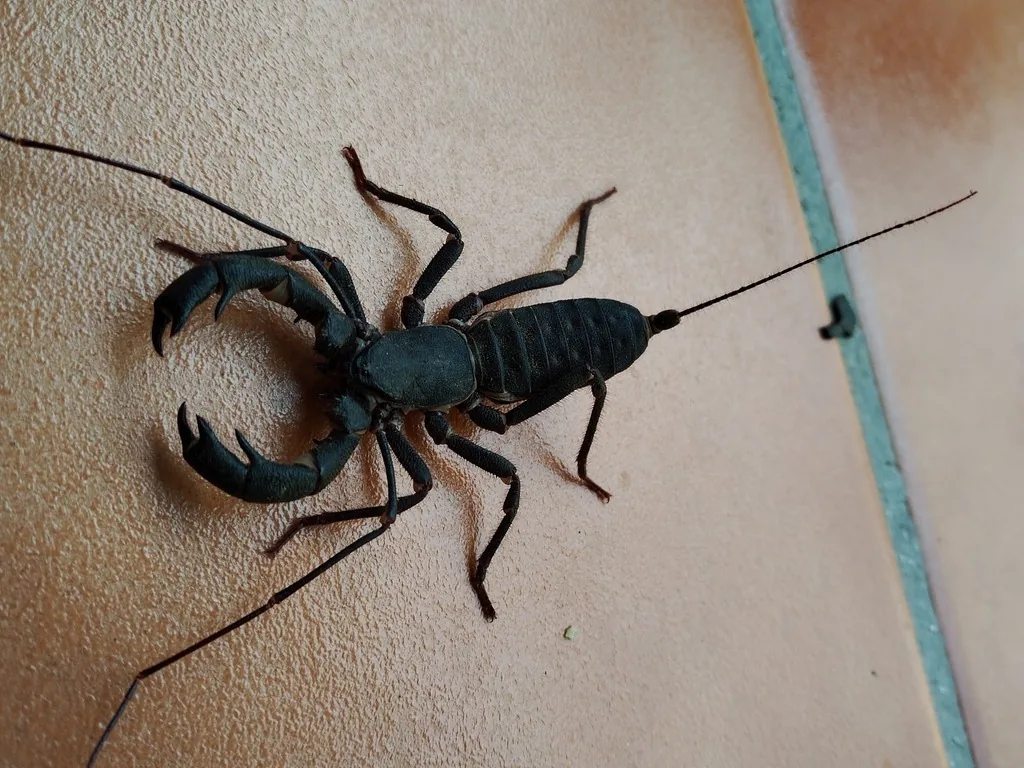
- Adults are nearly black, with a body about 1 1/2 to 3 inches long not counting the tail.[2][1]
- The heavy mouthparts (pedipalps) form large pincers used to crush prey.[2][1]
- The first pair of legs is long and thin and is used like antennae; the other three pairs are for walking.[2][1]
- A long, thin, whip-like tail extends from the end of the body, which gives the group its whip scorpion name.[2][1]
- When disturbed it gives off a sharp vinegar smell from a spray released at the base of the tail.[1][2]
Look-alikes
Where it lives
Found in Arizona, Florida, New Mexico, Oklahoma and Texas, and in Mexico; in Texas it is mainly in the west, especially the Trans-Pecos, but reaches the Panhandle and south Texas.[1][2]
Biology and life cycle
Vinegaroons hunt at night and have poor eyesight, finding prey by feeling with their front legs and sensing vibrations.[1][2]
By day they hide in burrows they dig with their pincers, or under logs, boards, rotting wood and rocks.[1]
They prefer drier, well-drained soils in deserts, grassland, scrub, pine forest and barrier islands, and in Florida they surface mainly in the rainy season.[1][2]
They eat soft-bodied insects such as termites, cockroaches and crickets.[1]
A female carries 30 to 40 eggs in a sac under her body in her burrow, and the young ride on her back for about a month.[1][2]
They grow slowly and can live at least seven years.[1]
Damage and signs
- Vinegaroons cause no damage; they are predators of insects that people consider pests, such as cockroaches and termites.[1]
Health risk
Vinegaroons have no venom. Their pincers can give a noticeable pinch, and their acetic acid spray, about 85 percent strength, is harmless on skin but stings badly in the eyes or nose.[1][2]
Control
Prevention
Don't pick one up by hand; mishandled vinegaroons can pinch with their pedipalps.[1][2]
Keep your face back from a disturbed vinegaroon, since it can aim its acid spray a few inches to about a foot.[1]
They often hide under logs, boards and rocks; a threatened vinegaroon retreats to its burrow or rears up in a bluff display, so give it room rather than handling it.[1]
Common questions
- Is a vinegaroon poisonous?
- No. Texas A&M AgriLife considers it non-poisonous, and UF/IFAS notes it has neither a venomous stinger nor a venomous bite.[2][1]
- Why does it smell like vinegar?
- When threatened it sprays a mist of about 85 percent acetic acid, the acid in vinegar, from glands at the base of its tail.[1][2]
- Is a whip scorpion a real scorpion?
- No. It is a different arachnid group with a thin whip-like tail instead of a stinger.[1][2]
Sources
- University of Florida/IFAS Extension, EDIS, “Giant Whip Scorpion, Mastigoproctus giganteus giganteus (Lucas) (Featured Creatures, IN890).” edis.ifas.ufl.edu/publication/IN890 (accessed 2026-10-06)
- Texas A&M AgriLife Extension, “Vinegaroon, Mastigoproctus giganteus (Field Guide to Common Texas Insects).” texasinsects.tamu.edu/vinegaroon/ (accessed 2026-10-06)
- iNaturalist, “Mastigoproctus giganteus taxon page (order and family).” www.inaturalist.org/taxa/126252 (accessed 2026-10-06)