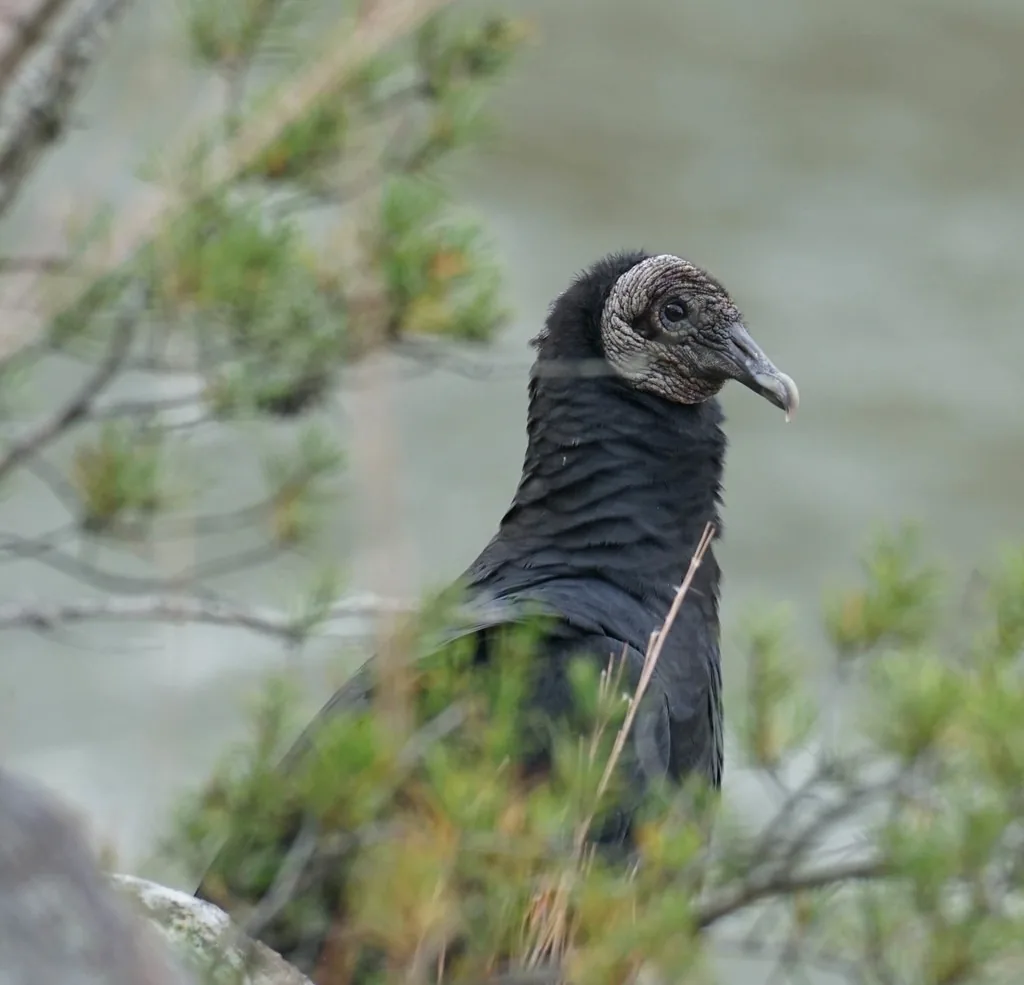
How to identify it
- The black vulture is mostly black with a bare gray-black head, a short tail, and a white or silver patch near each wingtip seen from below.[5][1][6]
- Black vultures weigh about 3.5 to 5 pounds with a wingspan of up to about 5 feet.[5][6]
- The turkey vulture is larger, about 4 pounds with a wingspan near 6 feet; adults have a bare, bright red head and gray undersides on the flight feathers.[1][6][5]
- In flight, black vultures hold their wings flatter and flap more, while turkey vultures soar for long stretches with wings in a shallow V.[5][1]
- Juvenile turkey vultures have a gray or brown head, so they can be mistaken for black vultures.[5][1]
Where it lives
Turkey vultures are found throughout the U.S. The black vulture is centered in the Southeast but has spread north into Maryland, Delaware, New Jersey and Pennsylvania over the past 50 years.[1]
Biology and life cycle
Vultures feed mainly on carrion and roadkill. Black vultures find food by sight, while turkey vultures can also find it by smell.[2][5]
They don't build nests; they lay eggs in thickets, hollow logs, caves, rock ledges and abandoned buildings.[2]
Both species usually lay 2 eggs once a year, and both parents care for the young for about 3 months.[2]
Vultures gather in communal roosts, often mixed black and turkey vultures, which are largest from late fall through early spring; roosts of 100 or more birds are not unusual.[2][5]
Black vulture numbers and range have grown over the past 30 years, and northern birds move south in fall and winter.[6][5]
Damage and signs
- Black vultures tear and sometimes eat asphalt shingles, rubber roofing, window caulking, vent seals and pool covers.[3][6]
- They peck rubber seals and windshield wipers on parked cars and rip vinyl or leather seats on boats and tractors.[3][5][6]
- Droppings and vomit pile up under roosts and on roofs and towers, causing odors, and on power towers they have caused arcing and outages.[3][6]
- Black vultures may attack newborn, sick or birthing calves, lambs, goats and piglets, usually going for the eyes and other soft tissue first.[3][5][6]
Health risk
Vulture droppings have contaminated water towers and springs with fecal bacteria, and turkey vultures may carry salmonella. Vultures do not spread anthrax, hog cholera or avian influenza.[3]
Control
Prevention
Pen birthing cows, goats and sheep near people so they can be watched closely; some producers also use livestock guard dogs.[5]
Keep them out
Bird spikes on ledges, netting, overhead monofilament lines, and a taut wire about 8 inches above a roof ridge can keep vultures from perching.[4]
Sanitation
Remove what draws them: dispose of dead animals, afterbirth and stillborns promptly, and remove open garbage.[4][5][6]
Traps and physical control
Disperse roosts early with persistent harassment such as loud noise, water spray, lasers or pyrotechnics, repeated at dusk for several days; check local noise and firearm rules first.[5][4][6]
A realistic vulture effigy hung upside down near a roost or calving area can drive vultures away; plastic replicas need no permit, but a real bird does.[5][4][6]
Pesticides
No repellents or toxicants are registered for vultures.[4]
When to call a professional
For damage that harassment can't fix, contact USDA APHIS Wildlife Services, which can advise and help start the federal depredation permit process.[6][5]
Protected by federal law
Black and turkey vultures are protected by the Migratory Bird Treaty Act. The birds, their nests and eggs cannot be harmed, killed or destroyed without a federal depredation permit.[1][5][6]
Permits are issued through the U.S. Fish and Wildlife Service, and USDA Wildlife Services can help with applications; state laws also apply.[1][6]
Scaring vultures away is legal, but rules differ by state and town: some states ban pole traps, and noise or pyrotechnics may be limited by local ordinances.[5][4]
Some states offer simpler options for livestock producers, such as Missouri's Farm Bureau sub-permits for limited take of black vultures.[5][6]
Common questions
- Can I shoot vultures that are damaging my property?
- Not without a federal permit. Vultures are protected under the Migratory Bird Treaty Act, so contact USDA Wildlife Services about your options.[5][6][1]
- How do I get vultures off my roof?
- Start harassing them as soon as they show up, using noise, water spray or an effigy, and add spikes or a ridge wire where they perch.[5][4]
- Do vultures kill livestock?
- Black vultures sometimes kill newborn or weak animals. If there's no blood at the scene, the animal was likely already dead before vultures arrived.[5][6]
Sources
- Internet Center for Wildlife Damage Management, “Vultures: Identification.” icwdm.org/species/birds/vultures/ (accessed 2026-10-06). Run by university wildlife damage specialists; species modules are based on Prevention and Control of Wildlife Damage (University of Nebraska Cooperative Extension, 1994).
- Internet Center for Wildlife Damage Management, “Vulture Biology.” icwdm.org/species/birds/vultures/vulture-biology/ (accessed 2026-10-06). Run by university wildlife damage specialists; species modules are based on Prevention and Control of Wildlife Damage (University of Nebraska Cooperative Extension, 1994).
- Internet Center for Wildlife Damage Management, “Vulture Damage Identification.” icwdm.org/species/birds/vultures/vulture-damage-identification/ (accessed 2026-10-06). Run by university wildlife damage specialists; species modules are based on Prevention and Control of Wildlife Damage (University of Nebraska Cooperative Extension, 1994).
- Internet Center for Wildlife Damage Management, “Vulture Damage Prevention and Control Methods.” icwdm.org/species/birds/vultures/vulture-damage-prevention-and-control-methods/ (accessed 2026-10-06). Run by university wildlife damage specialists; species modules are based on Prevention and Control of Wildlife Damage (University of Nebraska Cooperative Extension, 1994).
- University of Missouri Extension and USDA APHIS Wildlife Services, “Controlling Nuisance Black Vultures in Missouri, Guide G9466 (R. A. Pierce II and T. Guerrant, February 2023).” extension.missouri.edu/media/wysiwyg/Extensiondata/Pub/pdf/agguides/wildlife/g09466.pdf (accessed 2026-10-06)
- USDA APHIS Wildlife Services, “Managing Black Vulture Damage in Missouri (brochure).” extension.missouri.edu/media/wysiwyg/Extensiondata/Pro/NuisanceWildlife/Docs/USDA-BlackVultureMissouriTrifold.pdf (accessed 2026-10-06)
- iNaturalist, “Coragyps atratus taxon page (order and family).” www.inaturalist.org/taxa/4765 (accessed 2026-10-06)