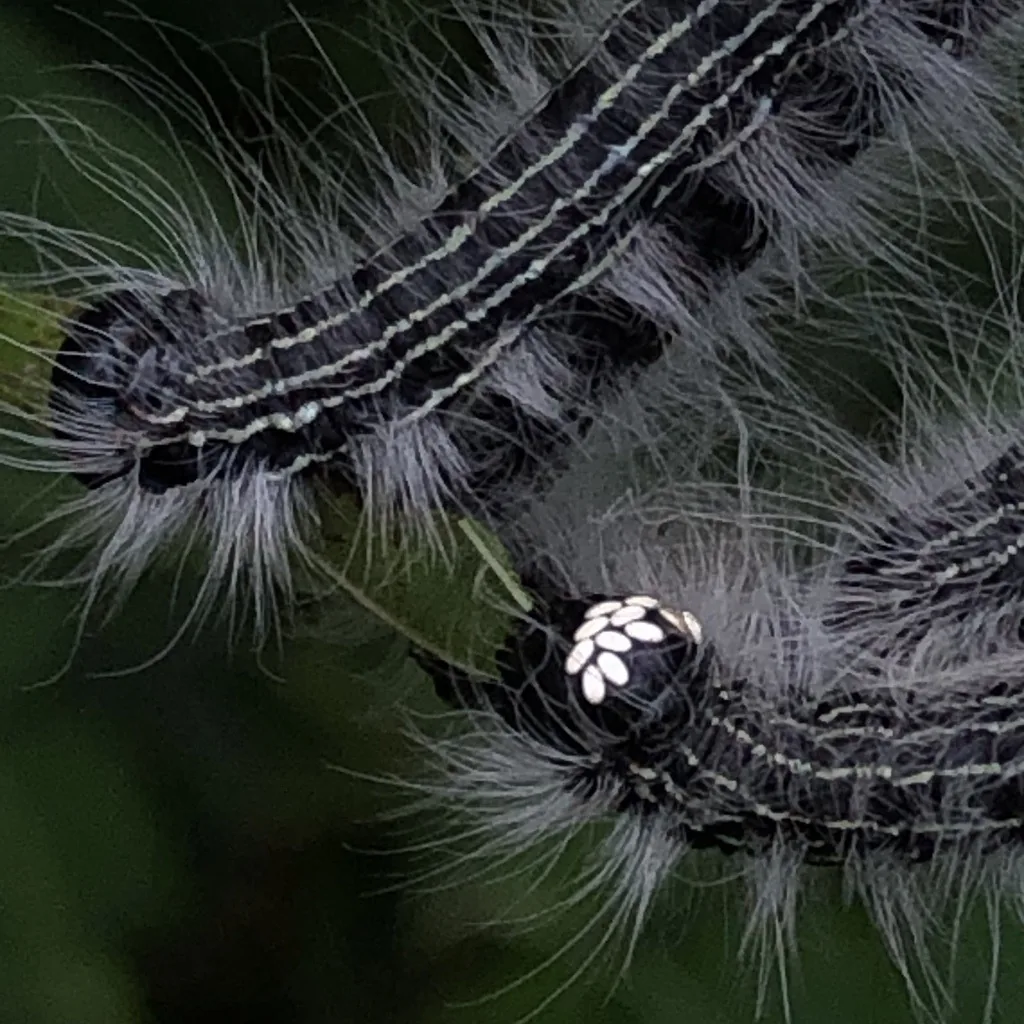
How to identify it
Where it lives
It occurs throughout the eastern United States and is moderately common on walnut trees in Iowa.[2]
Biology and life cycle
Moths emerge from the soil in late spring or early summer and lay eggs in masses of hundreds on the undersides of leaves.[1][2]
Caterpillars feed in clusters and crawl down to the trunk or a large limb in a group to molt, leaving a hairball of shed skins.[1][2]
There are two generations a year in North Carolina; they spend the winter as pupae in the soil.[1][2]
Damage and signs
Health risk
Control
Traps and physical control
Prune off leaves or twigs with egg masses or young clusters in early summer on small trees, and scrape molting masses off the trunk into a bucket or bag.[1][2]
Biological control
Birds and other natural enemies usually keep numbers low enough that serious defoliation is rare.[1][2]
Pesticides
Sprays work best on small caterpillars; NC State names carbaryl and pyrethroids, and keep pyrethroids away from pools, ponds and streams.[1]
Common questions
- What is the hairy gray mass on my walnut tree trunk?
- Likely a group of walnut caterpillars that crawled down together to molt.[1][2]
- Will walnut caterpillars kill my tree?
- Rarely; late-season defoliation does little harm to healthy trees, though two years of complete defoliation can stunt a tree.[1][2]
- How do I get rid of them without spraying?
- Remove egg masses and young clusters on small trees, or scrape the molting mass off the trunk.[1][2]
Sources
- NC State Extension, “Walnut Caterpillar (PDIC Factsheet).” content.ces.ncsu.edu/walnut-caterpillar (accessed 2026-10-15)
- Iowa State University Extension and Outreach (Yard and Garden), “Walnut caterpillar.” yardandgarden.extension.iastate.edu/encyclopedia/walnut-caterpillar (accessed 2026-10-15)
- iNaturalist, “Datana integerrima taxon page (order and family).” www.inaturalist.org/taxa/218166 (accessed 2026-10-06)