How to identify it
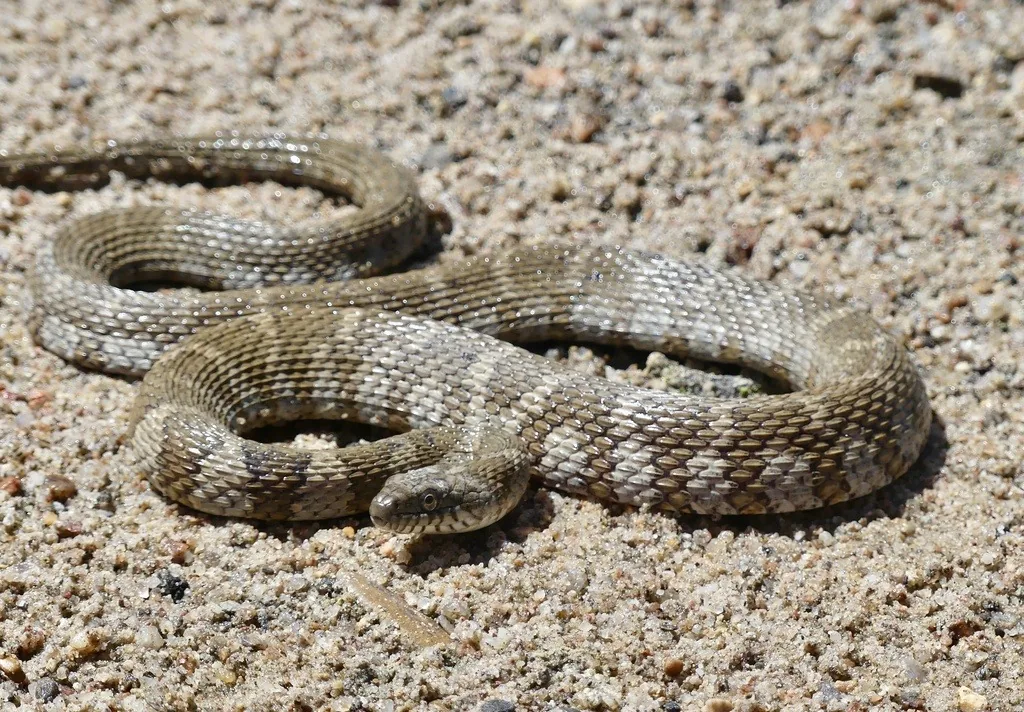
- Heavy-bodied, medium-sized snakes, usually about 2 to 3.5 feet long as adults, with strongly keeled scales that make the skin feel rough.[1][2][4]
- Northern watersnakes are gray, tan or reddish brown with dark crossbands near the head that break into alternating blotches farther down the body.[1][3]
- Banded watersnakes have dark crossbands that are broad across the back and narrow on the sides, plus a dark stripe from the eye to the jaw; older snakes may turn nearly solid black.[2][4]
- Like other nonvenomous snakes, water snakes have round pupils and no heat-sensing pit between the nostril and eye.[2][1]
Look-alikes
| Look-alike | How to tell them apart |
|---|---|
| Cottonmouth | Cottonmouths are heavier with a chunky head, a facial pit and cat-like pupils, and their eyes cannot be seen from directly above; a water snake's eyes can.[2][1] |
| Copperhead | A copperhead's bands are hourglass-shaped, while a banded watersnake's crossbands are more rectangular.[4] |
| Other water snakes | Several other Nerodia species share the same waters, such as the brown watersnake with squarish blotches and the saltmarsh snake with dark stripes in coastal brackish areas.[2] |
Where it lives
The northern watersnake ranges across eastern and central North America, while the banded or southern watersnake lives on the Southeastern Coastal Plain, including every county of mainland Florida.[3][4][2]
Biology and life cycle
They live in nearly any freshwater habitat, including ponds, lakes, rivers, streams, swamps, marshes and ditches, and often turn up in neighborhoods next to water.[1][2][4]
They bask on banks, logs, rocks and branches over the water, and in hot weather they become active mostly at night.[1][2][3]
Their main foods are fish and frogs, along with tadpoles, toads and salamanders; they grab prey and swallow it alive rather than constricting it.[1][2]
Water snakes give birth to live young, usually in late summer, and litters range from about 6 to more than 80 young.[1][2][4]
They overwinter in rock dams, levees, bank and crayfish burrows, old logs and stumps, and crevices in rock ledges.[1]
Damage and signs
- Water snakes do not damage structures, lawns or gardens; the issue is a defensive bite if one is grabbed or cornered.[6][2]
- Missouri's conservation department notes that game fish are usually too quick for water snakes, which mostly take injured or diseased fish.[1]
- Wild snakes rarely carry Salmonella, but ICWDM notes that water snakes living in waters with many waterfowl are an exception.[6]
Health risk
Water snakes are nonvenomous and not dangerous to people or pets. If grabbed they will bite hard, flatten their bodies and smear a foul-smelling musk, but nearly all bites happen when people harass or handle them.[2][1]
Control
Prevention
Leave water snakes alone; they flee to cover or water when approached and strike only as a last resort.[2]
Keep them out
Seal gaps of 1/8 inch and larger in foundations and around doors, pipes and utility lines, the same way you would to keep out mice.[7]
Sanitation
Keep grass closely mowed and clear rocks, boards, firewood and debris that give snakes cover and basking spots near the house.[7]
Reduce food that draws snakes, including rodents, and clean up fish scraps; northern watersnakes will feed on discarded carcasses where anglers clean fish.[7][1]
When to call a professional
If you cannot tell a water snake from a cottonmouth, keep your distance and get help from your state wildlife agency or a wildlife control professional.[2][7]
How to tell a water snake from a cottonmouth
Look from a safe distance: if the eyes are visible when the head is viewed from above, it is a water snake.[2]
Water snakes have round pupils; cottonmouths have vertical, cat-like pupils and a pit between the nostril and the eye.[2][1]
Cottonmouths are heavier bodied, darker and chunky headed, with a light line from each eye to the corner of the mouth.[1]
In Florida, harmless water snakes far outnumber cottonmouths in the same habitats, so a snake in or near water is most likely a water snake.[2]
Legal status
Snakes are classed as nongame wildlife and are protected by law in most states, and some species are threatened or endangered.[5]
Northern and banded watersnakes are not protected in most states, but they are protected throughout Georgia.[3][4]
Check with your state wildlife agency before killing or moving any snake.[5]
What doesn't work
Snake repellents have been promoted, but research on how well they work is lacking or inconsistent.[7]
No toxicants are registered for snake control.[7]
Common questions
- Are water snakes venomous?
- No. Water snakes are nonvenomous, though they bite readily and release a foul musk if grabbed.[1][2]
- Do water snakes ruin fishing?
- No. Missouri's conservation department says they mostly catch injured or diseased fish and actually help fishing by reducing fish disease and overpopulation.[1]
- Why are so many water snakes killed?
- People mistake them for cottonmouths. Many are killed in Florida every year this way, though leaving any snake alone is safest for everyone.[2][1]
Sources
- Missouri Department of Conservation, “Northern Watersnake and Midland Watersnake (Field Guide).” mdc.mo.gov/discover-nature/field-guide/northern-watersnake-midland-watersnake (accessed 2026-10-06)
- Florida Museum of Natural History, University of Florida, “Southern Watersnake (Nerodia fasciata), Florida Snake ID Guide.” www.floridamuseum.ufl.edu/florida-snake-id/snake/southern-watersnake/ (accessed 2026-10-06)
- University of Georgia Savannah River Ecology Laboratory, Herpetology Program, “Northern Watersnake (Nerodia sipedon).” srelherp.uga.edu/snakes/northern-watersnake/ (accessed 2026-10-06). Species account from the Herpetology Program of the Savannah River Ecology Laboratory, a University of Georgia research unit.
- University of Georgia Savannah River Ecology Laboratory, Herpetology Program, “Banded Watersnake (Nerodia fasciata).” srelherp.uga.edu/snakes/banded-watersnake/ (accessed 2026-10-06). Species account from the Herpetology Program of the Savannah River Ecology Laboratory, a University of Georgia research unit.
- Internet Center for Wildlife Damage Management, “Snakes: Identification.” icwdm.org/species/reptiles/snakes/ (accessed 2026-10-06). Run by university wildlife damage specialists (maintained at the University of Wisconsin-Stevens Point); species modules are based on Prevention and Control of Wildlife Damage (University of Nebraska Cooperative Extension, 1994).
- Internet Center for Wildlife Damage Management, “Snake Damage Identification.” icwdm.org/species/reptiles/snakes/snake-damage-identification/ (accessed 2026-10-06). Run by university wildlife damage specialists (maintained at the University of Wisconsin-Stevens Point); species modules are based on Prevention and Control of Wildlife Damage (University of Nebraska Cooperative Extension, 1994).
- Internet Center for Wildlife Damage Management, “Snake Damage Prevention and Control Methods.” icwdm.org/species/reptiles/snakes/snake-damage-prevention-and-control-methods/ (accessed 2026-10-06). Run by university wildlife damage specialists (maintained at the University of Wisconsin-Stevens Point); species modules are based on Prevention and Control of Wildlife Damage (University of Nebraska Cooperative Extension, 1994).
- iNaturalist, “Nerodia sipedon taxon page (order and family).” www.inaturalist.org/taxa/29305 (accessed 2026-10-06)