Pest profile

Western Grapeleaf Skeletonizer

Harrisina metallica · Lepidoptera: Zygaenidae[2]

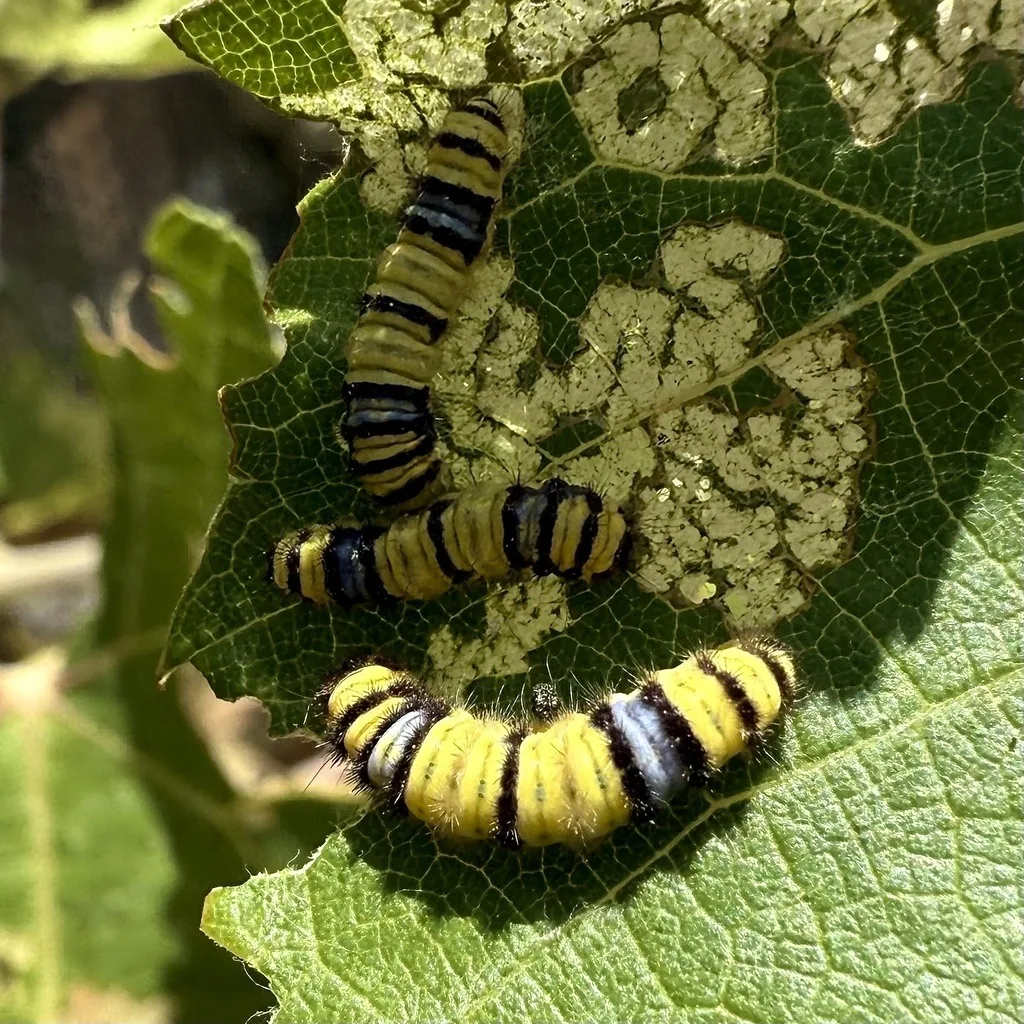
Western grapeleaf skeletonizer caterpillars line up side by side under grape leaves and can defoliate vines, and their stinging hairs irritate skin.[1]

Row of western grapeleaf skeletonizer caterpillars, yellow with purple and black bands, feeding side by side on a leaf
Row of western grapeleaf skeletonizer caterpillars, yellow with purple and black bands, feeding side by side on a leaf. Photo: sealgyu, public domain (CC0), via iNaturalist

How to identify it

  • Older larvae are yellow with two wide purple bands and several narrow black bands, reaching about 2/3 inch.[1]
  • Young larvae feed in a tight side-by-side row on the leaf underside.[1]
  • Adults are metallic bluish or greenish black moths with a wingspan of 1 to 1-1/3 inches, active day and night.[1]

Where it lives

An introduced moth, it feeds on grapevines, Boston ivy and Virginia creeper, and occasionally almond, apricot, cherry and rose.[1]

US map: public records from 9 states since 1990 (GBIF).

Biology and life cycle

In California's Central Valley, moths emerge in April and May; there are three generations there and two on the cooler coast.[1]

Females lay groups of several dozen eggs under grape leaves, and egg to adult takes about two months.[1]

Pupae form in grayish cocoons in bark crevices and ground litter.[1]

Damage and signs

  • Young larvae leave a papery, skeletonized leaf; older ones chew through all but the large veins and can defoliate vines by July.[1]
  • On stripped vines they feed on clusters, leading to bunch rot and sunburned fruit.[1]

Health risk

The caterpillars' hairs exude a stinging chemical that irritates skin, so handle infested vines with care.[1]

Control

Biological control

A granulosis virus commonly keeps populations low; infected larvae turn sluggish, darken and leave black liquid trails.[1]

The wasp Apanteles harrisinae and the tachinid fly Ametadoria misella are important parasites.[1]

Pesticides

If larvae are abundant and parasitism and virus are scarce, spray Bt or spinosad under the leaves while larvae are young.[1]

Common questions

Do grapeleaf skeletonizer caterpillars sting?
Yes. Their hairs exude a chemical that irritates the skin on contact.[1]
Why are my grape leaves papery and brown?
Young skeletonizer larvae scrape the undersides, leaving only veins and the upper cuticle.[1]

Sources

  1. University of California Statewide IPM Program, “Western Grapeleaf Skeletonizer (Pests in Gardens and Landscapes).” ipm.ucanr.edu/PMG/GARDEN/FRUIT/PESTS/wesgrskeleton.html (accessed 2026-10-06)
  2. iNaturalist, “Harrisina metallica taxon page (order and family).” www.inaturalist.org/taxa/209426 (accessed 2026-10-06)

Updated 2026-10-14. Built from sourced records. Spot an error? Tell us.