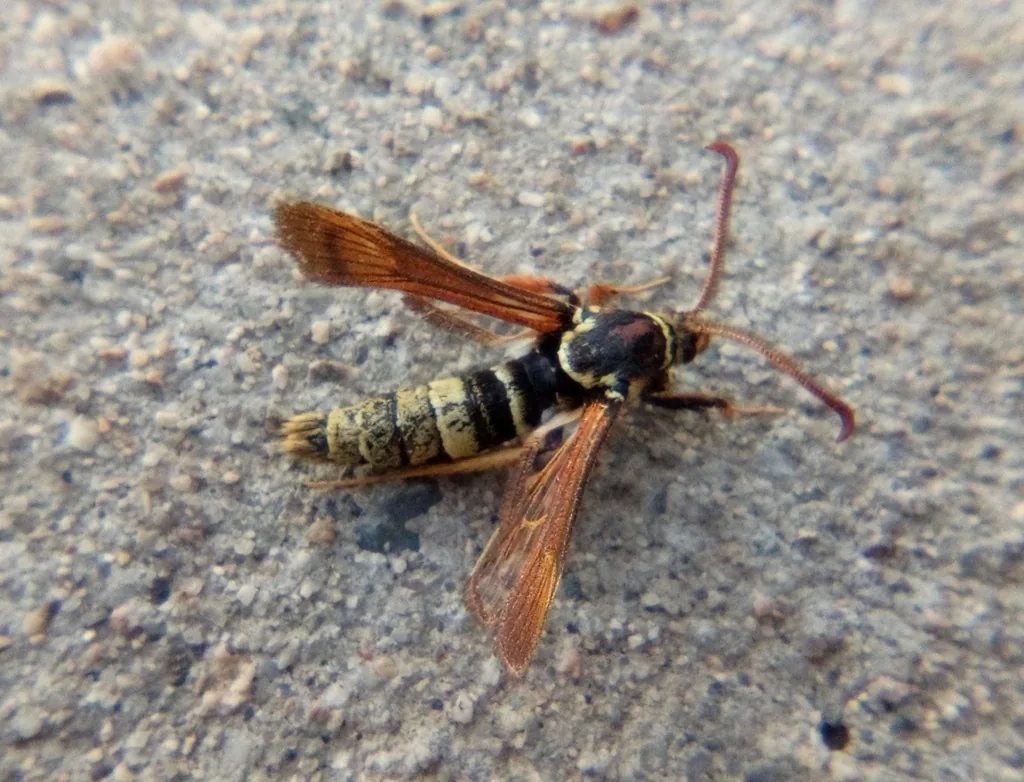
How to identify it
Look-alikes
| Look-alike | How to tell them apart |
|---|---|
| Yellowjackets | Yellowjackets have a narrow waist and threadlike antennae; the moth has a thick waist and feathery antennae.[1] |
| Sycamore borer | A related clearwing found mainly in sycamore.[1] |
Where it lives
It's found throughout warm, low-elevation areas of the West, and is a pest in Southern California and the Central Valley.[1]
Biology and life cycle
Adults are active mainly May through July, and in Southern California also in November and February through May.[1]
Females lay eggs in bark cracks and wounds; larvae bore into bark, cambium or heartwood.[1]
Damage and signs
- Poplar varieties vary widely in susceptibility, and willows tolerate infestation without apparent serious harm.[1]
Health risk
It feeds on trees; UC IPM mentions no risk to people.[1]
Control
Prevention
Check bark weekly for fresh pupal cases and use pheromone traps to time any action.[1]
Biological control
Commercial insect-killing nematodes injected into tunnels work against its larvae, and Apanteles wasps parasitize it.[1]
Pesticides
On high-value trees, bark sprays timed 10 to 14 days after first moth catch can reduce future infestations.[1]
Common questions
Sources
- University of California Statewide IPM Program, “Clearwing Moths (Pest Notes).” ipm.ucanr.edu/home-and-landscape/clearwing-moths/ (accessed 2026-10-06)
- iNaturalist, “Paranthrene robiniae taxon page (order and family).” www.inaturalist.org/taxa/354116 (accessed 2026-10-06)