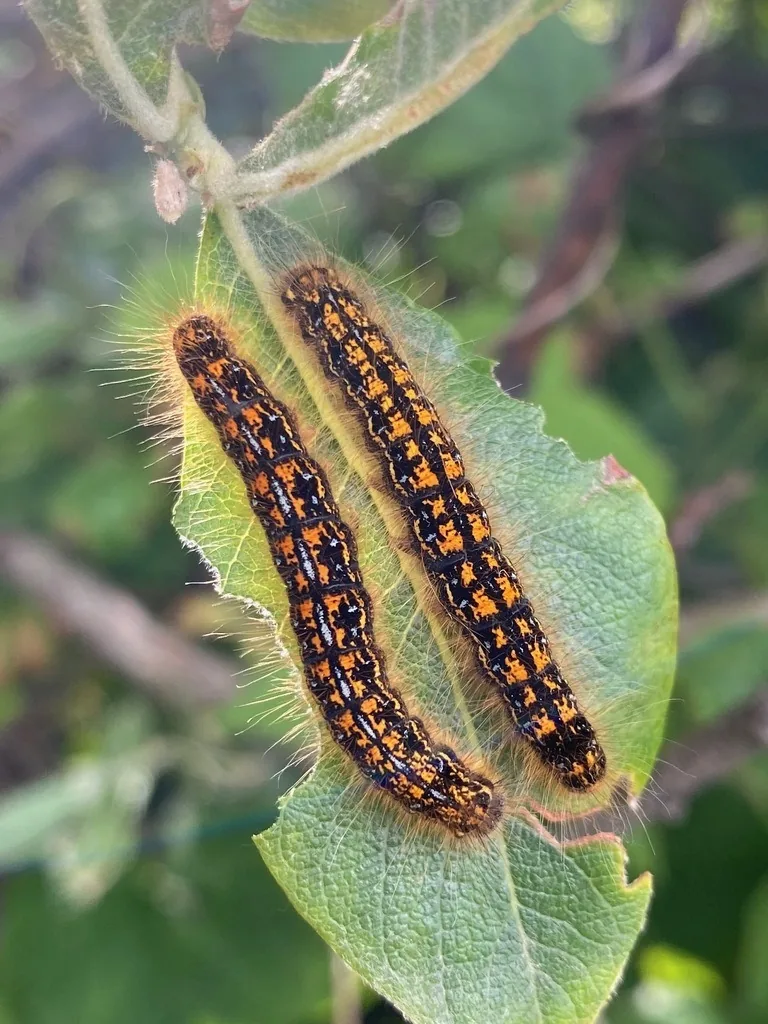
How to identify it
- Larvae are reddish brown with some blue spots and covered with tufts of orange to white hairs, growing to about 2 inches; coloring can vary a lot.[1][2]
- Caterpillars spin large silk tents on leaves and twigs and feed on foliage mostly within the tents.[1]
- Egg masses are shiny brown to gray and covered with a frothy coating that hardens, protecting the eggs over winter.[2][3]
- Adults are heavy-bodied, hairy moths in dull reddish brown, yellow, tan or gray, with a wingspan of about 1 to 2 inches.[2][1]
Look-alikes
| Look-alike | How to tell them apart |
|---|---|
| Eastern tent caterpillar | The eastern species is black with a white stripe down the back and blue spots on the sides, and builds its tents in branch crotches of wild cherry and apple.[4] |
| Fall webworm | Fall webworms appear in late summer and early fall and build their webs over branch ends, while tent caterpillars are spring feeders.[5][1] |
| Forest tent caterpillar | Mostly dark blue with wavy reddish-brown lines and white keyhole-shaped marks on the back; it feeds in groups on foliage without building a tent.[1] |
Where it lives
A western species: it is a landscape pest in California, Oregon and Utah, and a subspecies occurs in the Pacific Northwest.[1][2][3]
Biology and life cycle
It overwinters as unhatched larvae inside egg masses on host twigs; each female lays a single mass, often on the sunny side of the tree.[2][3]
Larvae hatch around budbreak, feed in tents, and may become solitary in later stages; they pupate about 1 to 1-1/2 months after hatching.[2]
Cocoons are made of white silk dusted white to yellow, attached to trees or tucked in leaf litter; moths fly from late July through August.[2]
There is one generation a year, and outbreaks tend to be cyclic, rising and falling over roughly 6 to 11 years in British Columbia.[3][1]
Damage and signs
- Larvae chew leaves, leaving ragged foliage and obvious silk webbing on infested branches.[1]
- Hosts include aspen, alder, chokecherry, cottonwood, crabapple and other fruit trees, oak, poplar, serviceberry, willow and wild rose.[2][1]
- Damage is usually aesthetic, but defoliation year after year can reduce growth or kill trees.[3][2]
Health risk
It's a pest of trees and shrubs; the harm is chewed leaves and unsightly tents, which are mostly cosmetic.[1][3]
Control
Prevention
Keep trees healthy and tolerate light feeding; severe damage to ornamentals is uncommon and insecticides generally aren't warranted.[2][1]
Traps and physical control
Inspect plants in spring and, while larvae are young, prune out tents or clip infested branches if you can do it without cutting large limbs.[1][3]
Biological control
Natural enemies often control outbreaks: over 100 species of parasitic flies and wasps, predatory beetles, assassin bugs, birds and a caterpillar-specific virus.[1]
Pesticides
Bacillus thuringiensis (Bt) works on small larvae if the spray penetrates the webbing and covers nearby foliage; a second spray 7 to 10 days later is recommended.[1][2]
Spinosad is also effective but can harm bees and some natural enemies, so don't spray it on flowering plants.[1]
Common questions
- Will western tent caterpillars kill my tree?
- Usually not. Healthy plants tolerate some leaf loss; only repeated yearly defoliation can reduce growth or kill trees.[1][2]
- Should I burn out a tent caterpillar nest?
- No. Torching tents can easily damage the tree; pruning out young tents or clipping infested branches is the better approach.[4][1]
Sources
- University of California Statewide IPM Program, “Tent Caterpillars (Home and Landscape).” ipm.ucanr.edu/home-and-landscape/tent-caterpillars/ (accessed 2026-10-06)
- Utah State University Extension, Integrated Pest Management, “Western Tent Caterpillar (Ornamental Pest Guide).” extension.usu.edu/planthealth/ipm/ornamental-pest-guide/arthopods/moths/western-tent-caterpillar (accessed 2026-10-06)
- Oregon State University, Department of Horticulture, “Western Tent Caterpillar (Nursery Pest Management).” agsci.oregonstate.edu/nurspest/insects/western-tent-caterpillar (accessed 2026-10-06)
- University of Kentucky Entomology, “ENTFACT-423: Eastern Tent Caterpillar (revised January 2026).” entomology.mgcafe.uky.edu/ef423 (accessed 2026-10-06)
- Penn State Extension, “Fall Webworm (updated June 24, 2026).” extension.psu.edu/fall-webworm (accessed 2026-10-06)
- iNaturalist, “Malacosoma californica taxon page (order and family).” www.inaturalist.org/taxa/359294 (accessed 2026-10-06)