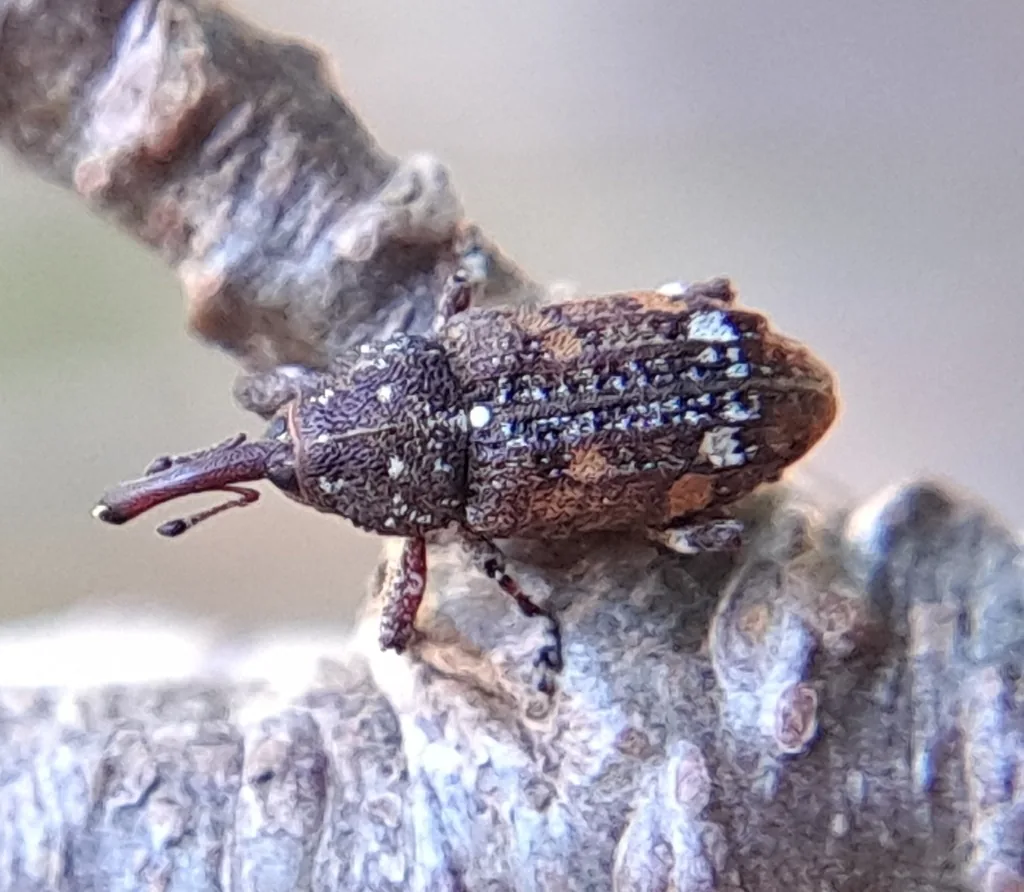
How to identify it
Look-alikes
| Look-alike | How to tell them apart |
|---|---|
| Lodgepole pine terminal weevil | A close relative, Pissodes terminalis, causes similar damage on lodgepole pine.[1] |
Where it lives
In Colorado injury is almost entirely in higher-elevation areas and foothills, though it reaches Colorado Springs.[1]
Biology and life cycle
Adults overwinter in litter near infested trees, then lay eggs in pits just below the new terminal bud in spring.[1]
Legless grubs feed under the bark and tunnel downward, girdling the leader; one generation a year.[1]
Damage and signs
- Trees end up stunted and bushy, with several competing leaders.[1]
Health risk
It feeds on plants; CSU Extension mentions no risk to people.[1]
Control
Sanitation
Prune out wilting terminals before adults emerge, cutting only the infested part, and remove the prunings from the site.[1]
Traps and physical control
Train a single new leader and pinch competing side shoots to restore the tree's form.[1]
Pesticides
Spring sprays on the terminal target adults before egg laying; fall soil applications of imidacloprid can also prevent injury.[1]
Common questions
Sources
- Colorado State University Extension, “White Pine Weevil.” extension.colostate.edu/resource/white-pine-weevil/ (accessed 2026-10-06)
- iNaturalist, “Pissodes strobi taxon page (order and family).” www.inaturalist.org/taxa/208537 (accessed 2026-10-06)