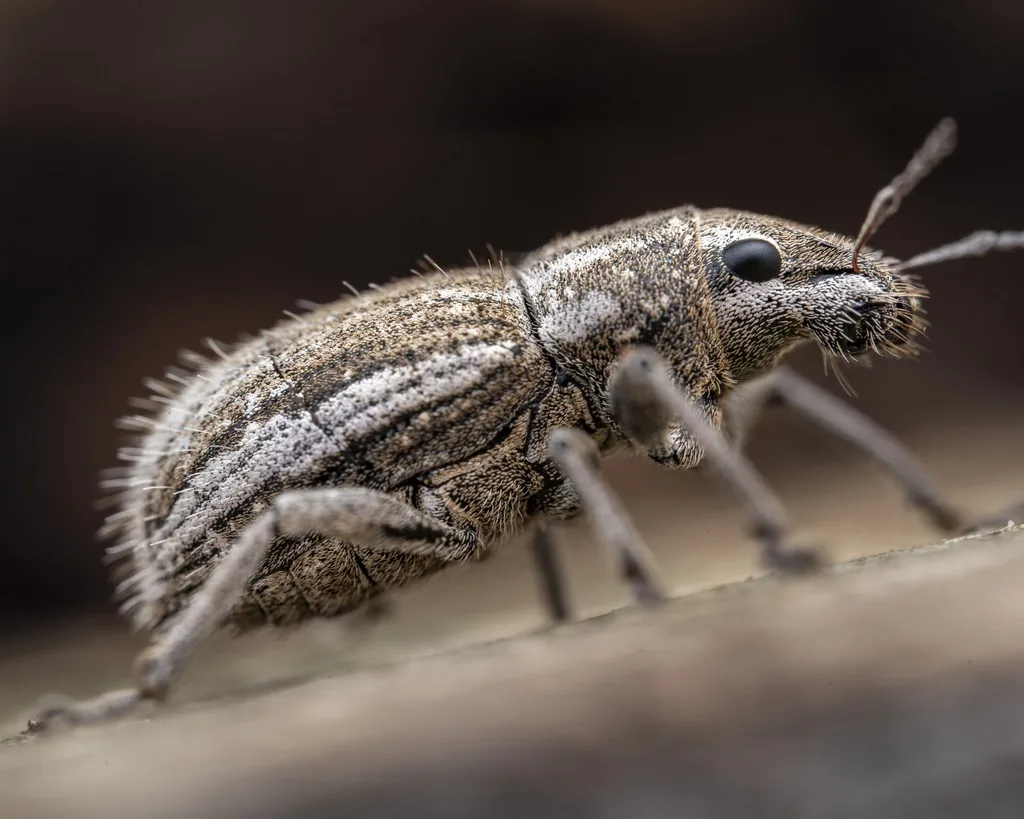
How to identify it
- Adults are about 1/2 inch long, light to dark gray or brown, with a pale band along the outer edges of the wing covers (the white fringe) and two pale lines along each side of the head and thorax.[1][2]
- Larvae are creamy yellowish-white, legless, C-shaped grubs about 1/2 inch long.[1][2]
- Adults feed on leaf edges, often in groups; as many as 200 to 300 may be found on one plant.[1]
Where it lives
First found near Svea, Florida, in 1936, they are now widely distributed in the southern United States.[2]
Biology and life cycle
There are no males in North America; females reproduce without mating.[1][2]
Adults emerge from May to October and lay egg masses of 11 to 14 on stems, roots and soil, and on hay, firewood, lumber and tools that touch the ground.[2]
They can't fly but may crawl up to 3/4 mile; there is usually one generation a year, though some grubs feed a second year before pupating 2 to 6 inches deep.[1][2]
Damage and signs
Health risk
Control
Prevention
Grubs are less damaging to grasses and small grains with fibrous roots; UF suggests rotating legumes on a three- to four-year cycle.[2]
Because eggs are laid on items that touch the soil, check hay, firewood, lumber and tools moved from infested sites.[2]
Pesticides
NC State says most insecticides labeled for landscape use should give adequate control of adults, and pyrethroids last longer.[1]
Common questions
- What are the gray beetles with a white edge chewing my plants?
- Likely whitefringed beetles, flightless weevils with a pale band along the wing covers.[1][2]
- Can whitefringed beetles fly?
- No; they can only crawl, up to about 3/4 mile.[1][2]
- What damage do whitefringed beetles do?
- Their grubs feed on roots, which can kill plants.[1][2]
Sources
- NC State Extension, “Whitefringed Beetles.” content.ces.ncsu.edu/whitefringed-beetles (accessed 2026-10-15)
- University of Florida IFAS Extension (Featured Creatures), “Whitefringed Beetles, Naupactus spp. (EENY-294).” ask.ifas.ufl.edu/publication/IN572 (accessed 2026-10-15)
- iNaturalist, “Naupactus leucoloma taxon page (order and family).” www.inaturalist.org/taxa/333624 (accessed 2026-10-06)