How to identify it
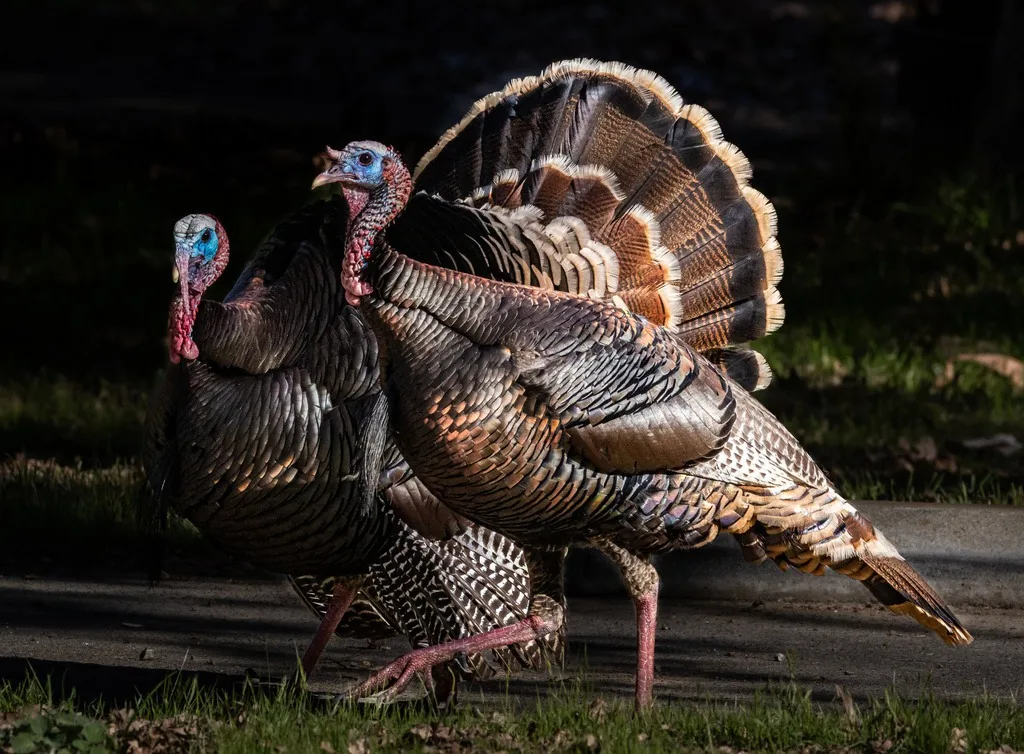
- A very large, heavy-bodied bird about 36 to 48 inches long, with short rounded wings, a short thick bill and strong legs.[1]
- Males, called toms, weigh about 17 to 21 pounds and females about 8 to 11 pounds.[1]
- Heads have few feathers, and males have the barest heads; males are more brightly colored, while females are browner and tan.[1]
- Toms have black-and-white barred flight feathers and spurs on their legs, and they gobble, strut and fan their feathers to attract mates.[1][2]
- Tracks show three toes pointing forward and one back, like many walking birds; their large size marks them as turkey tracks.[1]
Where it lives
Wild turkeys live throughout most of the United States, except for desert Southwest and tundra areas.[1]
Biology and life cycle
Turkeys are very social and often travel in flocks of 10 or more; each flock is organized by a pecking order in which birds dominate those of lower status.[2][6]
They are active by day; they see very well but have poor night vision.[2]
They can run up to about 12 miles per hour and fly mainly to escape danger or move to new areas.[2]
Hens nest on the ground from April to May, laying about 4 to 17 eggs in a shallow scrape, and may renest if a clutch or brood is lost.[2]
March through May is breeding season, when turkey activity increases.[6]
They eat a wide range of plant and animal foods, including acorns, seeds, grain, fruit and insects.[2]
Damage and signs
- Turkeys aren't known to damage structures, but roofs, decks and trees used as roosts get fouled with droppings.[3]
- They may peck shiny objects such as windows and vehicles, treating their reflection as a rival turkey; pecking has damaged car paint and even broken side mirrors.[6][3]
- Scratching and foraging can cause minor damage to gardens, and turkeys hunting grubs may dig up lawns.[3][5]
- In winter they can empty bird feeders quickly, and their calls can bother nearby residents.[3]
Health risk
Wild turkeys are not considered a health threat, but they can be aggressive at times, such as during breeding season, and hens protect their young. They may attack people, pets and other large birds that come too close, and turkeys near roads and airports pose a collision risk.[3]
Control
Prevention
Never feed turkeys, and take down bird feeders; food, given on purpose or not, makes turkeys act tame and can lead to bold or aggressive behavior.[5][6]
Keep them out
Cover or block shiny surfaces such as windows or vehicles where turkeys see their reflection.[5][6]
Use fencing or netting to protect gardens and lawns, and bird spikes or other ledge products to keep turkeys off roosting spots.[5][4]
Traps and physical control
Haze bold turkeys: stand your ground or move toward them, look bigger with raised arms or an open umbrella, make loud noises, or spray them with a hose. Don't run away.[5][6]
A leashed dog can also be an effective deterrent for bold turkeys.[6]
Mylar tape, motion-activated sprinklers and similar scare devices give short-term results; move them every few days so turkeys don't get used to them, and check local noise rules first.[4]
When to call a professional
Turkeys are protected game birds; check with your state wildlife agency before any lethal control or trapping.[1][4]
Why some turkeys turn aggressive
Turkeys that have been fed over months or years become overly comfortable around people, which is when aggressive behavior shows up.[6]
Flocks are organized by pecking order, and some turkeys act aggressively toward people by pecking, following or otherwise intimidating them.[6]
Aggression peaks in the spring breeding season, roughly March through May, and hens defend their broods.[6][3]
Don't run from a bold turkey; MassWildlife advises standing your ground and hazing it instead.[5]
Legal status
Wild turkeys are protected game birds throughout the United States, with set hunting seasons.[1]
Some states let landowners control turkeys damaging their property at any time of year, so check with your state wildlife agency first.[1]
In Massachusetts, turkey nests and eggs are protected by state law, though hazing a nesting hen to move her along is allowed.[5]
No toxicants are available for turkeys.[4]
Common questions
- Why is a turkey pecking my car?
- It is most likely reacting to its reflection, which it treats as an intruding turkey. Cover mirrors and shiny surfaces until the bird loses interest.[6][5]
- What should I do if a turkey chases me?
- Don't run. Face it, make yourself look bigger, make noise or spray it with water, and keep it up until the bird backs off.[5][6]
- Will taking down my bird feeder help?
- Yes. MassWildlife advises removing bird feeders, because they draw turkeys and other wildlife to your yard and help teach turkeys to linger near people.[5]
Sources
- Internet Center for Wildlife Damage Management, “Turkeys: Identification and Legal Status.” icwdm.org/species/birds/turkeys/ (accessed 2026-10-06). Run by university wildlife damage specialists (maintained at the University of Wisconsin-Stevens Point); species modules are based on Prevention and Control of Wildlife Damage (University of Nebraska Cooperative Extension, 1994).
- Internet Center for Wildlife Damage Management, “Turkey Biology.” icwdm.org/species/birds/turkeys/turkey-biology/ (accessed 2026-10-06). Run by university wildlife damage specialists (maintained at the University of Wisconsin-Stevens Point); species modules are based on Prevention and Control of Wildlife Damage (University of Nebraska Cooperative Extension, 1994).
- Internet Center for Wildlife Damage Management, “Turkey Damage Identification.” icwdm.org/species/birds/turkeys/turkey-damage-identification/ (accessed 2026-10-06). Run by university wildlife damage specialists (maintained at the University of Wisconsin-Stevens Point); species modules are based on Prevention and Control of Wildlife Damage (University of Nebraska Cooperative Extension, 1994).
- Internet Center for Wildlife Damage Management, “Turkey Damage Prevention and Control Methods.” icwdm.org/species/birds/turkeys/turkey-damage-prevention-and-control-methods/ (accessed 2026-10-06). Run by university wildlife damage specialists (maintained at the University of Wisconsin-Stevens Point); species modules are based on Prevention and Control of Wildlife Damage (University of Nebraska Cooperative Extension, 1994).
- Massachusetts Division of Fisheries and Wildlife (MassWildlife), “Prevent Conflicts with Turkeys.” www.mass.gov/info-details/prevent-conflicts-with-turkeys (accessed 2026-10-06)
- Massachusetts Division of Fisheries and Wildlife (MassWildlife), “Turkey Troubles: How to Minimize Aggressive Turkey Encounters This Spring (April 3, 2026).” mass.gov/news/turkey-troubles-how-to-minimize-aggressive-turkey-encounters-this-spring (accessed 2026-10-06)
- iNaturalist, “Meleagris gallopavo taxon page (order and family).” www.inaturalist.org/taxa/906 (accessed 2026-10-06)