How to identify it
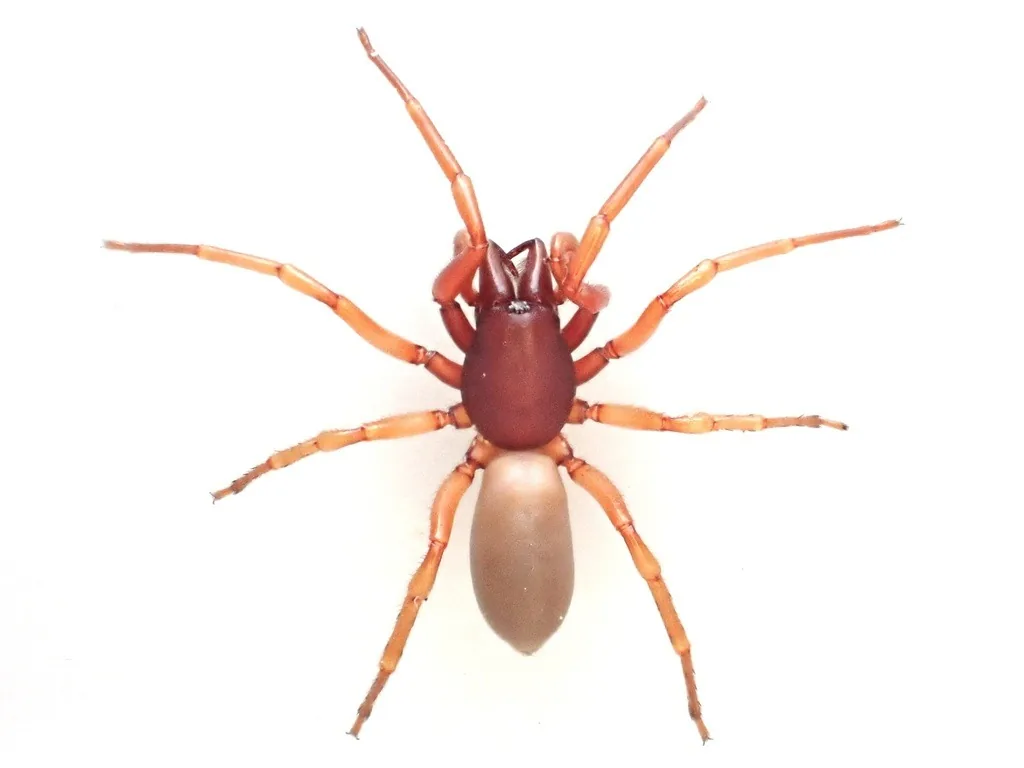
- The front body section and legs are reddish orange to reddish brown, and the abdomen is dirty white, cream, gray or tan.[1][2][3]
- Large, thick jaws and fangs point straight forward from the head, giving it a menacing look.[1][2]
- It has six eyes, arranged in an oval.[1][2]
- Females are about 11 to 15 mm long and males 9 to 10 mm, about 1/2 inch not counting legs.[1][3]
Where it lives
Native to the Mediterranean; in North America it is found from New England to Georgia and west to California.[1]
Biology and life cycle
It feeds mainly on sowbugs and pill bugs, which the British call woodlice, and also takes other arthropods.[1][2]
It lives under rocks, bark, mulch, plants, woodpiles and trash cans, in moist spots where isopods are plentiful.[2]
Adults probably overwinter; mating is reported in April, and females hang up to 70 eggs in a silken retreat, where spiderlings stay for a while.[1]
It turns up in and around homes mostly in spring and summer.[3]
Damage and signs
Health risk
It isn't known to be a health hazard. Bites have been linked to a small, intensely itchy red spot a few millimeters across, with no body-wide symptoms.[1][2]
Control
Prevention
Utah State University Extension also recommends changing exterior lighting to sodium vapor bulbs.[2]
Keep them out
Seal exterior cracks and crevices and install tight-fitting door sweeps on exterior doors.[2]
Sanitation
Reduce hiding places and moisture near the foundation, such as mulch, debris and woodpiles, and control sowbugs and pill bugs to remove its food.[2]
Traps and physical control
Vacuum spiders that get indoors, or catch them under a glass jar and release them outside.[2]
Pest monitors can capture spiders wandering in, especially from August to October.[2]
Common questions
- Is the woodlouse spider dangerous?
- No. Despite its big fangs it isn't considered a health hazard; a bite may cause a small, itchy red spot.[2][1]
- Why do I find woodlouse spiders in my basement?
- They follow their prey, sowbugs and pill bugs, which live in damp areas; cutting moisture and isopods near the house reduces them.[2][1]
Sources
- Penn State Extension, “Woodlouse Hunter Spider (updated September 8, 2025).” extension.psu.edu/woodlouse-hunter-spider (accessed 2026-10-06)
- Utah State University Extension, “Woodlouse Spider (IPM nuisance pest notes).” extension.usu.edu/planthealth/ipm/notes_nuisance/woodlouse-spider (accessed 2026-10-06)
- University of Minnesota Extension, “Woodlouse spider (What insect is this? Insects found indoors).” apps.extension.umn.edu/garden/diagnose/insect/indoor/relatives/medium/woodlouse-spider.html (accessed 2026-10-06)
- iNaturalist, “Dysdera crocata taxon page (order and family).” www.inaturalist.org/taxa/1454862 (accessed 2026-10-06)