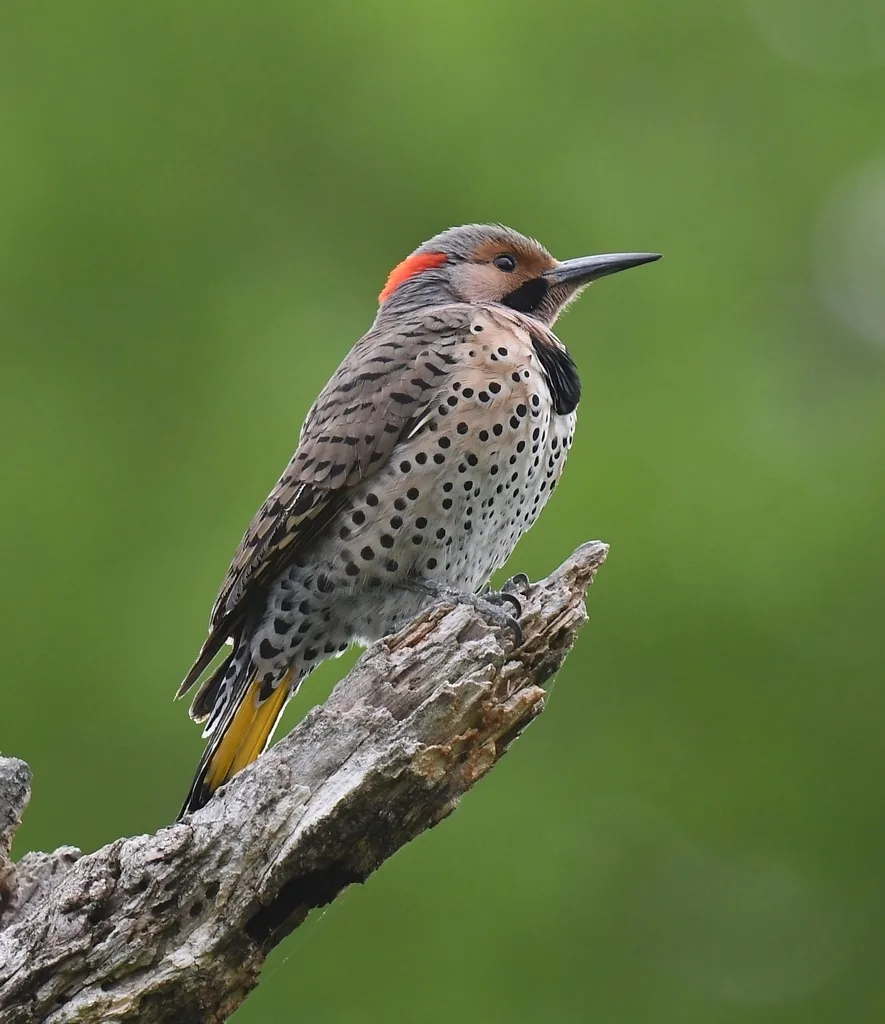
How to identify it
- Usually 7 to 15 inches long, with a stout, sharply pointed bill and stiff tail feathers used as a prop on tree trunks and walls.[2][1]
- Two toes point forward and two backward on each foot, letting the bird cling to vertical wood.[2][1]
- Most males show a pattern of black, white and red; females look similar but usually lack the red.[2][1]
- Rhythmic drumming on hollow branches, gutters, chimney caps or vents is often heard before the bird is seen.[2][1]
Look-alikes
Where it lives
Woodpeckers live throughout the United States; different species cause damage in different regions, and downy woodpeckers and northern flickers are common in suburbs and city parks.[2][3]
Biology and life cycle
Species most often involved with damage to homes include the downy, hairy, red-bellied, red-headed, acorn and pileated woodpeckers and the northern flicker.[2]
They breed in spring, laying 2 to 6 eggs in a cavity in a tree or structure, and both parents feed the young.[3]
Downy and hairy woodpeckers dig new cavities each year, while northern flickers often return to the same one.[3]
Most species feed on wood-boring insects, ants, berries, fruit and nuts; flickers often pick ants off the ground.[3]
Drumming advertises territory and attracts mates, and both males and females do it.[2][1]
Damage and signs
- Damage to buildings peaks from February through June during breeding season, with another round in fall.[4]
- A line of small holes in a row usually means a woodpecker was hunting insects; larger holes may be a nest cavity in the wall.[1]
- Cedar and redwood siding are favorites, especially channeled plywood with gaps where insects hide.[1][4]
- Houses stained in earth tones are more likely to be pecked than painted ones.[1][5]
- Acorn woodpeckers in the West drill rows of holes to store acorns and wedge them under roof shakes.[1][4]
- Vacation homes and barns can be badly damaged because pecking goes unnoticed for long periods.[4]
Health risk
Woodpeckers are not known to be a significant source of disease for people or pets; the problem is property damage and noise.[4]
Control
Prevention
Keep siding, trim and decking in good repair, and check cedar or log homes for insect infestation.[1]
When residing near woods, choose clapboard or synthetic siding over grooved plywood or board-and-batten, and paint rather than stain.[5]
Keep them out
Hang lightweight 3/4-inch bird netting from the eaves down the siding, kept at least 3 inches from the wall and pulled taut so birds can't get behind or tangled.[1][5]
Cover pecked spots with sheet metal or 1/4-inch hardware cloth, painted to match, as soon as damage starts.[1][5]
If a woodpecker is drumming on a chimney or metal vent, wrapping it with hardware cloth may help.[1]
Traps and physical control
Fill holes with wood plugs or putty quickly, since existing holes can encourage more pecking.[1][5]
Moving, reflective deterrents such as Mylar tape strips, pie pans and pinwheels hung near damage have had some success when used early.[1][5]
When to call a professional
For large or two-story netting jobs, a bird control or pest control professional can help with installation.[1]
What usually doesn't work
Plastic hawks, owls, snakes and cat silhouettes are generally ineffective.[1][5]
Ultrasonic devices are rarely effective as advertised, and many taste or odor repellents have shown little or no success.[5][1]
Suet feeders and nest boxes don't consistently reduce damage and may draw more woodpeckers.[1]
Sticky gels may help but can stain surfaces and trap or harm small birds.[1][5]
Legal status
All woodpeckers are protected under the federal Migratory Bird Treaty Act, and some species are endangered.[1][2]
Methods that don't harm the bird or its active nest, such as netting and scare devices, are allowed for non-endangered species.[1][2]
Lethal control is legal only under a federal permit from the U.S. Fish and Wildlife Service, and permits require strong justification.[1][2]
Common questions
- Why is a woodpecker drumming on my metal gutter?
- It's claiming territory or signaling a mate. Woodpeckers pick surfaces that resonate loudly, such as gutters, downspouts, chimney caps and vents.[1][2]
- Does woodpecker damage mean I have bugs in my siding?
- Sometimes. Rows of small holes suggest the bird is after insects, but woodpeckers also peck sound wood, so inspect before treating.[1][5]
- Can I get rid of a woodpecker myself?
- You can block and scare it. Netting is the most effective option, but killing or harming woodpeckers requires a federal permit.[1][2]
Sources
- University of California Statewide IPM Program, “Woodpeckers (Pest Notes, Home and Landscape).” ipm.ucanr.edu/home-and-landscape/woodpeckers/ (accessed 2026-10-06)
- Internet Center for Wildlife Damage Management, “Woodpeckers: Identification.” icwdm.org/species/birds/woodpeckers/ (accessed 2026-10-06). Run by university wildlife damage specialists (maintained at the University of Wisconsin-Stevens Point); species modules are based on Prevention and Control of Wildlife Damage (University of Nebraska Cooperative Extension, 1994).
- Internet Center for Wildlife Damage Management, “Woodpecker Biology.” icwdm.org/species/birds/woodpeckers/woodpecker-biology/ (accessed 2026-10-06). Run by university wildlife damage specialists (maintained at the University of Wisconsin-Stevens Point); species modules are based on Prevention and Control of Wildlife Damage (University of Nebraska Cooperative Extension, 1994).
- Internet Center for Wildlife Damage Management, “Woodpecker Damage Identification.” icwdm.org/species/birds/woodpeckers/woodpecker-damage-identification/ (accessed 2026-10-06). Run by university wildlife damage specialists (maintained at the University of Wisconsin-Stevens Point); species modules are based on Prevention and Control of Wildlife Damage (University of Nebraska Cooperative Extension, 1994).
- Internet Center for Wildlife Damage Management, “Woodpecker Damage Prevention and Control Methods.” icwdm.org/species/birds/woodpeckers/woodpecker-damage-prevention-and-control-methods/ (accessed 2026-10-06). Run by university wildlife damage specialists (maintained at the University of Wisconsin-Stevens Point); species modules are based on Prevention and Control of Wildlife Damage (University of Nebraska Cooperative Extension, 1994).
- iNaturalist, “Colaptes auratus taxon page (order and family).” www.inaturalist.org/taxa/18236 (accessed 2026-10-06)