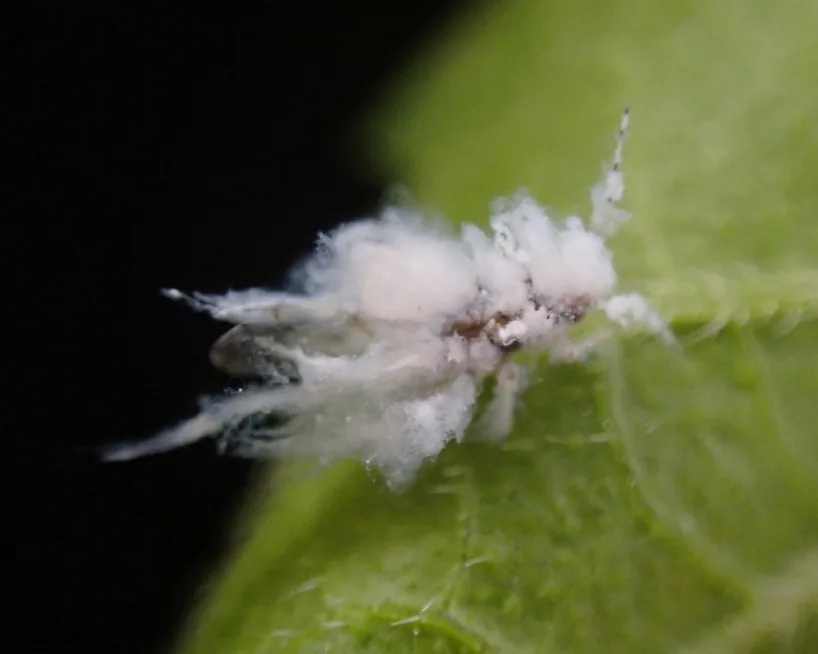
How to identify it
Look-alikes
| Look-alike | How to tell them apart |
|---|---|
| Citricola scale | The only other insect that makes annoying honeydew on hackberry in California; brown to gray oval scales on twigs.[1] |
Where it lives
Introduced from Asia, it infests Chinese hackberry and other Celtis, and occurs from Florida to Texas and north to at least Illinois.[1]
Biology and life cycle
Females give birth to live young through the season; eggs laid in fall overwinter on branch tips.[1]
In the San Joaquin Valley numbers peak in spring and fall, with many generations a year.[1]
Damage and signs
- Copious honeydew grows black sooty mold on leaves and surfaces below; no long-term harm to trees has been found.[1]
Health risk
It feeds on hackberry; UC IPM mentions no risk to people.[1]
Control
Prevention
Treat only when honeydew becomes intolerable, since tree health isn't threatened.[1]
Biological control
Lady beetles, syrphid flies and lacewing larvae eat it, though often not enough; avoid broad sprays that disrupt citricola scale parasites.[1]
Common questions
Sources
- University of California Statewide IPM Program, “Pest Notes: Woolly Hackberry Aphid (Publication 74111).” ipm.ucanr.edu/PMG/PESTNOTES/pn74111.html (accessed 2026-10-06)
- iNaturalist, “Shivaphis celti taxon page (order and family).” www.inaturalist.org/taxa/335282 (accessed 2026-10-06)